
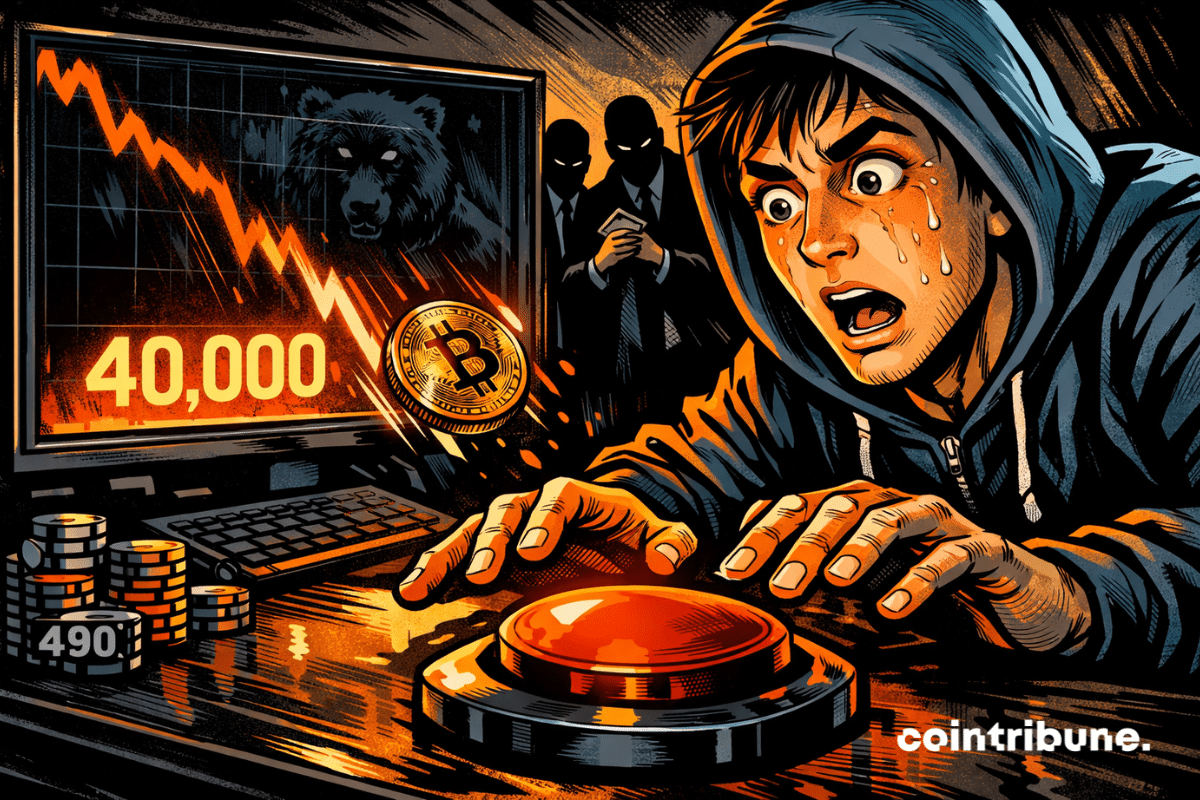
The Bitcoin options market is showing a clear signal: The $40,000 put has become the second-largest bet ahead of the February 27 deadline, with around $490 million in notional. In other words, some traders pay a lot for “catastrophe” insurance. Is this a prophecy? Not necessarily. It's often a hedging reflex when the market has just been shaken. Bitcoin is hanging around $66,000–68,000 today, after a sharp decline from October highs. In this setting, the options look less like a vote on the future and more like a seat belt fastened at the last moment.
In brief
- A Bitcoin put at $40,000 grows to $490M: the market buys protection before February 27.
- Calls remain dominant, a sign that many maintain a rebound bias despite nervousness.
- It's not a prediction, it's a stress thermometer.
A giant put on bitcoin is not a prediction, it's insurance
When a put option grows this much, you first have to look Who cowardice. Funds can cover a spot wallet, miners can secure their cash, and desks can structure more complex strategies. The figure of 490 million is impressive, but it speaks above all of a request for protection, not of a certainty that bitcoin will go to $40,000.
The other point that is often misleading is the confusion between “notional” and “real risk”. Notional is a way of measuring the size of a strike, not the maximum loss. An option can be purchased to protect against an extreme scenario… which never happens. And that’s precisely the point of insurance: to be happy to have it, and even happier not to use it.
Finally, $40,000 for bitcoin is a psychological level. It tells of a fear that is simple to understand and therefore easy to trade. In downturns, markets like round numbers. They serve as landmarks, sometimes traps, often as titles.
The “max pain” and the deadline: the mechanism that creates noise
We are also talking about another magnet: around $75,000, there would be around $566 million positioned, a level often described as the “max bread”. This idea is intuitive: this is the zone where a maximum of options would expire worthless, which “hurts” the option buyers, and rather suits the sellers.
We must be careful with this notion. “Max pain” is not a law of physics. This is a reading of open interest, useful for understanding where interests are concentrated, but insufficient to explain a price movement on its own. The spot can ignore it completely if a news story, macro feed, or leverage liquidation comes at the wrong time.
What matters most is the approach of the deadline. The closer you get, the more coverage adjustments can speed up movement, sometimes in a counterintuitive way. A falling bitcoin can cause hedges which accentuate the decline. A rebounding market can force rapid buybacks. On screen, it looks like an “emotional” decision. Behind the scenes, it's often plumbing.
The put/call ratio says: “we protect ourselves”, not “we capitulate”
Despite the $40,000 put on bitcoin, the entire options market remains predominantly call-oriented, with more purchase contracts than sales, and a put/call ratio around 0.72. This is the detail that many forget: traders do not only play the fall, they try to maintain exposure to the rebound while hedging.
This mix is logical after a big correction. On the one hand, you have investors who refuse to miss a turnaround. On the other hand, you have actors who have learned the hard way that bitcoin can slide further than expected. The two coexist in the options book, and it produces a risk map, not a single direction.
Should we be alarmed? Rather monitor. A big put shows that the market is pricing the extreme scenario more than before, especially in a context where some analysts are putting back on the table the idea of a “crypto winter” and much lower levels. But alarm does not mean panic. The correct reading is: fear becomes more expensive, so uncertainty has gone up a notch and sentiment has reached a critical level.
Maximize your Tremplin.io experience with our 'Read to Earn' program! For every article you read, earn points and access exclusive rewards. Sign up now and start earning benefits.


