
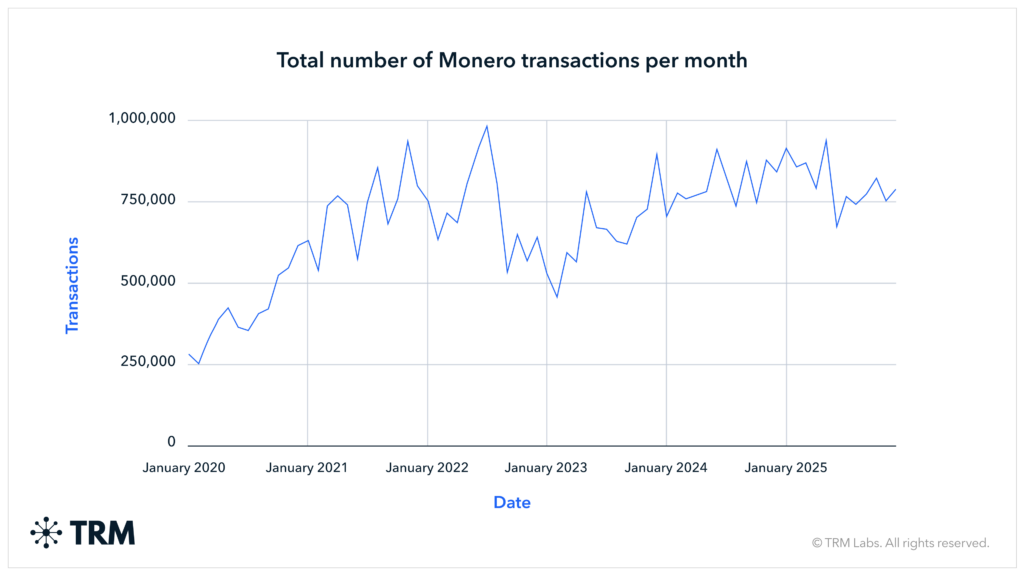
The cryptocurrency sector is constantly evolving under the influence of economic cycles and regulatory authorities. However, Monero (XMR) follows a unique trajectory. Recent data confirms a lasting trend: the use of this privacy-focused asset has been increasing since 2020 and continues to advance despite the usual market variations. This progression was maintained even after its withdrawal from several exchange platforms, with some darknet players turning more towards XMR.

In brief
- Monero transactional activity remains strong since 2020, with 2024–2025 volumes higher than previous years' levels.
- Despite its withdrawal from approximately 73 platforms in 2025, the use of XMR remains strong and is maintained outside of traditional exchanges.
- Monero adoption is growing in environments with increased regulatory pressure, where some darknet platforms are now choosing to operate solely in XMR.
- Approximately 14-15% of nodes exhibit atypical behavior, a risk that the “Fluorine Fermi” update seeks to mitigate by strengthening network security.
Stable and sustained transactional activity
According to an analysis by TRM Labs, the transaction volumes recorded in 2024 and 2025 surpass those at the start of the 2020-2022 period. This progression brilliantly illustrates the current and essential value of the network. Tools for monitoring transparent blockchains are improving. In response, interest in opaque alternatives is growing.
Activity on the Monero chain goes well beyond pure speculation. It stabilizes at a high level. Users perform regular operations. The network thus responds to a concrete utility need rather than episodic trading movements.
Resistance to withdrawals from exchanges
This persistence of use occurs in a complex context. Regulators perceive risks linked to anonymity. Analysis data indicate that many platforms therefore limit access to XMR. Giants like Binance, Coinbase or Kraken stopped supporting it, and around 73 exchanges would have removed Monero from their list in 2025.
Liquidity is leaving traditional infrastructures and is now concentrated on offshore or less regulated places, and access to the token is becoming more complex. However, usage on the channel is not weakening. Today's users are specifically looking for privacy. They accept friction to complete their transactions, according to TRM Labs.
Monero becomes the norm on the darknet
Adoption is also growing in darknet markets (DNM). A structural evolution favors platforms exclusively denominated in XMR. This change mainly affects areas under intense regulatory pressure.
By 2025, almost half of new darknet markets (48%) accepted Monero only, the analysis shows. This figure marks a notable increase. The actors in these networks are reacting to the effective tracing of bitcoin. They now favor assets offering better identity protection.
Challenges related to observing the network
If the fundamental cryptography of Monero remains inviolate, observation of the network reveals gray areas. About 14-15% of accessible nodes exhibit “non-standard” behavior. These anomalies do not systematically prove malicious intent and may result from simple technical irregularities.
However, the concentration of these nodes worries experts. It seems that certain operators control a significant part of the infrastructure, potentially to capture information. This situation does not alter the encryption of the data, but it theoretically weakens anonymity.
By analyzing the propagation of messages between these nodes, observers could ultimately deduce clues about user activity.
“Fluorine Fermi” update strengthens defense
Faced with this traffic analysis risk, Monero announced its new “Fluorine Fermi” update last October. This is a technical solution that introduces a more secure peer selection algorithm. The mechanism aims to block malicious or untrustworthy nodes.
The protocol thus strengthens its defense against “spy nodes”. These entities often attempt to link an IP address to a transaction. The developers describe this update as a critical barrier. It makes it possible to effectively combat attempts to monitor the blockchain.
Trend analysis paints a clear path for the future of privacy-focused cryptocurrency. The network will likely continue to deviate from traditional financial flows. Its use will focus on niches requiring strict confidentiality. Volume resilience, coupled with updates like Fluorine Fermi, suggests this asset will retain its unique role. Future success will depend on the code's ability to maintain opacity in the face of surveillance technologies.
Maximize your Tremplin.io experience with our 'Read to Earn' program! For every article you read, earn points and access exclusive rewards. Sign up now and start earning benefits.


