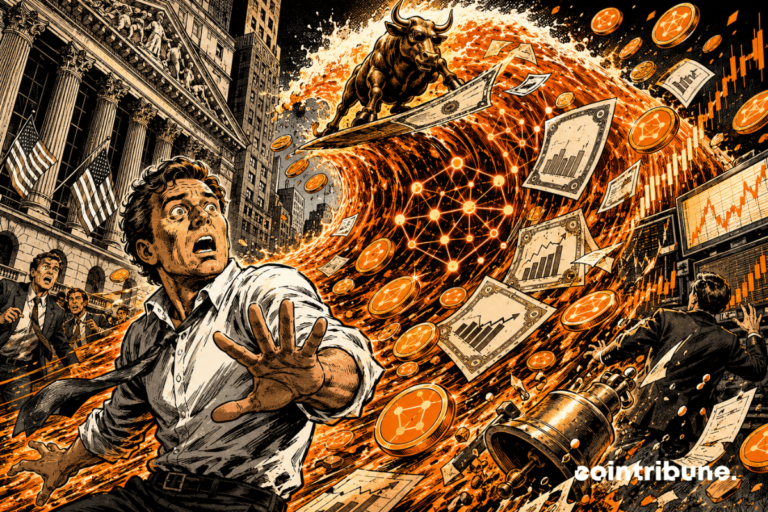
For years, bitcoin was sold as an escape route. A rare asset, outside central banks, supposed to shine when the rest trembles. Except that in 2026, the soundtrack changes: at the slightest shiver in tech, bitcoin coughs too. And that’s more than a market detail. It’s an identity crisis out in the open.

In brief
- Bitcoin is sliding from the “digital gold” narrative to a growth asset, increasingly tracking tech stocks.
- While ETH attracts aggressive treasury strategies, BlackRock is pushing tokenization into the heart of DeFi via Uniswap.
- At the same time, Polymarket is battling in court, a sign that crypto is becoming normalized… while hitting the regulatory wall.
When bitcoin sticks to stocks: “digital gold” put to the test
The most disturbing observation is not that BTC is falling. It is with whom it goes down. The short-term behavior resembles that of a growth stock more than that of a gold-style refuge.
Why now? Because institutionalization has changed the mechanics. ETFs, desks, “risk-on/risk-off” strategies have brought bitcoin into the same baskets as the rest. When managers reduce exposure to risky assets, bitcoin often ends up lumped in with tech stocks, even if its narrative says the opposite.
And the trigger for the moment is almost ironic: the uncertainties about the impact of AI in software. Software stocks are being shaken, bitcoin is following suit, as if it too wore a “growth” badge. In this setting, gold and silver can go in their own direction… while bitcoin remains stuck to the mental Nasdaq of investors.
Ether in cash mode: a bet that doesn't blink an eye.
This shift of storytelling does not only affect bitcoin. On Ethereum, another phenomenon is emerging: companies treat ETH as a strategic reserve, with a cash flow logic… and a tolerance for chaos.
BitMine Immersion Technologies is a brutal illustration of this. In the midst of a correction, the company added 40,613 ETH, bringing its holdings to approximately 4.326 million ETH. We are talking about a gigantic stock, showing massive latent losses at current prices. And, despite that, they double.
The implicit message is simple: “we don’t trade, we accumulate.” Tom Lee defends a long-term strategy, even if it means swallowing drawdowns that make the balance sheets bleed on paper. It's not romantic, it's accounting. And this is precisely what makes the movement credible in the eyes of certain investors.
But it also sends a signal to the market: if players accept latent losses of this size in order to “hold on”, then the debate is no longer just technological. It becomes financial, almost sociological: who has the stomach to survive volatility, and who only has a story without endurance?
BlackRock on Uniswap, Polymarket in court: crypto is normalizing… by fighting
This is where the story gets tasty: while bitcoin is behaving like a stock, Wall Street is starting to play directly into the DeFi scene. BlackRock has made its tokenized Treasury bond fund, BUIDL, exchangeable via UniswapX, with access reserved for “whitelisted” players via Securitize, in a very institutional framework.
The symbol counts as much as the plumbing: a behemoth of traditional markets pushes an “onchain” Trésor product, and in the same movement, also buys UNI (undisclosed amount). It's not just tokenization. It is an attempt to install institutional rails at the heart of a protocol born to circumvent the rails.
And while some are building bridges, others are preparing for regulatory shock. Polymarket took the state of Massachusetts to federal court, contesting the idea that a state can restrict its event contracts, and arguing that jurisdiction falls within the federal framework (CFTC) rather than a local mosaic.
Maximize your Tremplin.io experience with our 'Read to Earn' program! For every article you read, earn points and access exclusive rewards. Sign up now and start earning benefits.