
Digital asset manager CoinShares has put into perspective fears around quantum computers and their ability to compromise Bitcoin in the short term. According to the company, only a tiny fraction of the total supply is actually exposed to this type of threat. Although discussions around quantum have fueled concern in the markets for several months, CoinShares affirms that the current risks remain purely theoretical and still very far from a concrete threat.
In brief
- Only 10,230 BTC would have exposed public keys that could theoretically be targeted.
- The majority of these funds are concentrated in a few large portfolios, reducing systemic risk.
- Small wallets (less than 100 BTC) would take centuries to hack, even with optimistic assumptions.
- Experts remain divided between skepticism and calls for caution.
CoinShares: a threat to a marginal part of the network
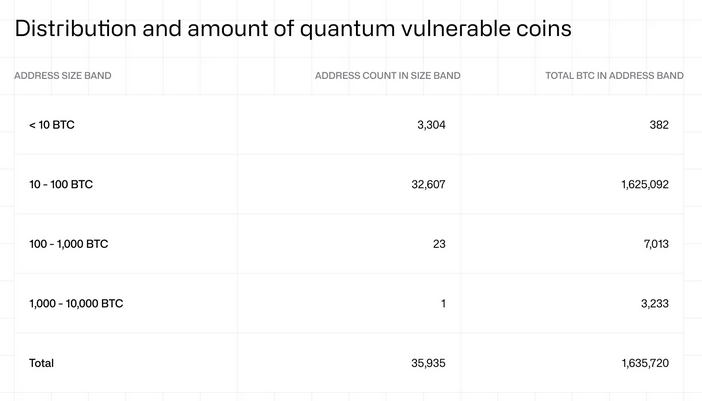
In an analysis published Friday, Christopher Bendiksen, head of Bitcoin research at CoinShares, estimates that only 10,230 BTC out of approximately 1.63 million currently exposed are held in addresses whose cryptographic keys are publicly visible, a necessary condition for a possible quantum attack. At their current value, this represents around $719 million, the equivalent of a large market transaction, according to Bendiksen, far from a systemic shock.
Most of these potentially exposed bitcoins are found in very large wallets. Around 7,000 BTC are held in addresses holding between 100 and 1,000 bitcoins, while around 3,230 BTC are held in wallets with balances ranging between 1,000 and 10,000 BTC. Bendiksen believes that even if compromised, the impact on the overall market would likely remain limited.
Conversely, approximately 1.62 million bitcoins are held in wallets containing less than 100 BTC. According to him, tackling these addresses would be unrealistic, even assuming spectacular quantum progress: it would take several centuries to break a single one.
Key points of CoinShares' evaluation include:
- Only a small portion of bitcoins are stored in wallets whose public keys are exposed.
- The majority of vulnerable coins are clustered in a limited number of large addresses.
- Small wallets would require unrealistic time and resources to compromise.
- The fundamental rules of the Bitcoin network are not affected by current quantum approaches.
Bendiksen explained that the risks of quantum computing lie in algorithms like Shor's, which could theoretically break Bitcoin's elliptic curve signatures, or Grover's, which could weaken the SHA-256 hashing algorithm. However, he clarified that none of these methods would make it possible to modify the fixed cap of 21 million bitcoins, nor to circumvent the proof of work mechanism, two foundations of the protocol.
Quantum Fears Spark Debate Over Bitcoin's Security Model
Concerns over quantum computing have become a recurring source of fear, uncertainty and doubt, with some warning that a cryptographic breach could compromise networks that secure an estimated $1.4 trillion in value. Bitcoins considered at risk are primarily unspent transaction outputs, or UTXOs, many of which date back to Bitcoin's early “Satoshi era,” a period marked by frequent address reuse.
Debate continues within the Bitcoin community regarding whether to implement a quantum-resistant update now, or to delay its introduction. Figures like Michael Saylor, executive chairman of Strategy, and Adam Back, CEO of Blockstream, believe these threats are exaggerated and still far in the future.
Bendiksen agrees, pointing out that truly threatening attacks would require millions of fault-tolerant qubits, well beyond the approximately 105 qubits achieved by Google's latest Willow system.
Taking a more cautious stance, Charles Edwards, founder of Capriole Investments, called quantum computing a potential existential risk. He calls for solutions to be put in place sooner rather than later, believing that anticipating this problem could even strengthen Bitcoin's valuation. Other researchers cite post-quantum signatures as a promising technological avenue to preserve protocol security.
Maximize your Tremplin.io experience with our 'Read to Earn' program! For every article you read, earn points and access exclusive rewards. Sign up now and start earning benefits.


