
A few months ago, bitcoin was trading comfortably above $100,000, supported by strong market confidence and high expectations of further upside. Optimism peaked with forecasts of a historically strong October and a potential record high above $126,000. This context has fueled ambitious projections and widespread bullish sentiment. However, the situation took a sharp turn on October 10, when a $19 billion selloff caused a sharp correction. Since this shock, the cryptocurrency has struggled to recover, posting losses for a fourth consecutive month.

In brief
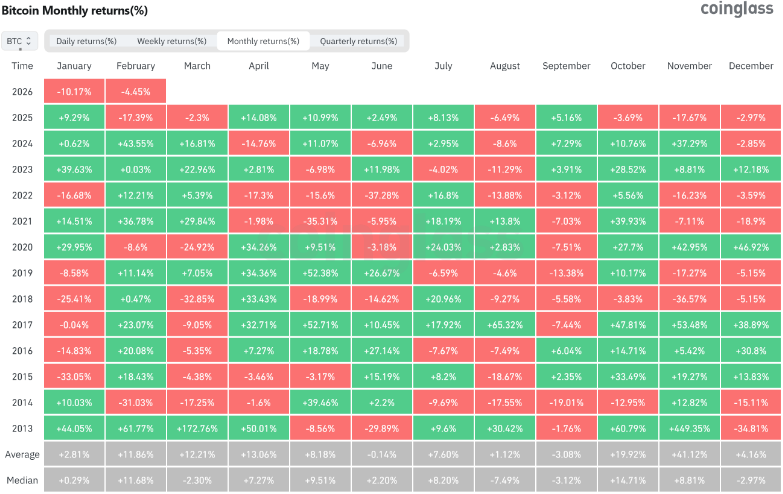
- Bitcoin suffered four consecutive months of losses with a decline of 10.17% in January, the second largest decline of this bearish phase.
- A massive $19 billion selloff in October triggered the initial crash, and new capital has remained scarce ever since, maintaining persistent selling pressure.
- Data from CoinGlass shows that November saw the largest four-month decline with a decline of 17.67%, while October and December saw more moderate declines of 3.69% and 2.97%.
- Historical trends indicate that after several months of losses, bitcoin often stabilizes, giving hope for a rebound in February.
Bitcoin falls for a fourth consecutive month
January ended as the fourth consecutive month of decline for bitcoin. The year began with some hope of recovery, but the initial momentum fizzled mid-month, with prices stagnating around $95,000 before reversing. Bitcoin first fell below $90,000, then continued its decline to around $81,000 last week. The situation deteriorated further on Saturday, when intensifying sales sent prices tumbling towards $75,000, their lowest level since April 2025. The moves triggered multibillion-dollar liquidations, further adding pressure to the market.
Data from CoinGlass indicates that bitcoin ended January with a loss of 10.17%making it the second largest monthly decline in this four-month downtrend. November recorded the sharpest correction at 17.67%, while October and December posted declines of 3.69% and 2.97%, respectively. These figures illustrate the continued weakness of the market in recent months.
Understanding Continuing Losses
Analysts cite persistent selling pressure and a lack of new capital as the main reasons for bitcoin's prolonged decline. Ki Young Ju, founder of CryptoQuant, highlighted that the realized capitalization of bitcoin remains largely unchangedwhich indicates the absence of significant capital inflows. In this context, a decline in market value does not reflect healthy or upward momentum.
Early holders are reaping big unrealized gains from ETFs and MSTR purchases. They have been taking profits since the start of last year, but significant inflows kept bitcoin near 100K. Now these influxes have dried up.
Ki Young Ju
Looking at historical trends, bitcoin has rarely experienced four consecutive months of losses. The last time this happened was between late 2018 and early 2019, when the cryptocurrency continued to make new lows before finally rebounding after six months of decline. If these patterns repeat themselves, bitcoin could fall further before beginning a sharper recovery, similar to that observed during this period.
Analysts target February for bitcoin recovery
Despite recent losses, analysts remain cautiously optimistic for February. Historically, when January ends down, the market often reverses direction the following month. The first wave of selling can then ease pressure on leveraged positions and allow the market to stabilize, laying the foundation for a potential rebound. Beyond February, bitcoin could perform better in the second and third quarters. However, analysts point out that traditional four-year cycles are now less reliablewhich means that positive developments could occur sooner than expected.
Overall, although bitcoin has been under significant pressure in recent months, some indicators suggest that the market could stabilize and potentially improve in the near term. Investors will be watching February's trends closely, looking for signs of weakening selling pressure and the return of new capital.
Maximize your Tremplin.io experience with our 'Read to Earn' program! For every article you read, earn points and access exclusive rewards. Sign up now and start earning benefits.