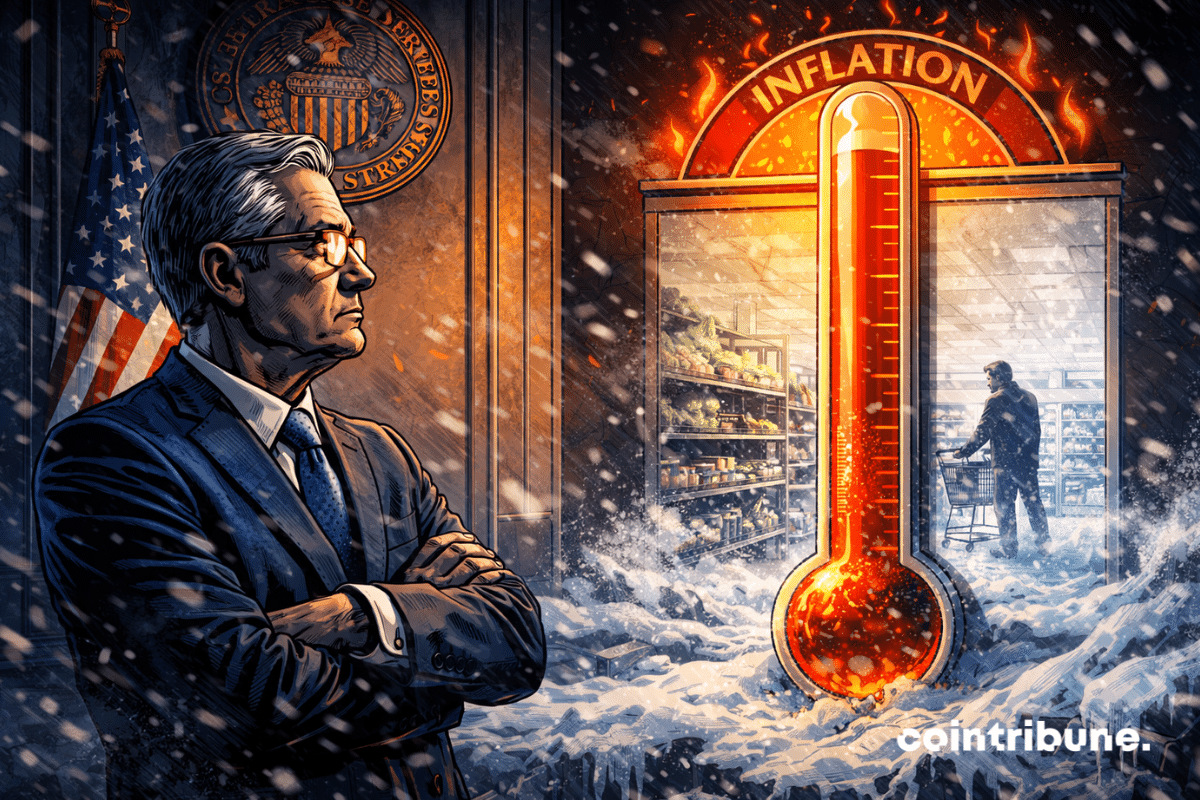
The official figures for American inflation are in direct opposition to those of alternative indicators. While the Fed delays a possible monetary pivot, independent data suggests that real inflation is already well below 2%. This discrepancy triggers doubts about the relevance of the tools used by the authorities and could upset market expectations, particularly in the crypto ecosystem, where each macroeconomic signal is closely scrutinized.

In brief
- A major gap is widening between official US inflation figures and those of an alternative index, Truflation.
- According to Truflation, real inflation in the United States would be 0.86% compared to 2.7% according to government data.
- The Core PCE indicator, closely monitored by the Fed, would also be below 1.4%, well below the target set by the central bank.
- This data, updated in real time, is based on millions of price points disaggregated and published without delay.
Alternative data that contradicts the official index
On January 28, the Truflation platform released a series of figures that cast doubt on official measurements of American inflation.
According to his calculations, the consumer price index would amount to 0.86% year-on-year, a level well below the 2.7% published by the government for December. Truflation goes further, proposing an estimate of Core PCE, the Federal Reserve's benchmark indicator, at 1.38%, well below the 2% target set by the Fed.
The data published by Truflation use a different methodology than the Bureau of Labor Statistics. The platform aggregates millions of price points from various suppliers and updates its figures in real time. Here is what she says:
- All our indices are calculated daily at a rolling annual rate, using millions of data from dozens of suppliers;
- It relies on disaggregated data flows, covering in particular health, food, energy, and consumer goods;
- The data is published without a monthly lag, unlike government publications, which allows for a more dynamic reading of trends.
This more granular and reactive approach allows us to observe a widespread deceleration in inflation well before it appears in traditional reports. The gap between these alternative readings and traditional indicators questions the relevance of the tools used to guide monetary policy.
A disconnected Fed? Implications for markets
This divergence fundamentally questions the coherence of Federal Reserve policy. By keeping rates unchanged and not indicating any specific timetable for a cut, the Fed could be, according to some analysts, disconnected from the rapid improvement in price conditions. The risk would be to prolong a restrictive monetary policy when the economic environment justifies easing.
For financial markets, and in particular for cryptos, this gap between perception and reality has direct consequences. Recent history has shown that risky assets like bitcoin react favorably to the prospect of lower rates.
If alternative data like that of Truflation were to establish itself in investors' analysis models, they could accelerate flows towards cryptos, to the detriment of assets more sensitive to bond yields. The Dollar Index recently closed below a long-term support level, a potential signal of a new phase of weakness for the American currency.
While the Fed is not cutting rates, alternative data shows much lower inflation than expected. This discrepancy fuels doubts about the current monetary strategy and could reshape market expectations, particularly in the crypto ecosystem, which is always sensitive to economic policy signals.
Maximize your Tremplin.io experience with our 'Read to Earn' program! For every article you read, earn points and access exclusive rewards. Sign up now and start earning benefits.