
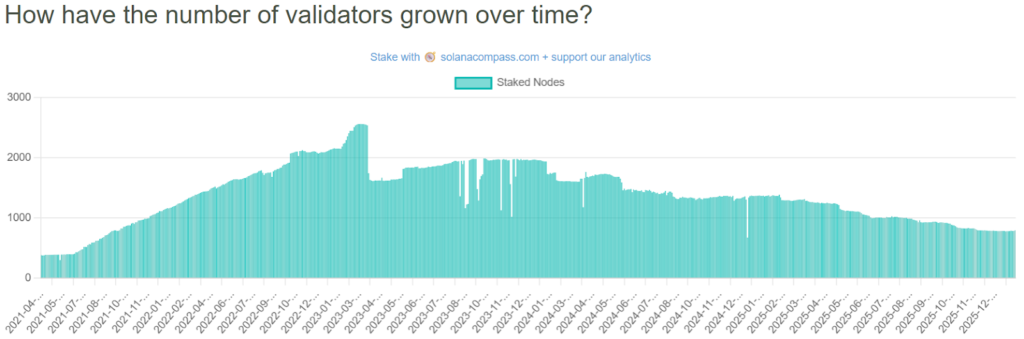
Solana, one of the most promising blockchains in the crypto sector, is going through a quiet but deep crisis. In three years, its number of validators has fallen by 68%, from 2,560 to just 795 in January 2026. Behind these figures lies a frightening reality… How did we get here? What are the consequences for the future of Solana?
In brief
- Solana has lost 68% of its validators since 2023, from 2,560 to 795, due to rising costs and fee competition.
- The Nakamoto coefficient dropped by 35%, signaling an increased concentration of power in the hands of a handful of crypto validators.
- Despite record transaction volumes, Solana must balance efficiency and fairness.
Solana validators are leaving the ship: will the network resist?
The data speaks for itself. Indeed, Solana has lost 68% of its validators since its peak in March 2023. According to Solanacompass, only 795 active validators remain today, compared to more than 2,500 three years ago. This hemorrhage is mainly explained by:
- The increase in operational costs;
- Fierce competition on fees, making the activity unprofitable for small operators.
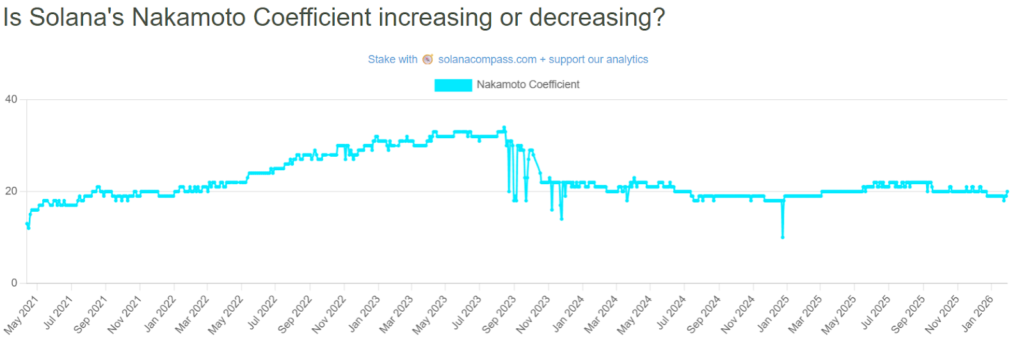
Some validators have even publicly admitted to considering shutting down their nodes, not because of a lack of confidence in Solana, but because the economic equation no longer holds. Furthermore, the situation is all the more worrying as the Nakamoto coefficient, a key indicator of decentralization, has also plunged by 35%, going from 31 to 20! Meaning that the crypto network is now more vulnerable to a concentration of power in the hands of a small number of dominant players.
Solana: the hidden consequences of a changing crypto network
There drop in number of validators by 68% raises a fundamental question: is Solana sacrificing its decentralization on the altar of performance? The crypto network justifies this development by maturation, arguing that fewer validators, but more robust, would guarantee better stability. However, the risks are real. Fewer nodes mean less geographic and technical redistribution. This could weaken network security in the face of attacks or major outages.
Paradoxically, despite this decline, the volume of transactions remains exceptionally high, approaching 100 million per day. A performance that poorly masks internal tensions. Within the crypto community, debates rage. On the one hand, some see it as a natural evolution. On the other, a pure and simple abandonment of the founding principles of the blockchain. Between efficiency and decentralized ideals, Solana seems at a crossroads, without the outcome yet being clear.
What solutions to avoid the end of Solana?
Faced with this crisis, initiatives are emerging to try to stem the exodus of validators. The Solana Foundation has launched support programs, such as the Solana Foundation Delegation Program (SFDP), aimed at financially assisting small operators. However, the results remain mixed: although the number of independent validators has increased slightly, the majority of nodes remain controlled by a handful of institutional actors.
Other avenues are being considered, such as optimizing operational costs or creating incentive mechanisms to attract new validators. Some even suggest taking inspiration from models like that of Ethereum, where decentralization remains an absolute priority. But a question remains: Can Solana reconcile performance and fairness, or must it accept a more centralized network to survive?
Solana’s validator crisis reveals a broader dilemma… How far can a blockchain go in centralization without betraying its DNA? With 68% of its validators gone, the crypto network is at a turning point. The solutions exist, but their implementation will determine whether Solana manages to preserve its balance between innovation and decentralization. And you, would you be ready to trust a network where decentralization is only a distant memory?
Maximize your Tremplin.io experience with our 'Read to Earn' program! For every article you read, earn points and access exclusive rewards. Sign up now and start earning benefits.


