
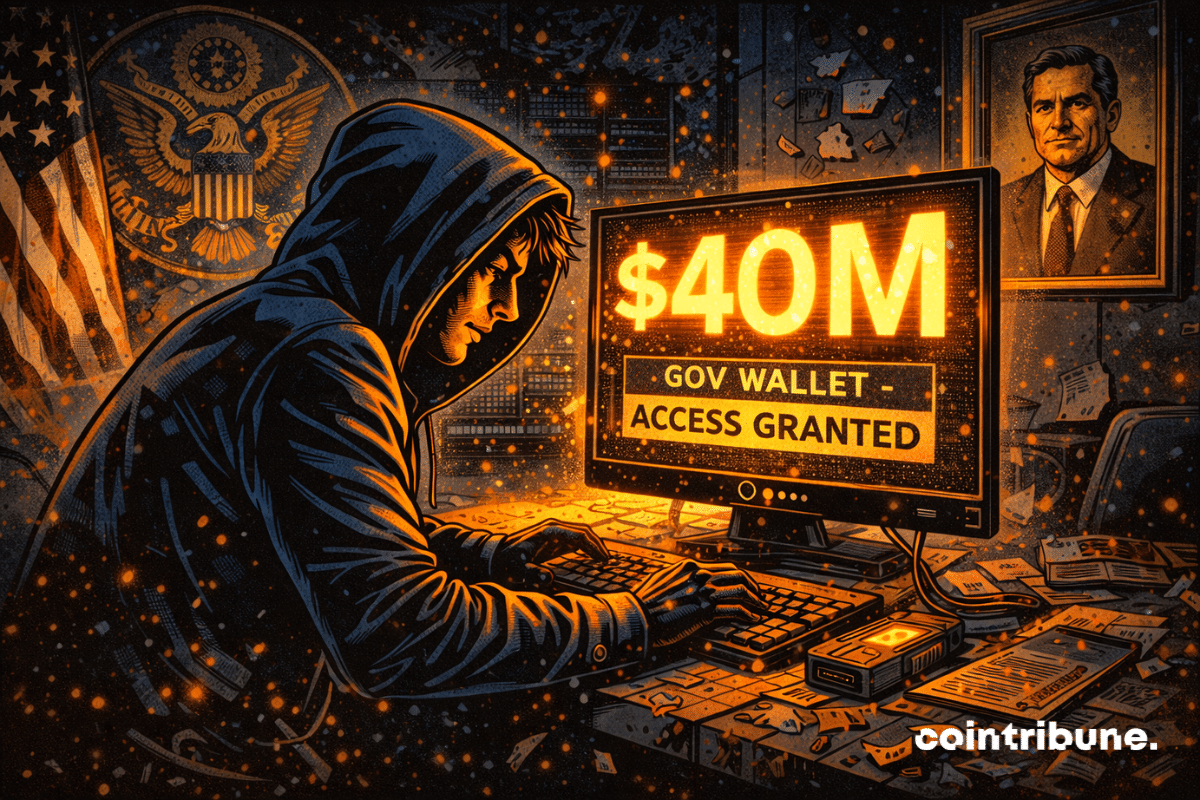
Nothing seems to be able to stop hackers anymore, not even the armored walls of public institutions or the most severe sanctions. In a world where data is worth gold, cryptos are becoming the new target for the most daring minds. And this time, the attack did not come from outside. According to a ZachXBT investigation, a high-profile theft allegedly targeted US federal wallets, exposing a scandal at the intersection of power, finance and cybercrime.
In brief
- Hacker “Lick” allegedly stole more than 40 million in crypto from US federal wallets.
- ZachXBT's investigation links these funds to a public contract awarded to the company CMDSS.
- Transactions linked to the 2016 Bitfinex hack revealed compromised government addresses.
- Critics accuse CMDSS of a lack of license and a worrying internal conflict of interest.
The hack from the inside: the guard's son caught red-handed
It's far from Lazarus Group, but it's a scenario that even Hollywood wouldn't have dared to imagine. The alleged perpetrator of the theft of tens of millions of dollars in crypto belonging to the American government would be none other than the son of the CEO of a company under contract with the federal services. According to the investigation by on-chain detective ZachXBT, the individual, known online under the pseudonym “Lick”, allegedly stole more than $40 million from wallets managed on behalf of the state.
The affair broke out after an outrageous scene broadcast on Telegram: a contest of egos, a “band-for-band”, where two cybercriminals show off their riches. In a recorded sequence, “Lick” shares his screen, revealing an Exodus crypto wallet containing several million dollars. By tracing the flows, ZachXBT discovers that the funds came from a government address linked to the seizure of the Bitfinex hack (2016).
The most disturbing? The suspect's father, Dean Daghita, runs Command Services & Support (CMDSS), a company contracted by the US Marshals Service, responsible for guarding the seized cryptos. A shame.
The recording clearly shows that John controls both addresses. Other addresses can probably be identified in the records.
ZachXBT
Washington embarrassed: the government's crypto guard weakened
Beyond the hack itself, it is the credibility of the federal digital asset management system that is collapsing. CMDSS won a key contract in October 2024 to manage “non-mainstream” cryptos, those which are not hosted on centralized exchange platforms. But from the start, voices were raised. Wave Digital Assets, a dismissed competitor, denounced the lack of financial license from CMDSS and pointed out a possible conflict of interest: a former agent of the US Marshals Service would have joined the company.
The concerns were justified. ZachXBT today traces a series of interconnected transactions totaling more than 90 million dollarssome linked to official seizure portfolios.
The consequences could be serious: loss of institutional confidence, delays in sales of seized cryptos, or even internal sanctions.
The famous analyst also sums up the seriousness of the moment:
The perpetrators of these attacks continue to brag about their stolen funds in leaked recordings, instead of simply remaining silent after an alleged theft against the US government.
Blockchain, ego and stupidity: one hack too many for the crypto-sphere
The Daghita affair highlights a fascinating paradox: in a world where every transaction is engraved in the blockchain, hackers continue to trap themselves out of pure vanity.
It was this absolute transparency that allowed ZachXBT to piece together the puzzle. By connecting the addresses 0xd8bc, 0x8924 and 0xc7a2, he traced the wire to government wallets. All thanks to a simple chat recording.
Beyond the legal aspect, the case questions the security of public infrastructures linked to crypto. If a service provider's son can access federal portfolios, an entire model of trust falters.
And crypto investors know it: such a scandal can cause massive sales and shake already fragile markets.
The numbers that send shivers down your spine
- $40 million: estimated amount stolen from federal wallets;
- 90 million dollars: suspicious flows traced on the blockchain;
- 24.9 million: sum transferred from a government address linked to the Bitfinex hack;
- October 2024: date of contract award to CMDSS by the US Marshals Service;
- 2026: year when the affair breaks out publicly via ZachXBT's thread.
The Daghita scandal reveals the gaping flaws in crypto security that can still be improved, even within the most powerful institutions. And while the American government tries to plug the gaps, a threat of another kind is advancing: that of quantum computers. Vitalik Buterin himself admitted, Ethereum could be hit before 2028.
Maximize your Tremplin.io experience with our 'Read to Earn' program! For every article you read, earn points and access exclusive rewards. Sign up now and start earning benefits.


