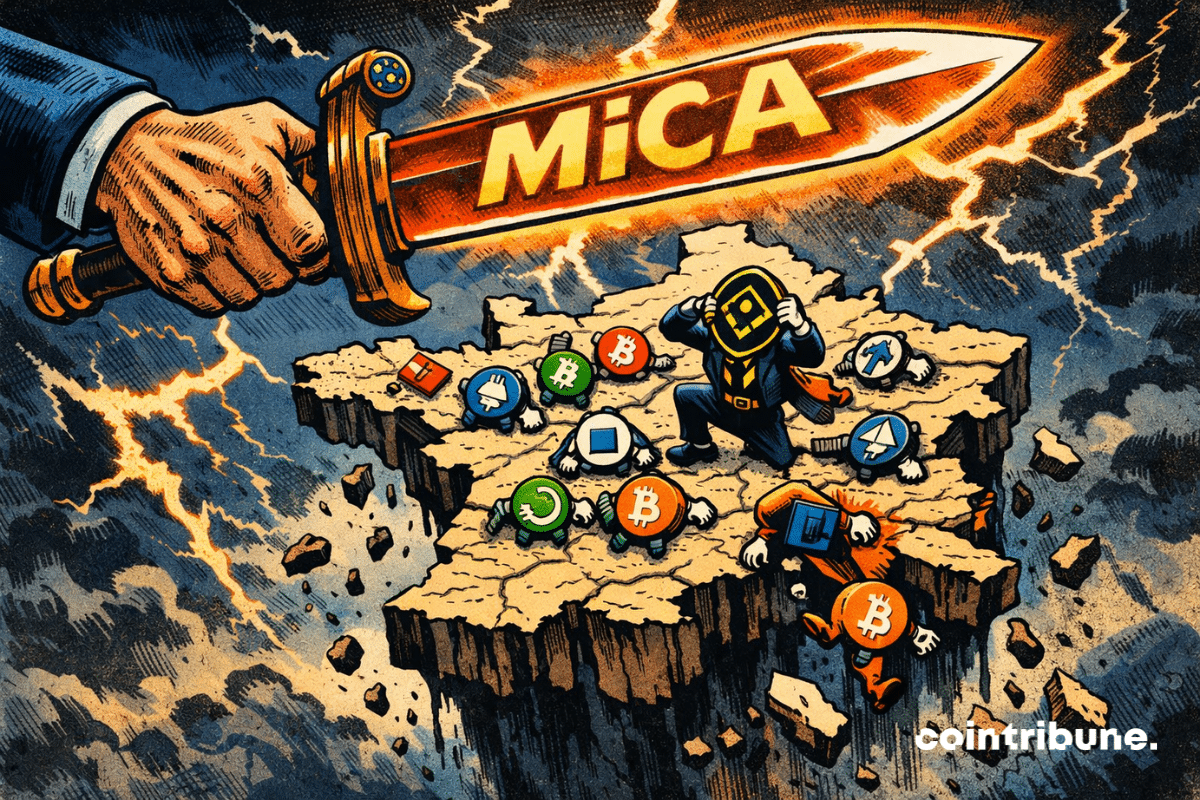
France is preparing for a real regulatory earthquake. Within ten months, companies not yet covered by the MiCA regulation will either have to close their doors or obtain European approval. In the corridors of the AMF, concern is growing: certain major players have not yet taken the plunge. For others, the race to compliance feels like an exhausting sprint. The countdown has begun and the crypto industry is holding its breath.
In brief
- 90 French crypto companies still without a MiCA license, ten months from the deadline.
- Binance has not yet obtained its European approval despite its French registration since 2022.
- The AMF demands more transparency and wants to exclude companies with licenses deemed lax.
- MiCA will sustainably transform the French crypto landscape, favoring solid and well-capitalized players.
Binance facing the MiCA clock: France will not tremble
The giant Binance, registered in France since 2022, has still not obtained its MiCA approval. An emblematic situation: nearly 90 companies still operate in regulatory limbo.
According to Stéphane Pontoizeau of the AMF, around 30% of companies have submitted their application, 40% have not yet done so, and 30% have given no sign of life. The authority explains that it has contacted all the companies concerned, but some have still not specified whether they intend to apply for approval or simply cease their activities. An inertia which is worrying: as June 2026 approaches, unlicensed companies will have to end their services.
Binance, aware of the risk, is already exploring solutions in Europe to obtain authorization more quickly. But France, determined not to become the weak link, is considering blocking actors who have chosen jurisdictions considered too lax. The message is clear: in Paris, crypto regulation must be respected or left.
MiCA, between protection and pressure: the big European sorting
Adopted in 2023, MiCA (Markets in Crypto-Assets Regulation) marks a historic break in European regulation. Behind the promise of a harmonized framework, the text imposes strict obligations: minimum capital, solid governance, environmental transparency and publication of a white paper for each asset.
Since December 2024, only PSCA approved providers can practice. A transitional period runs until June 2026, but time is running out.
For France, MiCA is a sorting tool. It must separate reliable players from opportunistic projects, avoid new scandals like FTX or Terra Luna and protect investors. However, some consider the French version more severe than that of its European neighbors. ESMA also recalled in December that non-compliant companies must have an orderly closure plan before the deadline.
Europe is moving towards strong regulation; the actors oscillate between confidence and fear.
Startups: survival or European exile
In France, only 70 companies have already obtained their MiCA approval: solid players like Deblock, Bitstack, OKX or Caceis. For others, the journey resembles an endurance test. Crypto startups are struggling to finance their business: capital requirements, compliance procedures and reinforced audits. Some plan to obtain their approval in other European countries, which are more administratively flexible.
But the AMF has warned: it could refuse access to the French market to those who attempt this circumvention. A firm position, at the risk of seeing part of national innovation evaporate.
MiCA was designed to protect investors while leaving real room for innovation. Between rigor and competitiveness, French players are moving forward on a crest line. The market is changing, and only the most agile will be left standing.
MiCA countdown dates and numbers
- 90 companies without approval ten months before the deadline;
- Only 30% submitted their file to the AMF;
- 70 companies already approved, including Bitstack and Caceis;
- June 2026: end of the transitional period;
- Objective: a safer and more transparent European market.
Ten months from the end of the deadline, the tension is palpable. However, some at the Banque de France consider MiCA still too permissive. They call for strengthening the European framework in order to prevent regulatory flaws from re-emerging in other forms. France, faithful to its tradition of rigor, intends to weigh in on this debate: the balance between innovation and stability remains to be written.
Maximize your Tremplin.io experience with our 'Read to Earn' program! For every article you read, earn points and access exclusive rewards. Sign up now and start earning benefits.