
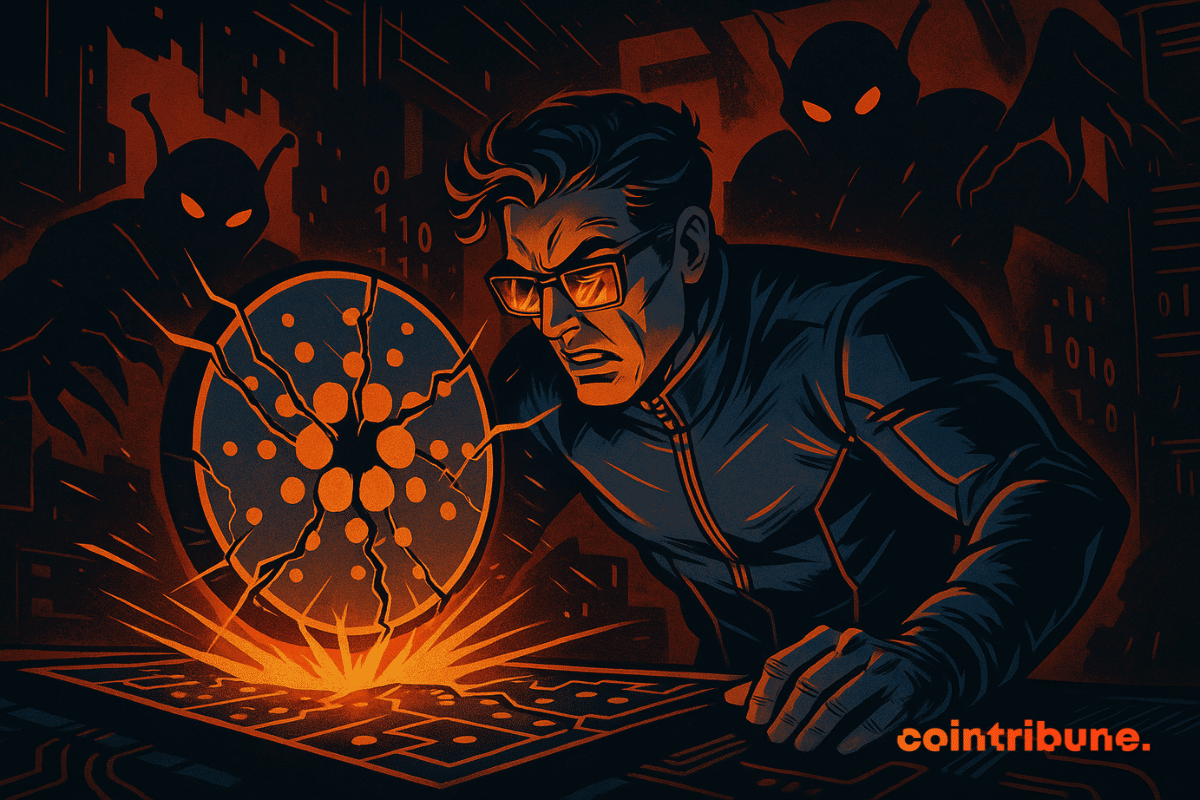
As the crypto industry attempts to recover from a steep fall, more problems are looming on the horizon. In an atmosphere already saturated with volatility, it was Cardano, although renowned for its stability, which saw its network fracture. A bug several years old, a malformed transaction, an operator a little too curious… and suddenly, the protocol falters. No thefts, no loss of funds… but an already tense climate of trust which is further cracking. An earthquake narrowly avoided.
In brief
- A malformed transaction has triggered a temporary split on the Cardano blockchain.
- The error comes from a 2022 bug, exploited by an operator using AI.
- The ecosystem reacted quickly: urgent update, merger of the channels into one.
- The incident raised criticism of the robustness of the protocol and the governance of the project.
Cardano, split and bug: the crash narrowly avoided
Cardano news: on November 21, 2025, the blockchain suffered a chain split caused by a malformed transaction. Behind this flaw? A discreet bughidden in the code since 2022, awakened by a staking operator using code generated by artificial intelligence.
Homer J, the manager, did not shy away: “ Sorry (I know this word is not enough given the impact of my actions) Cardano community, it was me who endangered the network through my negligence last night. Basically it was a personal challenge like “let's see if I can reproduce the bad transaction”, and I was pretty stupid… »
Result: two chains are formed. One contained the “poisoned” transaction, the other did not. Miners continued to produce blocks…on both. But only one could survive.
Voices in the community quickly denounced an attack. Charles Hoskinson, founder of Cardano, don't mince your words :
This was a premeditated attack carried out by a disgruntled SPO who spent months on the Fake Fred Discord actively researching how to damage IOG's brand and reputation. It targeted my personal pool, resulting in disruption of the entire Cardano network. Every user has been impacted. SPOs have lost rewards. There could have been double spending. DeFi has been disrupted.
Crypto & chaos: when human error causes a network to wobble
Using AI to interact with a blockchain is not illegal. But this requires rigor. In this specific case, it was human thoughtlessness that amplified the problem. Homer J admitted to relying on suggestions from an AI model without verifying, without testing. No malice, he said. But a negligence which had concrete consequences.
This is not a first in the crypto world. Bitcoin experienced a similar event in 2013. A bug between client versions 0.7 and 0.8 resulted in a temporary hard fork. Blocks were lost. Rewards too. Ethereum saw the birth of Ethereum Classic because of The DAO hack in 2016.
Astute observer Andrew Throuvalas sums up:
Cardano actually crashed for the first time. Apparently, a hacker caused a network partition by exploiting a bug present in an older version of Cardano's software. This created two channels. Blocks are produced on both sides, but eventually one will outperform the other, orphaning the malicious chain's blocks.
The lesson is clear: even the best-designed chains can fail. The issue is not infallibility. It is the ability to react, to repair, to learn.
Rifts swept under the carpet: what the Cardano incident reveals
Fortunately, the Cardano machine has not stopped. Blocks continued to be produced. Operators were quickly asked to update their nodes to version 10.5.3. This version rejects the offending transaction and combines the two chains into one. A working group was also set up for data reconciliation.
But all this does not erase the doubt. Part of the community is wondering: if such an old bug could have been exploited, what about the others? Krumlar, an active user, hits the mark:
You're not a bad person. Stop this nonsense. You want to know what's really bad? The fragile nature of Cardano, if you can break it that easily.
Cardano's reputation is based on its scientific rigor and its formal approach. However, this incident reveals a governance flaw. Who validates the patches? Who tests in depth? The ecosystem, although solid, shows that it remains vulnerable to human error… even accidental.
Key takeaways – facts and figures
- The price of ADA, Cardano's native token, is currently trading around $0.40;
- The bug dates from 2022, but was only exploited recently;
- Two distinct channels temporarily coexisted on November 21, 2025;
- The node patch version is 10.5.3;
- The author of the flaw used AI-generated code without going through a testnet.
And now ? Cardano is banking on the Ouroboros Phalanx update to strengthen its security and prevent this type of drift. A necessary response, but not sufficient. Because if the technology is solid, it is trust that will now have to be rebuilt.
Maximize your Tremplin.io experience with our 'Read to Earn' program! For every article you read, earn points and access exclusive rewards. Sign up now and start earning benefits.


