
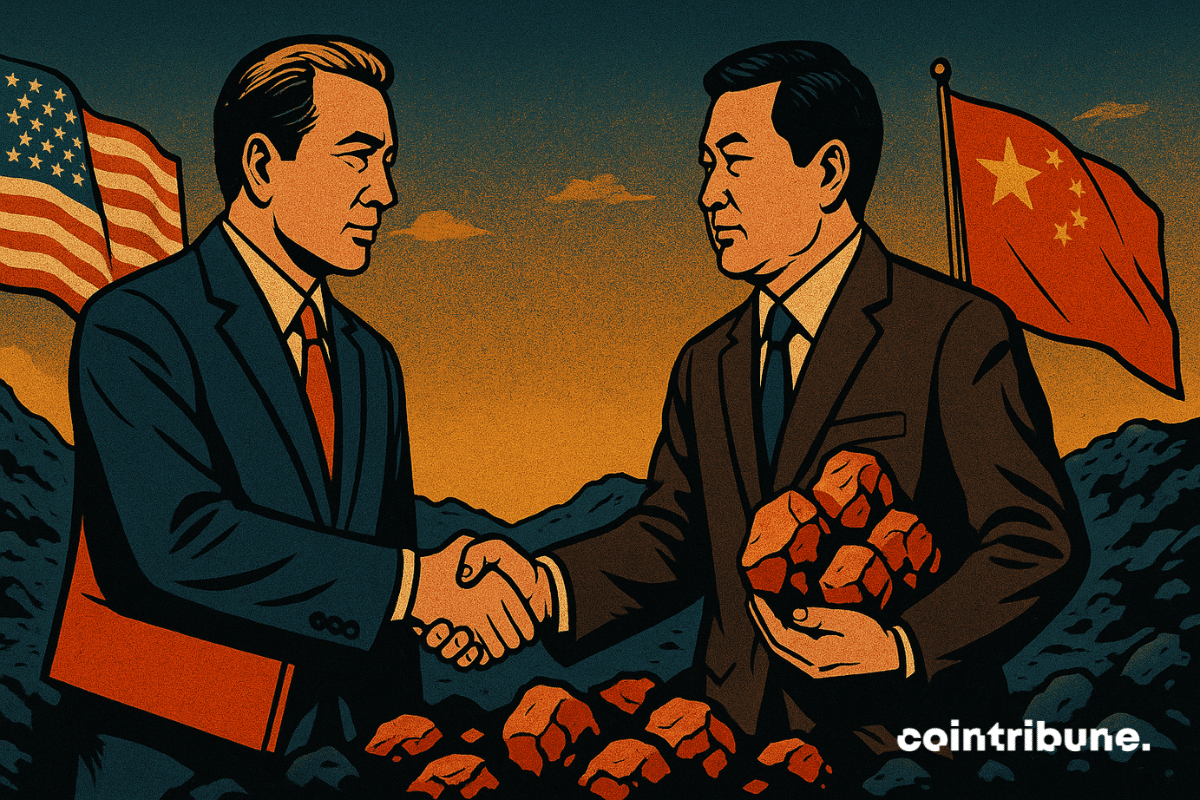
A few days before Thanksgiving, Washington and Beijing are preparing to conclude a decisive agreement on rare earths, these vital materials for the technology industry, defense and crypto mining. In a tense geopolitical climate, this compromise could defuse a crisis with serious consequences for global supply chains. Faced with the threat of American customs sanctions and Chinese restrictions on exports, this agreement marks a strategic turning point, but nothing is over yet.
In brief
- A strategic agreement between the United States and China on rare earths could be signed before Thanksgiving.
- Treasury Secretary Scott Bessent says China will honor its commitments made at the Trump-Xi summit.
- Washington renounces a 100% tariff increase, while Beijing suspends its export restrictions.
- This agreement aims to secure access to critical materials for tech, defense and the crypto mining sector.
Washington and Beijing defuse the rare earth crisis
While appearing on Fox News' Sunday Morning Futures, US Treasury Secretary Scott Bessent announced that a rare earth deal between the US and China, following recent restrictions, could be finalized by Thanksgiving.
“I am confident that after our meeting in Korea between the two leaders, President Trump and Xi, China will honor its commitments”did he assertedreferring to recent bilateral negotiations.
According to Bessent, this draft agreement follows a framework established last month between the two powers, in which Washington committed to suspend the imposition of 100% customs duties on Chinese imports, while Beijing froze the establishment of an export licensing system targeting rare earths and industrial magnets.
The stakes are considerable, particularly for strategic American industries that depend on these critical materials, including the crypto mining sector. Rare earths are used in the manufacture of specialized components, essential for the proper functioning of supercomputing machines.
By avoiding a trade escalation, this agreement temporarily preserves the United States' access to these resources, which are crucial to maintaining industrial competitiveness. Here is the elements of the agreement:
- The suspension by the United States of a planned tariff increase on imports from China (100% on certain product categories);
- China's freezing of a proposed export license for rare earths, which would have limited the global supply of strategic elements;
- Beijing's implicit commitment not to use rare earths as a tool of pressure in the military or technological sectors, despite certain rumors described as “false” by Scott Bessent;
- The stated objective is to guarantee the stability of supply chains for sensitive sectors such as defense, technology, and crypto equipment.
This is an attempt at de-escalation, at least temporarily, between the world's two leading economic powers. It intervenes in a still fragile commercial climate, where each diplomatic gesture can have concrete repercussions on markets and industries.
Tensions on agricultural purchases
If the mining aspect of the agreement seems to be on track, other promises resulting from the Trump-Xi meeting in South Korea are already crumbling, particularly on the agricultural level.
On November 15, the US Department of Agriculture revealed that only two purchases of US soybeans by China had been recorded since the summit, totaling 332,000 tonnes. A figure far removed from the 12 million tonnes that Agriculture Secretary Brooke Rollins had mentioned for the period up to January, and well below the 25 million tonnes per year promised for the next three years.
“We are still very far from what was announced by the United States in terms of an agreement,” commented Tanner Ehmke, chief economist at CoBank, recalling that China has never officially confirmed such quantitative promises.
China, according to Ehmke, has significant stocks of soybeans from Brazil and other South American countries. Furthermore, American exports continue to be penalized by a tariff of 24%, even after a reduction of ten points, which makes American products less competitive.
In addition, Beijing has only declared that there is a consensus to expand trade in agricultural products, without quantified commitment or precise timetable. While Trump assured Sunday that “China is going to buy a lot of soybeans,” markets remained skeptical, and prices fell 23 cents to $11.24 per bushel after the USDA report was released.
This divergence between political speeches and the reality of exchanges casts a shadow over the real scope of the Sino-American agreement. If the rare earths aspect seems to be moving towards stabilization, agriculture reveals a more uncertain dynamic, illustrating the limits of this diplomatic rapprochement. For players in the crypto sector, these contrasting signals call for caution.
The pending deal may well represent only a partial ceasefire in a trade war with far-reaching ramifications. If critical supply chains appear momentarily secure, future developments will depend as much on Beijing's strategic decisions as on the strength of American commitments.
Maximize your Tremplin.io experience with our 'Read to Earn' program! For every article you read, earn points and access exclusive rewards. Sign up now and start earning benefits.


