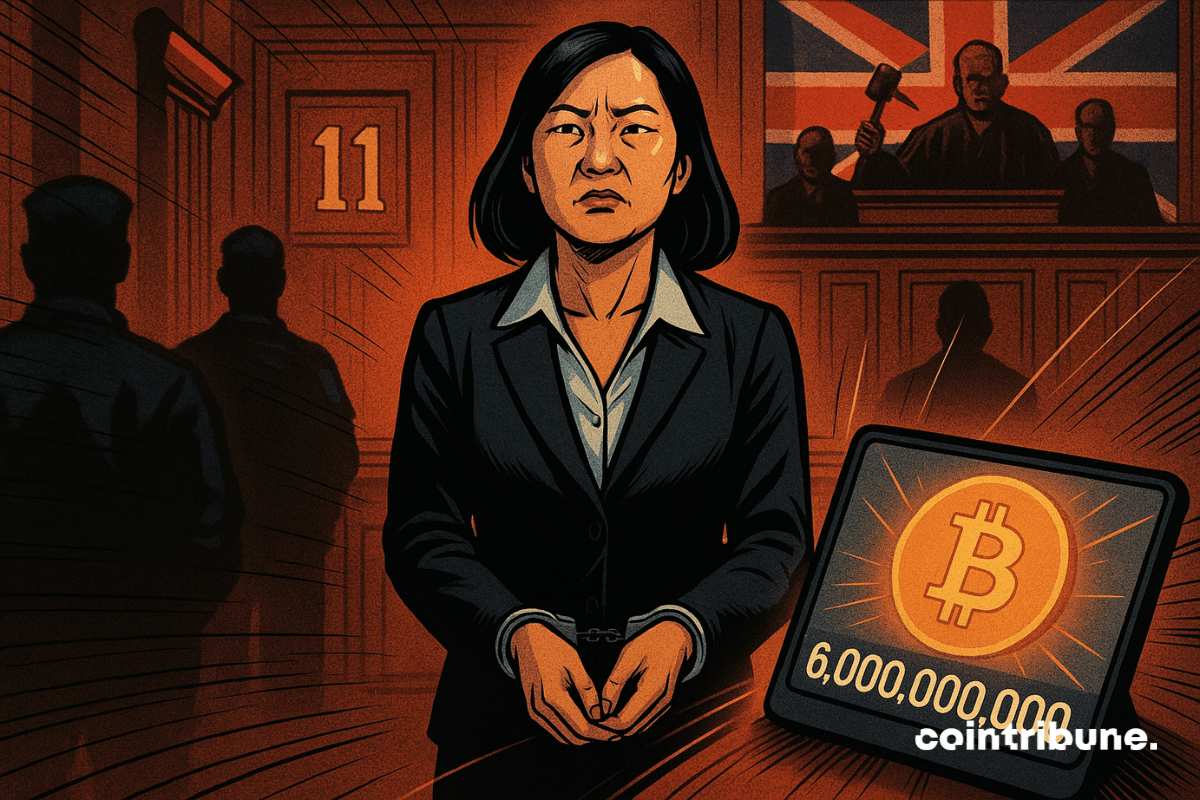
It happens that justice catches up with the most devious. In the global arena of crypto scammers, where schemes compete in ingenuity, Zhimin Qian has just entered the pantheon of fallen fraudsters. It was in London, far from the first Chinese victims, that her fate changed: sentenced to more than 11 years in prison. Behind its ambitions of grandeur and its monarchical dreams, it is a mechanism of crypto predation which is collapsing. One among many others, but one which symbolizes the extent of the excesses that the crypto industry can cause when it escapes all control.
In brief
- Zhimin Qian defrauded 128,000 victims via a crypto pyramid between 2014 and 2017.
- 61,000 bitcoins were seized, a record confiscation in British judicial history.
- The fraudster lived in hiding in Europe for seven years with falsified identities.
- The London court sentenced her to eleven years and eight months in prison.
Historic-scale Bitcoin fraud judged in London
Zhimin Qian, 47, also known as Yadi Zhang, was found guilty of money laundering and possession of criminal property. The Southwark court ruled: 11 years and 8 months in prison, for having profited from a Ponzi pyramid set up between 2014 and 2017 in China. The harm? More than 128,000 victims, and 61,000 bitcoins seized.
This trial entered the British legal annals. Will Lyne, head of economic crimes at the Metropolitan Police, pointed out :
This is currently the largest cryptocurrency seizure ever made by law enforcement in the UK, and the largest money laundering case in the country's history in terms of value.
At the same time, two accomplices were sentenced: Jian Wen to 6 years and 8 months, Seng Hok Ling to 4 years and 11 months. All helped move funds through real estate acquisitions and dormant digital wallets.
A crypto-fugitive between jewelry, false passports and royal dreams
After leaving China with falsified papers, Zhimin Qian traveled across Europe. Between the suites at the Ritz-Carlton and the Van Cleef & Arpels boutiques, she spent lavishly. In London, she rented a mansion for 17,000 pounds a month. His ambition? Buy properties to launder your BTC. But its luxurious profile raised alarms.
Her hunt really began in 2018, when she failed to pass KYC (Know Your Customer) checks by wanting to buy three properties for a total of 40.5 million pounds. Then she disappears. Until his reappearance in 2024, thanks to the reckless use of an inactive crypto wallet, which led to his arrest.
His personal diary, seized by the police, reveals delusional ambitions :
[Je veux] become the monarch of Liberland, a self-proclaimed country consisting of a strip of land between Croatia and Serbia
Qian also harbored dreams of rubbing shoulders with British royalty. A fantasy interrupted by legal reality, which reminds us that the crypto-sphere, as decentralized as it is, is not above the law.
Crypto, scams and bitter lessons for investors
This case revives the debate on regulation in the crypto sector. Qian is not the first, and will not be the last, to have taken advantage of the regulatory void to build a fraudulent empire. Many of his victims, according to lawyer Jackson Ng, were from modest backgrounds: taxi drivers, butchers, farmers… attracted by promises of huge returns.
Takeaways from the Qian affair:
- 128,000 people scammed between 2014 and 2017 via the company Lantian Green;
- 61,000 BTC seized, the equivalent of more than $6 billion;
- Qian fled for 7 years across Europe under multiple identities;
- Bitcoin was worth $3,600 in 2018, compared to more than $100,000 today;
- Three convictions in total: Qian, Wen, and Ling.
The case echoes other recent crypto scandals. It asks a fundamental question: how can we protect crypto investors without stifling innovation? Between speculative euphoria and the naivety of savers, the line is often blurred.
Zhimin Qian's fall only revives memories of another famous ghost: Ruja Ignatova. The founder of OneCoin, nicknamed the “Cryptoqueen”, was allegedly murdered by a drug lord, according to a recent chilling revelation. A disastrous fate for the one who embodied, like Qian, the other face of crypto promises.
Maximize your Tremplin.io experience with our 'Read to Earn' program! For every article you read, earn points and access exclusive rewards. Sign up now and start earning benefits.