Making a transaction on Ethereum now costs just a few cents. This Sunday, gas costs plunged to 0.067 gwei, a level not seen in years. While traders welcome this spectacular decline, it raises questions about the economic viability of Ethereum's model.
In brief
- Gas fees on Ethereum fell to 0.067 gwei on Sunday, amid a widespread slowdown in crypto markets.
- A swap transaction now costs just $0.11, compared to more than $150 during congestion periods in 2021.
- This decrease is notably explained by the Dencun update of March 2024, which reduced fees for layer 2 solutions.
- Ethereum base layer revenue has fallen 99% since 2024, raising concerns about the sustainability of the model.
Ethereum records historically low transaction fees
Yesterday, Ethereum users were able to transact for a fraction of a cent. Gas fees bottomed out at 0.067 gwei, a level rarely seen in the network's history.
For active traders, this is an unexpected boon. Trading tokens costs $0.11, buying an NFT costs $0.19, and transferring assets to another blockchain requires only $0.04.
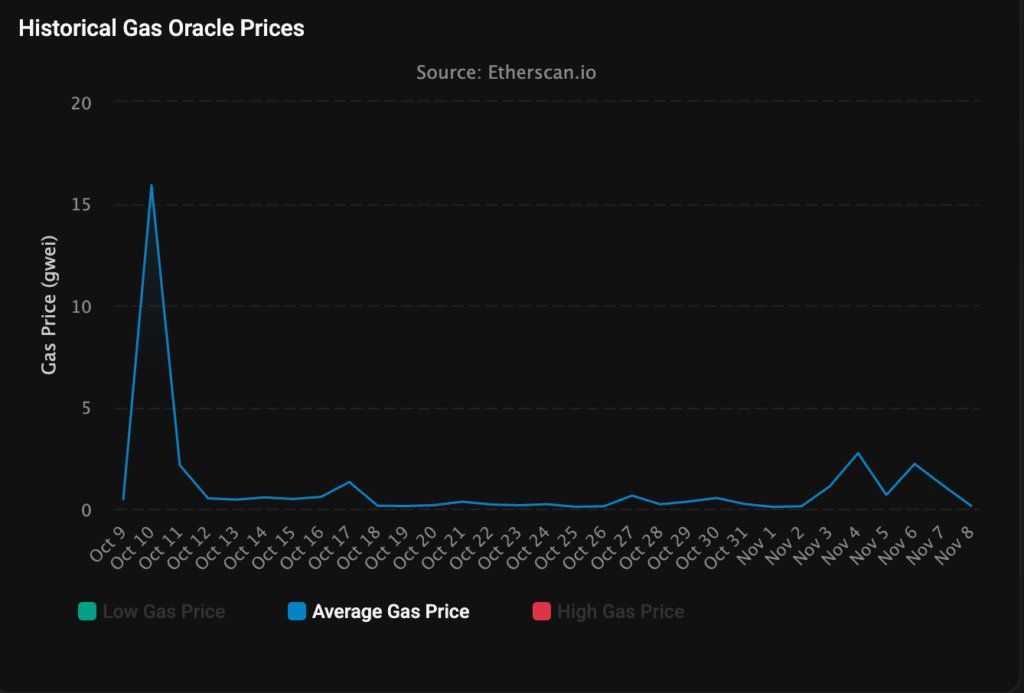
This phenomenon is part of a downward trend that began after the “flash crash” of October. On October 10, during a flash crash that saw some cryptos lose up to 90% of their value in 24 hours, fees had momentarily jumped to 15.9 gwei. But two days later, they already fell to 0.5 gwei. Since then, they have continued to stagnate below the symbolic bar of 1 gwei.
This situation stands in stark contrast to the golden era of 2021. At the height of the bull market, making a single transaction on Ethereum could cost $150, or even more during peak congestion.
Users then had to choose between paying exorbitant fees or waiting hours, sometimes days, for the network to clear up. Today, this problem is a thing of the past.
The Dencun update, deployed in March 2024, played a key role in this transformation. By optimizing data management for Layer 2 solutions, it has significantly eased the pressure on the core network.
Platforms like Arbitrum, Optimism and Base can now process massive volumes of transactions at lower costs, freeing up Layer 1 space.
The dangers of a weakened economic model
However, this medal has its other side. Since the start of 2024, Ethereum's base layer has been experiencing net revenue losses. The fees generated are no longer enough to offset the operational costs of the network.
The 99% drop in income challenges the most seasoned observers. How can a network remain viable with such an erosion of its financial revenues?
Validators, who secure the network by processing transactions, depend on these fees to make their investments profitable. With plummeting income, their motivation could wane.
Certainly, staking rewards still exist, but they do not fully compensate for the disappearance of transaction fees. Moreover, nearly 2.45 million ETH are currently waiting in the validator withdrawal queue, which reflects a certain nervousness among participants.
Critics point to Ethereum's scaling strategy, which relies heavily on a layer 2 ecosystem. This architecture presents an apparent contradiction.
On the one hand, it allows the network to compete with recent blockchains like Solana or Aptos, capable of processing thousands of transactions per second. On the other, it channels economic activity towards external protocols, thus depriving layer 1 of its traditional sources of revenue.
According to an analysis by Binance, Ethereum faces a “double-edged sword”. Layer 2 solutions strengthen its technical competitiveness, but simultaneously create internal competition.
Users naturally favor networks where fees are lowest. Result: activity massively shifts to Base, Arbitrum or Optimism, leaving the main layer underutilized. This dynamic could ultimately weaken Ethereum's fundamental value proposition.
A necessary strategic rethinking
Faced with this paradoxical situationthe Ethereum community finds itself at a crossroads. Low fees are undeniably a competitive advantage in attracting users.
However, they also report a decline in demand for the base layer, which calls into question the sustainability of the model in the long term. Future updates, including Fusaka scheduled for December 2025, will introduce mechanisms like PeerDAS to further optimize the network.
But will they solve the structural income problem? The community must quickly find a viable model: one that will reconcile accessibility for users and sufficient remuneration for validators, otherwise the leader in smart contracts could lose its throne to competitors less scrupulous about decentralization.
Maximize your Tremplin.io experience with our 'Read to Earn' program! For every article you read, earn points and access exclusive rewards. Sign up now and start earning benefits.