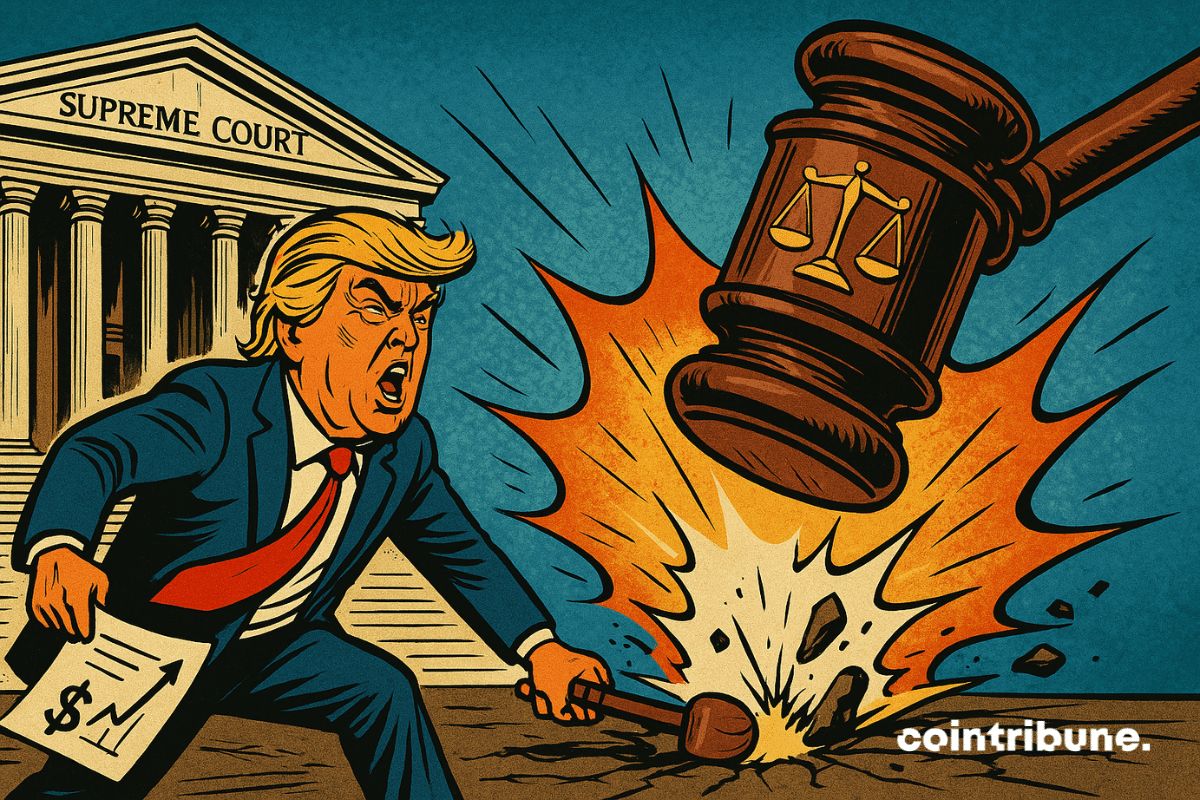
Kalshi and Polymarket report a sharp drop in the odds in favor of Donald Trump, as the Supreme Court examines the legality of his tariff powers. This turnaround sheds light on two dynamics: the possible decline in presidential authority over foreign trade, and the growing role of decentralized platforms as sensors of political anticipation. A case where constitutional law, economic strategy and technology intersect under the gaze of judges… and investors.
In brief
- Kalshi and Polymarket record a dramatic drop in odds in favor of Donald Trump.
- The markets are anticipating an unfavorable decision from the Supreme Court on its pricing powers.
- More than $1.3 million was bet by traders on the outcome of this highly political affair.
- Several judges have questioned the legitimacy and extent of presidential tariff powers.
Prediction Markets Disavow Trump Position
The silent battle over American presidential powers is now being played out on prediction platforms, after the American justice system declared customs duties illegal.
While the Supreme Court examines the constitutional basis of the tariffs imposed by Donald Trump via the 1977 IEEPA, the markets are anticipating a verdict unfavorable to the president.
This Thursday, the American regulated platform Kalshi displayed only 29% probability that the Supreme Court will rule in favor of the president, a drop of 28 points in a single day.
On Polymarket, a decentralized platform based on blockchain and whose contracts are settled in USDC, the confidence level is even lower, at 25%. The cumulative total volume traded on the two platforms exceeded $1.3 million, reflecting tangible interest and nervousness around this matter. This dynamic reflects a shared reading between traditional investors and crypto users, who are adjusting their positions in the face of what they perceive as a reversal.
These market movements are closely linked to the reassessment of the legal context by traders. Since the Supreme Court agreed to take up the matter in September, positions have narrowed around a central point: the president's ability to invoke a 1977 emergency law (International Emergency Economic Powers Act) to impose tariffs without Congressional approval. The sudden reversal, described by Kalshi as the largest daily decline observed on the contract, reflects several factual elements:
- The awareness that the outcome of the trial is now perceived as unfavorable to Trump by a majority of actors;
- A rapid reconfiguration of positions on both platforms, with probabilities aligned around 25-29%;
- An increase in volume traded as investors seek to reposition or exit their contracts;
- A notable convergence between traditional (Kalshi) and decentralized (Polymarket) markets, which read judicial signals and other on-chain data with the same probabilistic analysis grid.
Judges wonder: the Supreme Court faces the limits of executive power
During the oral hearing organized this Wednesday by the Supreme Court of the United States, several conservative judges expressed a marked skepticism towards the position defended by the Trump administration.
Indeed, Justice Neil Gorsuch warned against the risk of creating a “one-way ratchet”which would permanently tilt the institutional balance in favor of the executive power. Amy Coney Barrett, also appointed by Trump, questioned government officials on the logic of targeting countries like France or Spain as part of a device supposed to respond to an emergency situation. Finally, the President of the Court, John Roberts, recalled that “tariffs, as a form of tax, have historically been within the purview of Congress”.
These statements reveal a potential challenge to the use of the International Emergency Economic Powers Act (IEEPA) to justify unilateral trade policies. The judges seem concerned by a drift in the executive power, which, if it were to be confirmed in this case, could arrogate budgetary prerogatives without parliamentary counterweight.
If the Court were to restrict the current interpretation of the IEEPA, the consequences would be multiple. From a legal point of view, this would set a precedent limiting the American president's room for maneuver on international trade issues.
Economically, this could reduce the uncertainty linked to ad hoc pricing policies, often a source of volatility on the markets. And for cryptos, traditionally sensitive to geopolitical tensions, this could ultimately result in fewer sudden movements linked to unilateral announcements, and therefore a reduced perception of bitcoin as a safe haven, with a correlation with gold which has reached 0.85, in the face of this type of risk.
Maximize your Tremplin.io experience with our 'Read to Earn' program! For every article you read, earn points and access exclusive rewards. Sign up now and start earning benefits.