
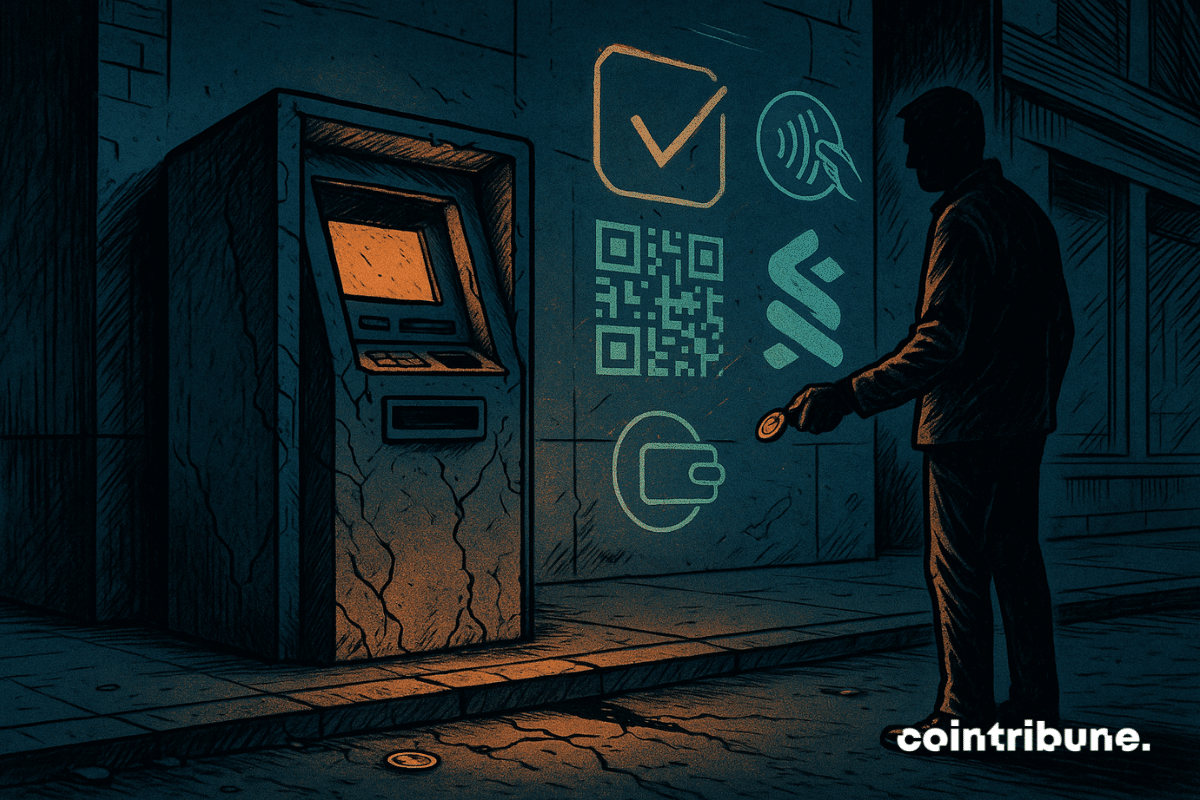
As central banks accelerate their digital currency projects, a statement shakes up the financial landscape: “money will be entirely digital”. These words, spoken by Bill Winters, CEO of Standard Chartered during Hong Kong FinTech Week 2025, outline the contours of a cashless future, anchored on blockchain. This is not a simple technical development, but a structural shift in the global monetary system, which major institutions now seem to consider inevitable.
In brief
- Standard Chartered CEO Bill Winters announces that “money will be completely digital”, predicting the disappearance of cash.
- This declaration, made during Hong Kong FinTech Week 2025, speaks of a complete transformation of the global monetary system.
- According to Winters, all transactions will one day be settled via blockchain, requiring an overhaul of financial infrastructure.
- The city of Hong Kong is hailed as an ideal testing ground, thanks to its balance of fintech innovation and a rigorous regulatory framework.
Towards a cashless world: the radical vision of Standard Chartered
It was during a panel organized during Hong Kong FinTech Week 2025 that Bill Winters, CEO of Standard Chartered, affirmed that the future of money will be entirely digital, while the banking institution sees Bitcoin at $135,000 by December.
In his words: “all transactions will eventually be recorded on blockchains, and money will be entirely digital”. This statement leaves no room for doubt about the direction taken by the British bank, one of the most influential in the Asia, Africa and Middle East regions.
Through this speech, Winters painted the picture of a global overhaul of the monetary system, with a profound reconfiguration of the mechanisms for the circulation of value.
In his speech, Winters insisted on the need to actively experiment, recognizing that the path to this total transition was not yet marked. He highlighted the privileged position of Hong Kong, which he sees as a model of regulated financial innovation. These are, according to him, the ideal conditions for testing the foundations of a new monetary system. He summarized his thoughts in three key points:
- Blockchain as the basis for future financial transactions: according to Winters, all transfers will eventually be done on blockchains;
- The complete digitalization of money: the disappearance of cash is no longer a hypothesis, but an expected, natural development;
- Hong Kong as a preferred testing ground: Winters declared that “Hong Kong has already asserted its leadership position, and I have no reason to think that will change”welcoming the balance between technological innovation and regulatory requirements established by local authorities.
Hong Kong, a technological laboratory supported by banking giants and Beijing
Beyond the technological vision expressed by Standard Chartered, it is another major player, HSBC, which revealed a complementary dimension: the structural and strategic potential of Hong Kong.
Georges Elhedery, CEO of the group, took advantage of the same event to reiterate the bank's commitment to local development, announcing a massive investment project: $13.6 billion to privatize Hang Seng Bankone of its regional subsidiaries. “This encapsulates the confidence and belief we have in the future of financial and technological innovation in Hong Kong”did he declared.
Furthermore, he highlighted HSBC's efforts to invest in the future of innovation, in particular through a partnership with the Hong Kong University of Science and Technology, intended to train the talents who will build the finance of tomorrow.
The other significant intervention was that of Paul Chan Mo-po, Hong Kong's financial secretary. He placed the city in its unique geopolitical context. When asked if Hong Kong could one day overtake Switzerland as the world's leading cross-border wealth management center, Chan responded confidently: “we have a remarkable ecosystem, quality products, professional services. Furthermore, mainland China supports us. It has a huge population and significant resources, which strengthens our confidence”.
This declaration reminds us that Hong Kong's major advantage also lies in its support from mainland China, which has colossal financial resources.
In this dynamic of total digitalization of money, bitcoin stands out as a precursor. The first asset to have demonstrated the feasibility of a decentralized payment system on a global scale, it has for more than a decade embodied this technological breakthrough that traditional institutions are beginning to integrate.
Standard Chartered's statement marks a turning point. Indeed, the total digitalization of money is no longer a hypothesis, but an assumed trajectory, as evidenced by the digital euro project. Between technological ambitions and geopolitical realities, Hong Kong stands out as a catalyst for this transformation, the effects of which will lastingly redefine the global financial architecture.
Maximize your Tremplin.io experience with our 'Read to Earn' program! For every article you read, earn points and access exclusive rewards. Sign up now and start earning benefits.


