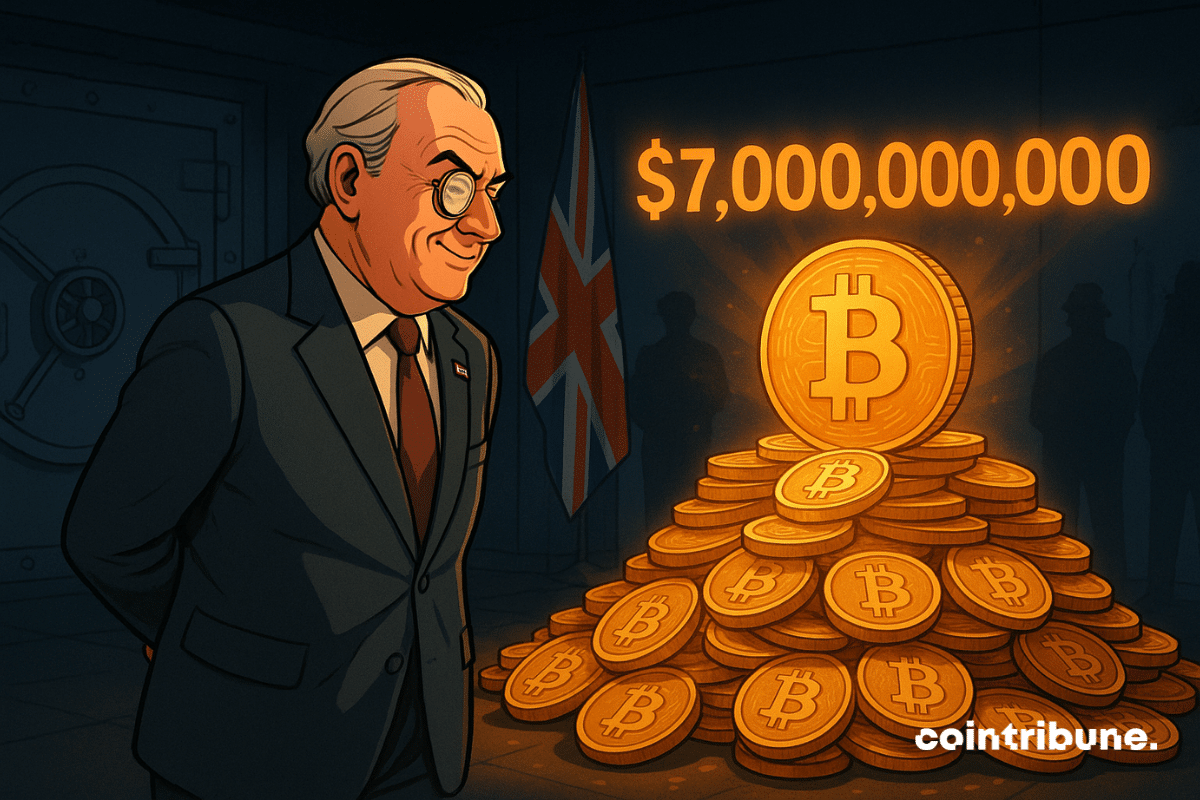
The error is to sell. Buying at the bottom has become a mantra in the crypto world. The mistakes spent around Bitcoin served as a lesson: the United Kingdom seems to want to never give in what is now called “digital gold”. Faced with the rise of cryptocurrencies and their volatility, London adopts a firm posture: regardless of pressures, we no longer liquidate. This refusal to liquidate reveals a strong political and symbolic ambition in the world game around the BTC.
In short
- The United Kingdom holds 61,000 BTC seized during massive fraud of Chinese origin.
- The victims, 128,000 people, demand the complete restitution in Bitcoin, not in book.
- The authorities are considering a partial redistribution, based on the initial value of losses.
- A legal battle undertakes, which can last until 2027 according to the lawyers of the victims.
The ascent of “Bitcoin Queen” and record entry
Even before the Qian affair, sentimental scams linked to Bitcoin multiply: a man recently lost $ 1.4 million in crypto, believing that he had found love. This story starts in China, between 2014 and 2017: Zhimin Qian is launching a gigantic scam, promising swollen yields to thousands of investors.
The diagram collapses. Qian converts the funds into Bitcoin then fled to the United Kingdom, with false papers.
In Hampstead, in 2018, the police discovered 61,000 BTC in digital devicesa seizure that the British press describes as greater Crypto operation ever made.
Judged in September 2025 in London, Qian pleaded guilty of possession and transfer of criminal goods – without the heart of fraud, operated in China, be judged directly. There remains a future civil trial, scheduled for January 2026, opposing the United Kingdom and the 128,000 Chinese victims.
The stake? Know if London can legally keep or restore BTC. This case, halfway between digital thriller and global case law, questions the ability of states to deal with crypto crimes in legal gray areas.
State VS Victims: Battle on rights and profit
The heart of the case is legal: to whom should the Bitcoins seized? The United Kingdom claims to rely on the law of criminal goods to retain them. However, many specialized lawyers recall the principle of fair tracing, which allows victims to establish a property link and recover stolen assets.
Ashley Fairbrother said in the media:
I am not sure that English law is on the side of the British government as to its ability to maintain Bitcoin seized.
Something bells, because the state often offers to reimburse the original value of fraud in trustee, not the current value of the BTC, which makes the victims lose billions of capital gains.
If the Court accepts this mechanism, the United Kingdom would capture the difference, capitalizing on the growth of Bitcoin over the years. The victims claim the return of the BTC, valued today, not only the initial amount. The civil court will have to decide between the national budgetary interest and an international justice of equity.
The precedent could influence how other states treat crypto cross -border seizures in the future.
The United Kingdom anticipates after sale: strategic and symbolic posture
Selling these bitcoins is said to deny the market lesson: keeping it is better. The United Kingdom shows thatHe prefers to keep this digital capital intact Rather than selling it. This choice is a symbolic power posture as much as economic. London is positioned as a major player in global crypto regulation.
Here are some significant facts:
- 61,000 BTC seized in Hampstead – the largest unique seizure in the United Kingdom;
- 128,000 victims claim their rights to the British state;
- The current value largely exceeds the initial amount of losses (~ £ 5 billion);
- The civil trial will open in January 2026.
This conservatism is part of a strategy: do not give in to the market, impose jurisprudence. The United Kingdom tries to set a standard: when a state enters cryptos, it does not sell them immediately, it keeps them as strategic active. This positioning could inspire other nations to act in the same way.
In the United States, we are no longer talking about selling BTC since the arrival of Donald Trump. His government retains its digital assets. Better still: his Minister Scott Bessent claims that the purchase of new bitcoins by the USA is not excluded. A sign that, for some, the strategy is not only to hold but also to strengthen the reserves.
Maximize your Cointribne experience with our 'Read to Earn' program! For each article you read, earn points and access exclusive rewards. Sign up now and start accumulating advantages.