
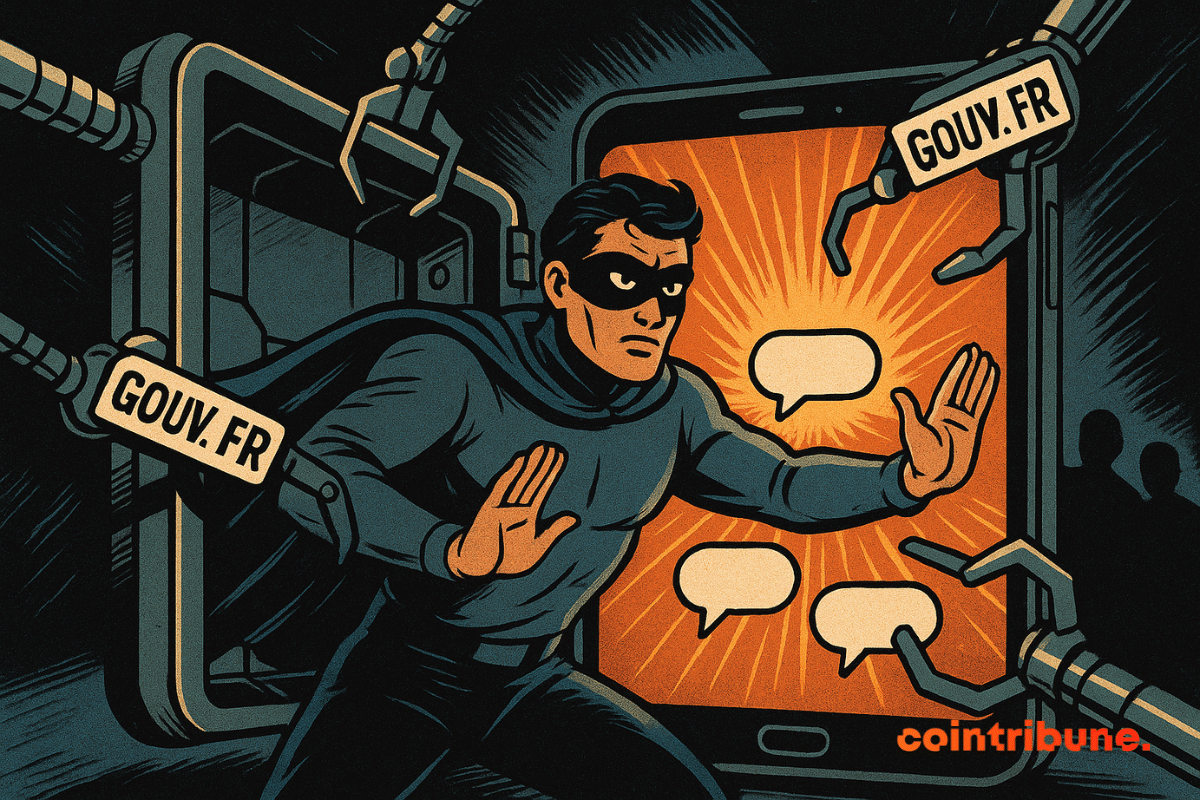
Pavel Durov comes out of silence and strikes hard. The founder of Telegram claims that the French intelligence services tried to force him to censor political content linked to the Moldovan elections. A revelation that revives tensions between the messaging platform and the French authorities. The case takes a disturbing turn for freedom of expression in Europe.
In short
- Pavel Durov accuses the French intelligence services of having demanded the censorship of content related to the Moldavian elections.
- Telegram refused to suppress legitimate political channels, despite promises of judicial “arrangements”.
- This affair is part of a wider showdown between technological platforms and European governments on information control.
- Durov remains under judicial supervision in France since his arrest in August 2024, without the date of appeal fixed.
A blackmail disguised as judicial cooperation
Pavel Durov published on Telegram on Sunday explosive revelations. According to him, the French intelligence services would have asked him to censor content linked to the Moldovan elections, in exchange for “good things” promised to the judge in charge of his trial. For the founder of Telegram, it is neither more nor less than blackmail.
At first, the platform had agreed to withdraw certain publications which clearly violated its conditions of use. Nothing abnormal at this stage. But very quickly, the French authorities returned with a second list of Moldovan channels to make disappear. And there, the scenario changes at all.
Shortly after, the Telegram team received a second list of so -called “problematic” Moldovan channels. Unlike the first, almost all of these channels were legitimate and entirely in accordance with our rules.
Durov
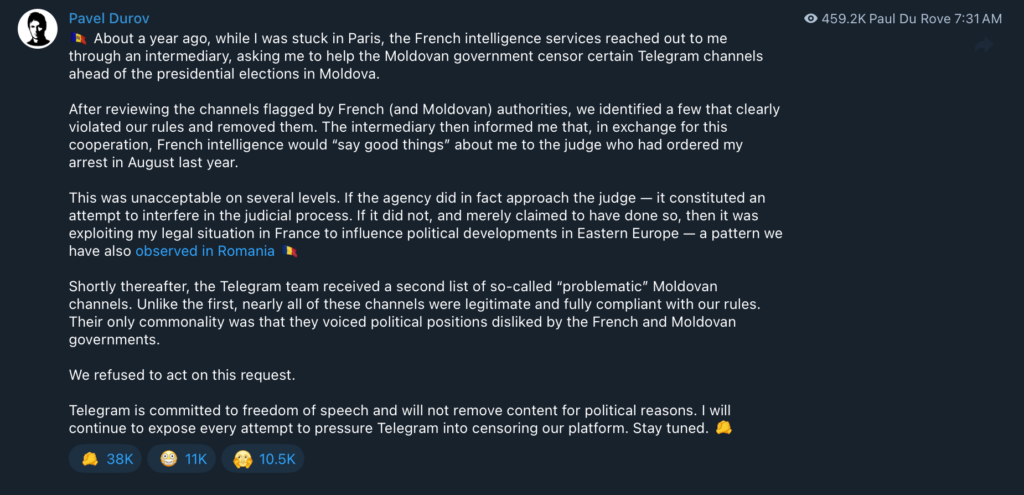
Their only common point? They brought political opinions that displeased French and Moldovan governments. Faced with a request deemed arbitrary and purely political, Telegram categorically refused.
This Moldavian affair is not an isolated case. Last May, Durov had already denounced similar pressures concerning the Romanian elections. What sketch a disturbing scheme: that of a broader information control strategy by certain European states, to the detriment of freedom of expression.
Telegram, last bastion of freedom of expression?
Since his arrest in Paris in August 2024, Pavel Durov has established himself as a figurehead of the digital resistance. A year later, the French investigation stagnates: no evidence was found against him, but he remains subject to an obligation to present himself in France every fourteen days. A judicial control which, according to his support, is increasingly similar to administrative harassment.
The founder of Telegram does not mince his words. “” We cannot “defend democracy” by destroying democracy. We cannot “fight against electoral interference” by interfering with the elections. “, he insisted.
In his eyes, the pressures exerted to censor content is much more serious electoral interference than that which the authorities claim to fight. This paradox, he underlines, directly mine the credibility of France on the international scene.
Faced with this situation, the Crypto community and the defenders of digital freedoms have largely stored behind Durov. Telegram is no longer just an encrypted messaging: the platform has become a symbol of resistance to authoritarian drifts in the digital age. A fight that goes far beyond the person of its founder to touch the very foundations of freedom of expression in Europe.
The European context strengthens these concerns. In June 2025, a European Union proposal aimed at monitoring all communications, including encrypted messages, obtained support from nineteen Member States.
Telegram, for its part, categorically refuses to open a stolen door or to deliver its encryption keys. And Durov warns: rather than yielding, the platform will not hesitate to leave certain jurisdictions, including France.
A battle that shapes the European digital future
Pavel Durov's warnings resonate with particular intensity. Last June, he claimed that France “rushes towards a societal collapse” due to state censorship and the policies deemed ineffective of the government.
Radical remarks, of course, but which find an increasing echo among many observers concerned with the evolution of the political and digital climate.
Digital Services Act (DSA), presented by Brussels as an instrument to combat disinformation, appears in the eyes of Durov as an existential threat.
Behind the displayed protection of users, he sees the implementation of a centralized ideological control. Risk? Top Europe to a two -speed internet: on the one hand, content validated by states; On the other, the dissenting voices marginalized.
The Telegram-France affair highlights a deep fracture. On the one hand, the technological platforms that defend encryption and freedom of expression.
On the other, governments that invoke public security to justify ever more intrusive surveillance. Between these two poles, millions of users whose privacy becomes the object of a political and geopolitical confrontation.
Faced with this pressure, Durov remains firm: Telegram will not fold. The platform publishes transparency reports on deleted content every day and collaborates with NGOs to respond to emergencies. However, she categorically refuses to transform into a tool for political censorship at the service of states.
Maximize your Cointribne experience with our 'Read to Earn' program! For each article you read, earn points and access exclusive rewards. Sign up now and start accumulating advantages.


