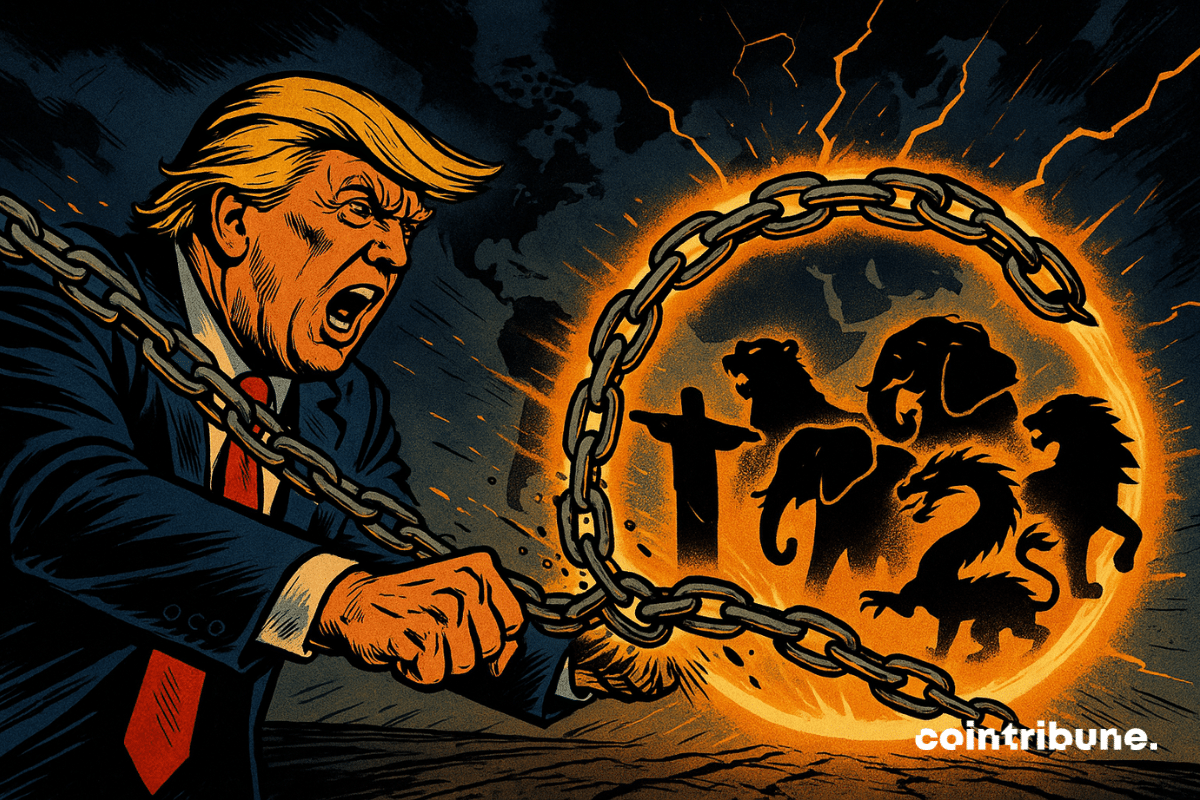
By trying to isolate his rivals, Donald Trump could well obtain the opposite effect. Under pressure from its commercial sanctions, the countries of the BRICS Bloc, long divided, are initiating an unprecedented strategic rapprochement. As tensions go up, China, India, Russia and their partners seem more inclined than ever to cooperate on the economic and diplomatic levels.
In short
- Donald Trump imposes severe commercial sanctions on the countries of the BRICS, with records of customs records up to 145 % for China.
- These measures create common ground between the members of the BRICS, who react by a coordinated strategy to reduce their dependence on the dollar.
- China, India and Russia are preparing to hold an unprecedented trilateral summit for six years, in a context of increasing tensions with the United States.
- Despite persistent disputes, especially between India and China, the BRICS develop pragmatic cooperation in trade and strategic resources.
A pricing pressure that welds the BRICS
Since his return to the White House, Donald Trump has chosen to head on the BRICS by an aggressive trade policy, marked by unrivaled customs duties. The figures speak for themselves and illustrate a resolutely punitive strategy:
- China was threatened with a rate of 145 % if no compromise was found with Washington;
- India is struck by a customs right of 50 %, half of which is specifically linked to the purchase of Russian oil at reduced prices;
- Brazil is also subject to 50 % customs taxes on certain exports;
- South Africa undergoes a levy of 30 %, despite its low direct commercial exposure to the United States;
- Egypt, a new entering the BRICS block, could see its taxes simply increase due to its participation in the group.
Ajay Srivastava, former senior Indian trade official, underlines that these sanctions only eat a common front: “They give them a common incentive to reduce their dependence in the United States, even if their agendas differ”.
Faced with this external pressure, the countries of the BRICS Alliance react in a convergent way. The group's central banks have strengthened their gold purchases, and the bilateral trade agreements in national currencies (Yuan, Roupie, Rouble) are multiplying. This dynamic, formerly sporadic, now takes the form of an assumed strategy to reduce dependence on the US dollar.
Pragmatic cooperation despite internal tensions
While trade tensions with the United States are intensifying, the leaders of the main members of the BRICs are preparing to display its unit during the Shanghai cooperation organization (OCS), which will be held in Tianjin, China.
For the first time in six years, a trilateral summit between China, India and Russia is envisaged. The Kremlin grows in this direction, hoping “Strengthen the heart of the Alliance des Brics” And soothe the historical tensions between New Delhi and Beijing. This is an assumed attempt to consolidate the group's hard core in the face of Western pressure.
This initiative is coupled with bilateral relaxation signals. Beijing and New Delhi, long in disagreement on their 3,500 -kilometer border, once again opened direct flights, facilitated access to visas and engaged discussions on rare land supply, a sector in which China holds more than 85 % of the global processing capacity.
During an official visit, Chinese Foreign Minister Wang Yi confirmed that China undertook to strengthen its deliveries to India, essential for its defense and energy transition industries.
Nevertheless, distrust persists, especially due to the proximity between Beijing and Islamabad, as well as the controversial Chinese dam project on the Tibetan set, which worries New Delhi. This geopolitical complexity limits the scope of a real rapprochement, especially since India continues to massively depend on the American market, with $ 77.5 billion in exports to the United States in 2024, against much lower volumes towards China or Russia.
However, beyond tensions, a pragmatic logic seems to emerge. BRICS are no longer a simple ideological platform. The block becomes a variable geometry cooperation space, focused on trade, finance and supply chains. Thus, local currency settlement projects, the campaigns “BUY BRICS” And the ambitions of reforming global governance (in particular via the WTO) testify to this. If the BRICE single currency project is on a break, alternatives to the dollar take shape.
Maximize your Cointribne experience with our 'Read to Earn' program! For each article you read, earn points and access exclusive rewards. Sign up now and start accumulating advantages.