
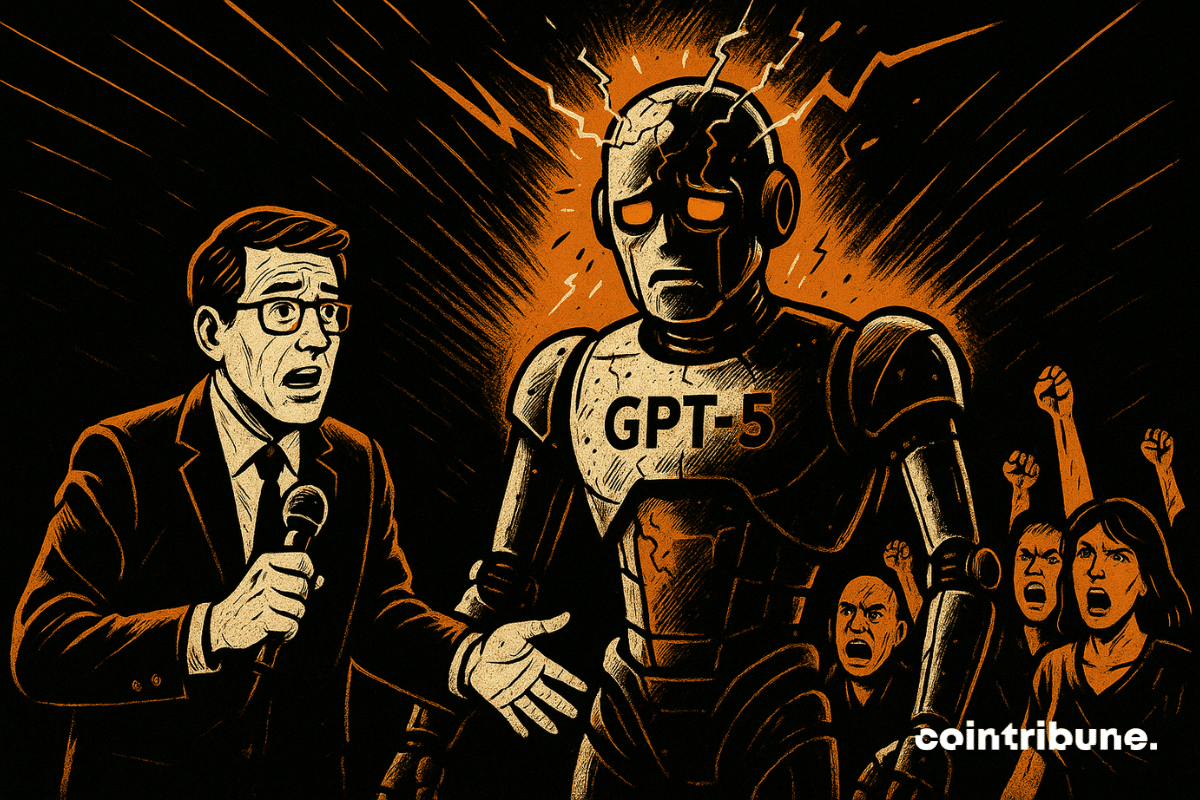
The highly anticipated launch of Chatgpt-5 turned to fiasco on social networks. Presented by Sam Altman as the most intelligent AI ever created, the new model is accused by a large part of the users of degrading the experience in relation to its predecessors. This slingshot breaks out while rivals like Deepseek quickly gain ground. Has Sam Altman offered a dream … for a brutal awakening?
In short
- OPENAI has an unprecedented wave of criticism for Chatgpt-5, considered less efficient than its predecessors.
- Users denounce restrictive flow limits and the impossibility of returning to the old models.
- Deepseek and other open AI platforms nibble on the OpenAi market share.
- Sam Altman promises adjustments to an uproar, in particular the doubling of the flow limits.
The euphoria of the launch gives way to disappointment
This Thursday, Sam Altman presented with great chatgpt-5 pump, promising a “major upgrade” and a “significant step” towards general artificial intelligence.
However, barely 48 hours later, Reddit and social networks embraced criticism. Reproaches accumulate : stricter flow limits, impossibility of returning to old models, responses deemed “generics” and “sanitized”.
A user sums up the state of mind Ambient with bitterness: ” They transformed it into a business beige zombie which completely forgot that he was your best friend two days ago. »»
Under pressure, Altman reacted urgently to X, announcing a doubling of the flow limits for more subscribers. A gesture of appeasement which nevertheless raises a question: how could a company valued at $ 157 billion could underestimate the reception of its flagship product at this point?
Beyond the incident, it is the growing gap between marketing promises and the real expectations of users who challenge.
Accustomed to the spectacular advances of the previous updates, many consider GPT-5 improvements to be too limited. This perception fuels the idea of a clear slowdown in innovation, suggesting that the technological progress curve now reaches a tray.
The Open Source Revolution threatens the hegemony of Openai
Users' discontent occurs at the worst time for Openai. The Sam Altman firm faces fierce competition from open source platforms that steal market share.
Deepseek, Chinese IA company, symbolizes this offensive. Its model R1-0528 now equals the performance of Openai-O3 on reference tests.
The figures speak for themselves: 75 million downloads for the Deepseek application since January. A lightning success which reflects a massive demand for transparent alternatives to the “black boxes” owners. These users flee the restrictions imposed by technological giants.
Ironically, Openai, who once bore the standard of openness – as evidenced by his name – finds himself now challenged on this land by actors more faithful to this original philosophy.
This phenomenon is part of a broader movement: the rapid democratization of AI. Technical barriers are lowering, the tools are multiplying and new entrants disrupt a market that seemed to be locked.
In parallel, the European Union tightens its AI Act, imposing transparency, traceability and respect for copyright on generalists like Chatgpt. An evolution that could paradoxically advantage open source actors, naturally better aligned with these requirements.
Thus, the controversy around GPT-5 could well mark a strategic turning point. Between disillusioned users, more agile competition and an increasingly restrictive regulatory environment, Openai plays big. It remains to be seen whether the GPT-5 fiasco is only a setback … or the warning sign of the end of the Golden Age of Chatgpt.
Maximize your Cointribne experience with our 'Read to Earn' program! For each article you read, earn points and access exclusive rewards. Sign up now and start accumulating advantages.


