American inflation challenged all catastrophist predictions in April, falling at 2.3 % despite the entry into force of massive customs tariffs from the Trump administration. This unexpected drop raises a disturbing question: what if analysts had dramatized the impact of protectionist measures? Are the fears of an inflationary spiral exaggerated?
In short
- Inflation fell to 2.3 % in April against 2.4 % in March, its lowest level since 2021.
- Trump's customs tariffs have not yet produced the anticipated inflationary effect.
- Trade agreements with China and the United Kingdom could reduce impacts.
- Experts provide more marked effects in the coming months.
American inflation decreasing despite Trump customs tariffs
The American labor statistics office published data on May 13 that make prophets of misfortune blush: American inflation slowed down for the third consecutive month, going from 2.4 % in March to 2.3 % in April.
This drop has been the lowest increase since February 2021 and paradoxically brings the US economy closer to the target of 2 % set by the Federal Reserve, precisely at the time when all predicted the opposite.
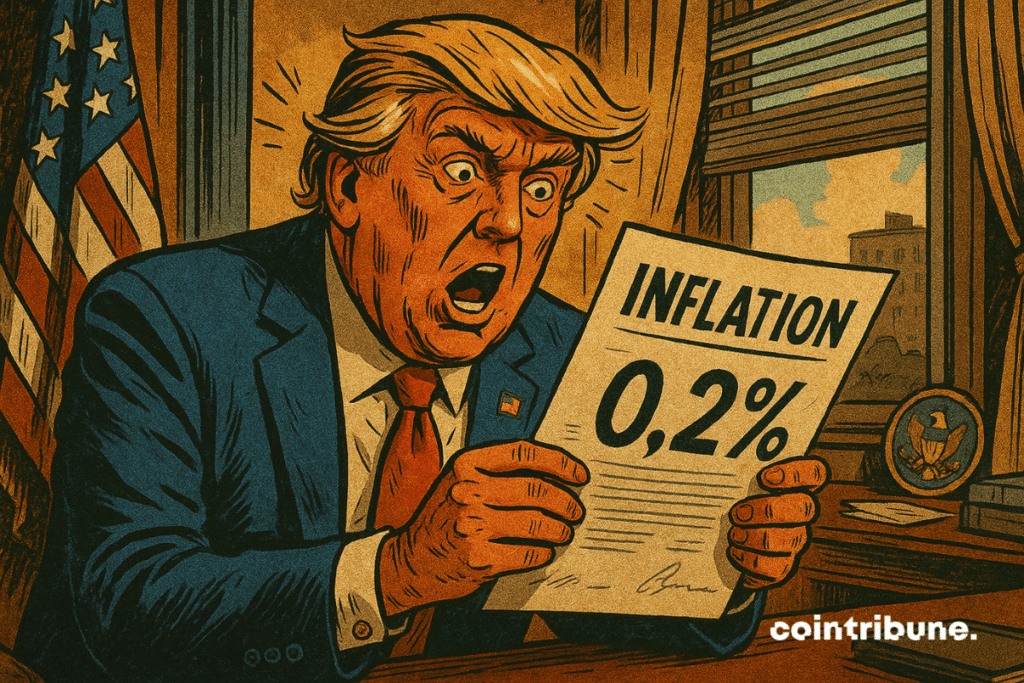
The Consumer Price Index (IPC) only increased by 0.2 % in April compared to March, while economists, convinced of an immediate Trump effect, tapped on an increase of 0.3 %.
Even more surprising, the basic IPC, which excludes volatile components such as food and energy, has also increased to an increase of 0.2 %, defying all predictions.
This lull, however, hides contrasting sectoral developments. Food prices fell 0.1 %, a first since 2020, while energy rebounded by 0.7 % after dropping 2.4 % in the previous month. The housing, heavy goods vehicles of the IPC, maintains a stable annual increase of 4 %.
Delayed, but inevitable effects?
Faced with these embarrassing figures, analysts are looking for explanations to save their alarmist forecasts.
In early April, the American president had effectively implemented a reference rate of 10 % on most imports, with rights of 145 % on Chinese products and 25 % on the automobile, steel and aluminum.
Beichen Lin, senior strategist at Russell Investments, tries to justify The gap:
Companies have probably made up stocks before the prices are entry into force, which delays their impact on inflation.
A practical excuse taken up by UBS, which now repels its catastrophic predictions between May and October.
Meanwhile, commercial negotiations are progressing. An agreement with China provides for a mutual reduction in prices of 115 points for 90 days, while arrangement with the United Kingdom exempts certain strategic sectors, suggesting a more nuanced approach than the announced apocalypse.
JPMorgan had also sounded alarm, increasing the probability of global recession to 60 %. The bank estimates that these protectionist measures will cost $ 700 billion to American consumers, equivalent to 2.4 % of GDP.
The American economy seems to resist the darkest predictions: an inflation that slows against all expectations and customs tariffs whose apocalyptic effects are always expected.
This lull may only be temporary, leaving the expectations in the expectation of the next decisions of the Fed and the evolution of international trade negotiations. Only the coming months will reveal whether this resilience continues or if the delayed impacts end up materializing.
Maximize your Cointribne experience with our 'Read to Earn' program! For each article you read, earn points and access exclusive rewards. Sign up now and start accumulating advantages.