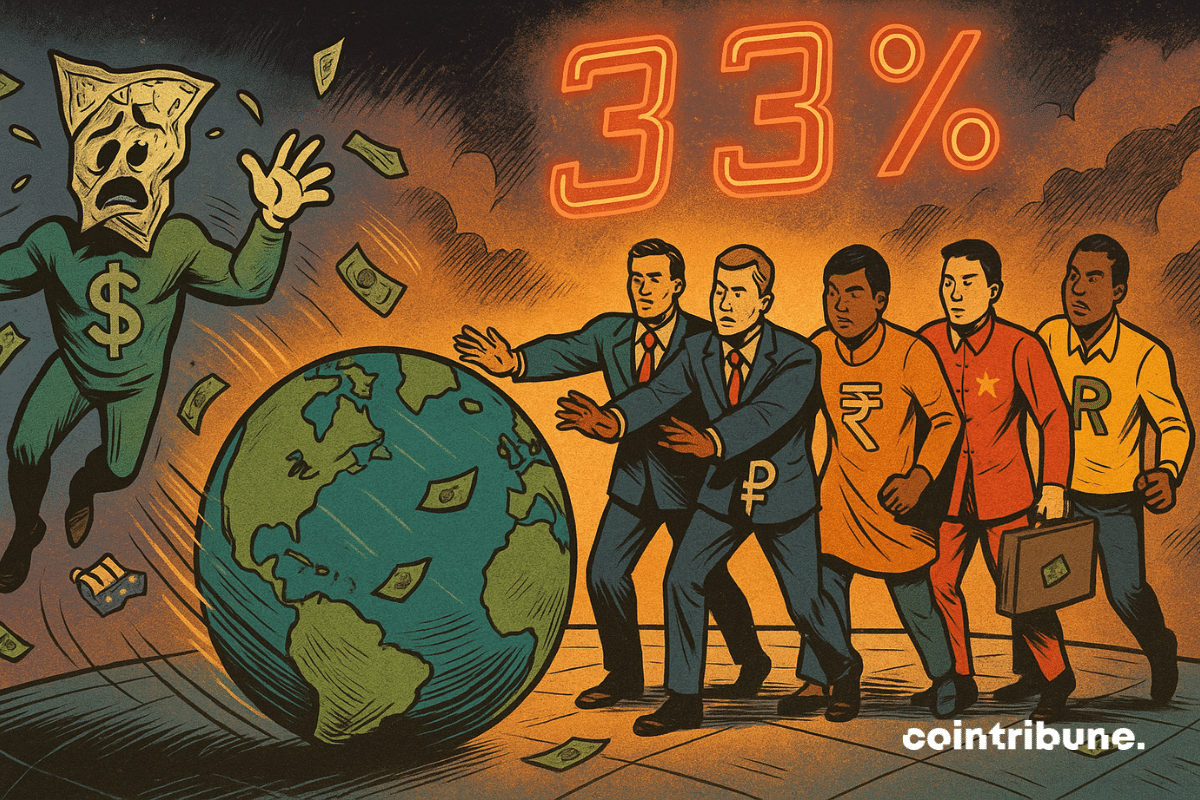
World monetary architecture vacillates on its foundations. By reducing the dollar share in their exchanges to 33 %, the BRICS acts a historic rupture. Their trade is now based mainly on their own currencies. Behind this tilting, an assumed strategy, that of fragmenting a system dominated by the greenback. It is no longer an intention, it is a movement in progress. And it redraws the balances of a financial order so far under the influence of Washington.
In short
- The BRICS cross a historic CAP announcing that only 33 % of their trade is still made in dollars.
- Sergei Lavrov, Russian Minister of Foreign Affairs, says that 67 % of intra-bric transactions are now in local currencies.
- The block is not content to exchange without dollar, but it also develops its own financial tools to strengthen its autonomy.
- These initiatives could accelerate the fragmentation of the global monetary system and further weaken the dominant position of the dollar.
The dollar fell against local currencies in intra-bric trade
Sergei Lavrov, Russian Minister of Foreign Affairs, said that “National currencies now represent more than 65 % of trade within the BRICS”. In addition, he add that “The dollar share fell to a third party”.
In other words, 67 % of intra-brick transactions are now settled in local currencies. This figure, unambiguously revealed, illustrates a methodical tilting in the group's business practices, and gives body to the dedollarization project carried for a long time by its members.
The data put forward by Lavrov confirm an economic realignment which is based on several concrete pillars:
- The reinforced economic weight of the BRICS: these savings now have a combined GDP greater than that of the G7 in purchasing power parity.
- A diversification of reserves: China, Russia and Brazil have significantly reduced their dependence on American treasury bills.
- The climb of the yuan in payments: Chinese currency would represent 24 % of trade regulations in 2025.
- The strategic role of resources: control of raw materials like oil (Brent) gives a lever for members.
- An assumed political positioning: dedollarization is no longer a defensive posture, but an assertive and collective strategy.
Through these data, it is no longer a simple diplomatic intention, but a current economic process that the BRICS assume with an open face.
New financial infrastructure to consolidate dedollarization
Beyond trade flows, it is on the institutional field that the BRICS now seem to concentrate their efforts. Indeed, during a recent ministerial meeting, the block formalized its intention to “Strengthen the use of local currencies in commercial and financial regulations with the BRICS partners”.
The press release also specifies that the ministers have underlines “The importance of continuously extending funding in local currencies”, which has thus marked the desire to structure an internal financial ecosystem, freed from the dollar.
In parallel, they mentioned during discussions the creation of a new investment tool intended to energize the flows of capital to member economies. The objective is double: to reduce dependence on the Western financial system while promoting the development of a common platform capable of supporting the emergence of a multipolar financial order.
This initiative, although technical, illustrates the transition from a phase of intention to that of concrete implementation. The top of the brics planned for 2025 should specify these projects, in particular a possible advance towards a common stablecoin.
This approach could ultimately reshape the global financial hierarchy. By consolidating their own infrastructure of regulations and financing, the BRICS open up to a monetary autonomy trajectory which could seduce other emerging countries. If this strategy were to be extended to new members or business partners, the United States could see its international financial lever further. The next decade could well seal the evolution of a more fragmented monetary system, in which the dollar would no longer necessarily be the only reference.
Maximize your Cointribne experience with our 'Read to Earn' program! For each article you read, earn points and access exclusive rewards. Sign up now and start accumulating advantages.