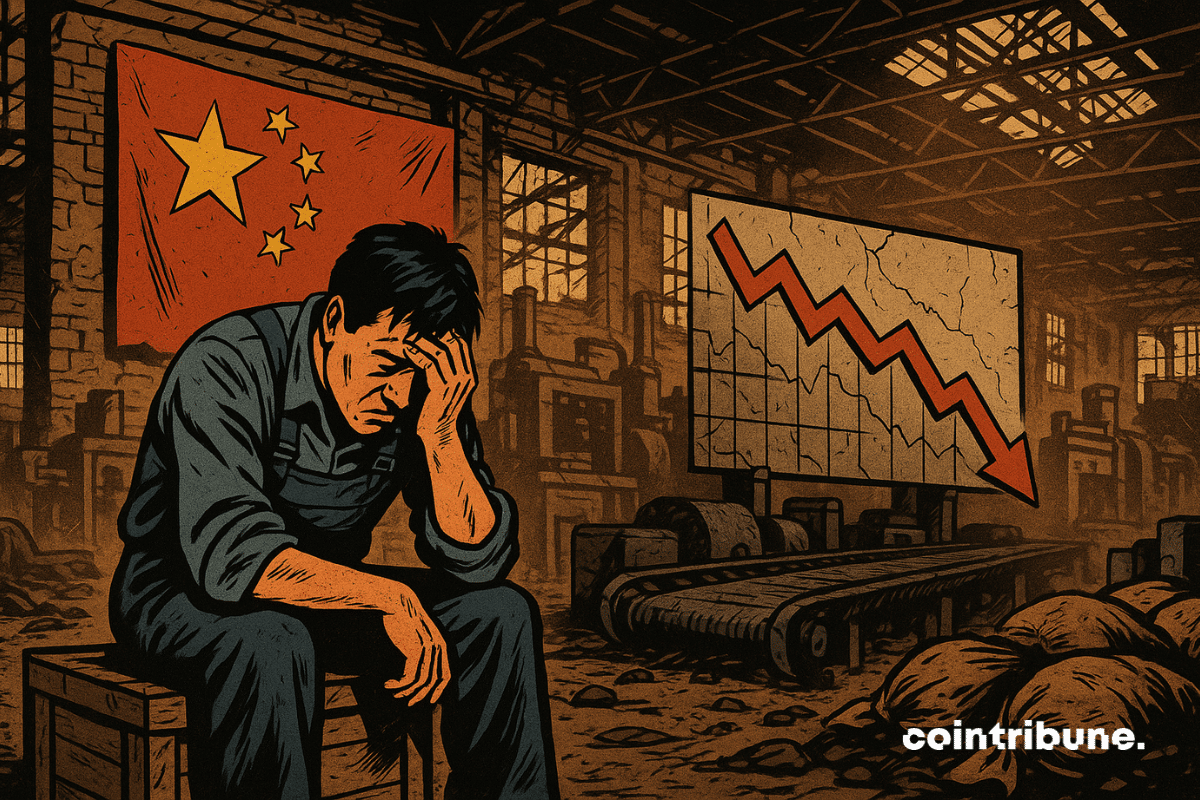
Chinese industry shows signs of weakness. For the first time in more than a year, the country's manufacturing activity has contracted, according to the latest figures from the National Statistics Bureau. Indeed, the new American tariff offensive relaunched by Donald Trump, with customs duties up to 145 %, begins by producing its effects. In Wall Street as in Beijing, worry climbs. This commercial show between the two powers awakens fears of a global slowdown to systemic consequences.
In short
- The trade war relaunched by Donald Trump already weakens the Chinese economy, with 145 %massive customs measures.
- The PMI Manufacturing index of China fell to 49 in April 2025, a sign of a contraction in industrial activity for the first time in more than a year.
- Other indicators, such as the PMI of services and growth forecasts, confirm a generalized economic slowdown.
- China adopts a hard line against the United States, accentuating its economic isolation instead of seeking appeasement.
Chinese pressure industry
The first figures fell as an alert on the markets. Indeed, the PMI Manufacturer index of China was 49 in April, against 50.5 in March. A threshold of less than 50 indicates a contraction of industrial activity.
According to the National Statistics Office, this drop is awarded to a high comparison base and “Brutal changes in the external environment”. It is the highest contraction recorded since December 2023, an inflection that coincides with the offensive return of American protectionist measures.
Washington has indeed imposed 145 % prohibitive customs duties on the majority of Chinese products. Although certain sectors such as electronics and imports of steel and aluminum for the automobile have been exempt, the political message is clear: the revival of hard economic nationalism, with the frontal target China.
This manufacturer withdrawal is part of a globally tense economic climate. The data reveal a greater slowdown than the only industrial sector. Among the notable elements, there is in particular:
- The non-manipoturizing PMI index, which measures the service sector, fell to 50.4 in April, against 50.8 in March, which signals a quasi-vastness in this area too;
- Société Générale anticipates a 70 % drop in Chinese exports to the United States, which represents a direct negative shock of 2 % on GDP;
- Oxford Economics believes that “The impact of customs tariffs means that China's growth objective is no longer achievable”;
- UBS and Goldman Sachs banks lowered their growth forecasts for China in 2025 to around 4 %, while Beijing officially targets 5 %.
These figures draw the portrait of a deep slowdown, amplified by sustainable trade tensions, and make fear a loss of competitiveness for the Chinese economy.
A shy response from Beijing, between political resistances and targeted measures
While the indicators sink into the red, Beijing's reaction remains measured, almost cautious. The Chinese government announced this week targeted measures to support exporting companies in difficulty, in particular by easy access to credit and by incentives for domestic consumption.
However, no massive recovery initiative has been revealed. Ting lu, chief economist for China at Nomura, a declared ::
We believe that Beijing must take more daring measures.
In a recent note, he calls for confronting the structural challenges that are “The collapse of the real estate market, the reform of the pension system, and the improvement of international relations”. For the moment, central power seems to want to delay, and favors resilience to frontal intervention.
On the diplomatic level, Beijing adopts an offensive posture. The Minister of Foreign Affairs Wang Yi warned international partners against any convenience in the face of Washington's pricing pressure. “Giving in to customs customs hours would only bare the tyrant”he launched.
This speech highlights a refusal to give in to American requirements, but also a form of growing isolation. By refusing to open the way for commercial negotiations, China could worsen an economic isolation already noticeable in the markets.
This firmness posture has heavy implications, both in the short term and medium term. If Beijing continues to exclude a massive revival and refuses to soften its diplomatic positions, the risk is that of prolonged slowdown and a loss of confidence of investors. In such a climate, capital flows could turn away from traditional Chinese assets. Some analysts already believe that this instability could indirectly strengthen the attraction of cryptos, considered by part of the market as an alternative to increasing monetary and geopolitical tensions.
Maximize your Cointribne experience with our 'Read to Earn' program! For each article you read, earn points and access exclusive rewards. Sign up now and start accumulating advantages.