

The first 100 days of the Trump administration have deeply marked the cryptocurrency industry. Between appointments favorable to the sector, the creation of a Bitcoin strategic reserve and a trade war with important consequences, the balance sheet remains contrasting according to the experts, some even qualifying this period of “95 worst days of modern presidential history”.
In short
- Trump has created a Bitcoin Strategic Reserve, but only with crypto-active in legal operations
- The World Trade War launched by Trump caused market instability, also affecting the crypto sector
- Many Pro-Crypto appointments have taken place in key government agencies such as dry and CFTC
Concrete actions for American crypto industry
From his inauguration on January 20, Trump made the Crypto sector a priority. He appointed several personalities favorable to cryptos in strategic positions, including Paul Atkins to the dry to replace Gary Gensler, considered hostile to industry.
David Sacks was appointed “Tsar of the crypto and the AI”, while Brian Quintenz took the head of the CFTC.
The creation of an internal working group dedicated to cryptos by presidential decree marked the desire to make the United States “the world capital of cryptos”.
This same decree has prohibited the establishment of a digital central bank currency (MNBC), a controversial subject in the Crypto community which sees it as a risk of increased state surveillance.
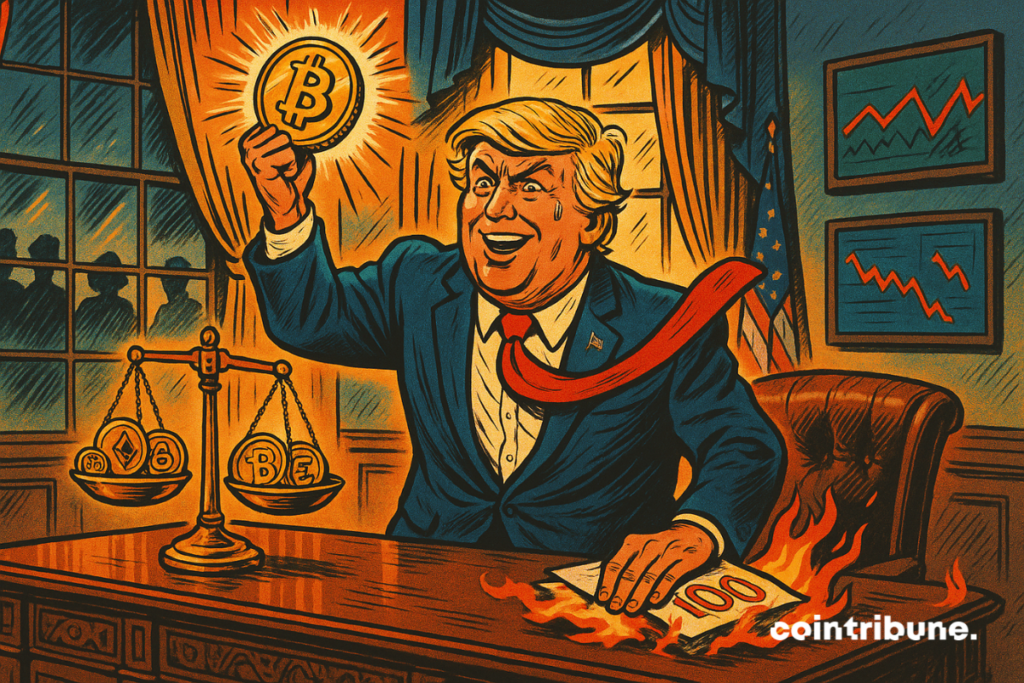
On March 7, Trump materialized one of his campaign promises by creating a “Bitcoin strategic reserve”.
However, this initiative has proven to be less ambitious than expected: instead of direct Bitcoin purchasing by the government, the reserve will be content to group the cryptos entered during legal operations, with the possibility of additional purchases only if they remain “neutral on the budgetary level”.
A trade war with heavy consequences for the market
Trump's aggressive commercial policy has significantly impacted the Crypto sector. In early February, the announcement of drastic customs duties in Canada, Mexico and China caused a first drop in markets.
This situation worsened on April 2 with the “Liberation Day”, when Trump imposed customs duties of at least 10% on all trade partners in the United States.
This policy led to a general fall in markets and raised concerns about an imminent recession.
Anthony Scaramucci, former director of communication for the White House, has estimated that “the scholarship has lost $ 9,000 billion” and that the economy “is now heading towards a recession on average, or even a deep recession”.
American bitcoin minors are particularly affected by the increase in operating costs, in particular for the purchase of new mining platforms, now subject to high customs duties. This situation compromises their profitability in a context where international competition remains strong.
Ethical controversies that weaken legislative advances
Trump's personal ties with crypto industry are raising strong controversy. The WLFI family project raised ethical questions, especially after the announcement of a Stablecoin USD1 on March 25, a few days after raising more than $ 500 million.
American legislators asked for an investigation, citing a conflict of interest between the presidential function and this financial project.
The situation worsened on April 25 with rumors that the main holders of the same Trump could dine with the president for $ 300,000. Although denied by the administration, these allegations pushed the Democratic Senator Jon Ossoff to “firmly” support the dismissal of the president.
According to Scaramucci, these controversies compromise the legislative efforts in the sector:
Trump has ignited all this so much that he made the implementation of stablecoins legislation even more difficult.
Despite everything, advances are notable, such as the stable law passed in committee on April 3, which is now awaiting a general vote before being transmitted to the Senate.
In short, despite ambitious promises and concrete measures, the first 100 days of Trump have a contrasting assessment for the crypto industry. If the administration has laid important milestones for the development of the sector, the ethical controversies and the consequences of the trade war weaken these advances and raise concerns for the future.
Maximize your Cointribne experience with our 'Read to Earn' program! For each article you read, earn points and access exclusive rewards. Sign up now and start accumulating advantages.


