
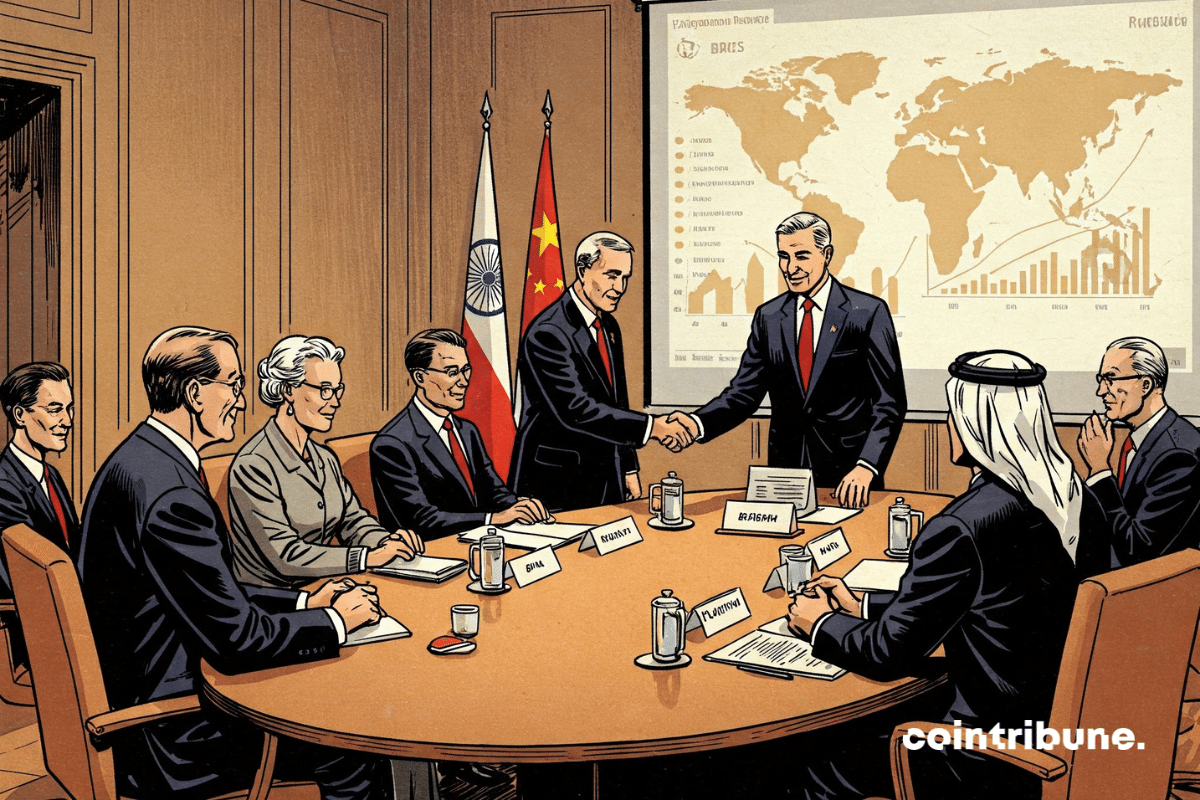
While economic sanctions were aimed at stifling Moscow, Russia recorded growth of 4.1 % in 2023. This figure, confirmed by the Russian authorities, upsets the certainties of Washington and its allies. In a climate of war in Ukraine and the recomposition of monetary alliances, the return in force of the Russian economy reveals an effective bypass strategy, carried by the BRICS. This data questions the effectiveness of Western sanctions and reshapes the cards of the geoeconomic game.
In short
- Russia surprises observers by posting economic growth of +4.1 % in 2023, despite the heavy sanctions imposed by the United States since 2022.
- The secretary of the Russian Security Council, Sergey Shoigu, says that this growth could reach 4.3 % in 2024, before a slowdown planned at 2.5 % in 2025.
- In response to sanctions, Russia has intensified its rapprochement with the BRICS and launched a strategy of dedollarization.
- This commercial realignment weakens the dollar and strengthens the position of the BRICS as a key player in the emergence of a new world monetary order.
Unexpected growth despite the sanctions
In a statement, the secretary of the Security Council of Russia, Sergey Shoigu, said that “The Russian economy has increased 4.1 % in the past two years”. According to his remarks, this ascending trajectory continues with an estimate of 4.3 % for the year 2024, while projections for 2025 anticipate a slowdown at 2.5 %.
This surprising performance comes in a context where the United States, supported by its Western allies, had imposed a series of heavy economic sanctions which aimed to strangle the Russian economy after the triggering of the war in Ukraine. However, these coercive measures seem to have had an opposite effect, which reveals an economy capable of resisting major external shocks.
Economic data confirm this robustness, especially in terms of foreign trade and financial stability. Shoigu underlines that Russia recorded in 2023 a massive trade surplus and significant growth of its exchanges:
- +3.8 billion dollars in foreign trade increase over one year;
- 716 billion dollars in total trade volume in 2023;
- 146 billion dollars of trade balance surplus;
- The reduction in external and internal debt confirmed by the Russian authorities;
- A banking system deemed ” resilient “ By Shoigu, despite the exclusion of Western financial networks.
Far from being marginal, this macroeconomic stability was accompanied by an effective internal reorganization, which has shown that Moscow has been able to anticipate and absorb the effects of sanctions. It thus poses a strategic challenge to the countries which tapped on a rapid deterioration of the Russian economy.
BRICS lever: a structured bypass strategy
In addition to this economic performance, it was in the commercial architecture of the BRICS that Russia has found a decisive relay. From the first waves of sanctions, Moscow accelerated its integration into the BRICS Alliance and implemented an assumed dedollarization strategy.
This initiative allowed Russia to continue its international exchanges via local currencies. Russia has rewritten its trade agreements in order to send and receive local currencies for cross -border transactions.
This reorientation was supported by partners such as China, India and Saudi Arabia, who saw in sanctions an opportunity to strengthen their own energy and financial autonomy.
India, for example, saved $ 7 billion in foreign currency by buying Russian oil at broken prices. As for Saudi Arabia, it imported Russian crude oil at a reduced price before redistributing it on the European market, thus garnering comfortable margins.
These practices, made possible by the absence of a dollar in transactions, bear witness to a progressive, but structured displacement, of the center of world monetary gravity. The Russian strategy has not only made it possible to bypass sanctions, it has also consolidated a multipolar dynamic where the BRICS are positioned in catalyst for new commercial standards.
In the medium term, this realignment could have repercussions on the currency markets, the stability of the international monetary system and even on the use of the dollar in global trade. While alternatives to the SWIFT system are under discussion, and that some members of the BRICS block experience their own payment infrastructure, the tendency to monetary fragmentation could accelerate. In this context, cryptos could establish themselves as parallel or transition instruments in economies in search of monetary independence.
Maximize your Cointribne experience with our 'Read to Earn' program! For each article you read, earn points and access exclusive rewards. Sign up now and start accumulating advantages.


