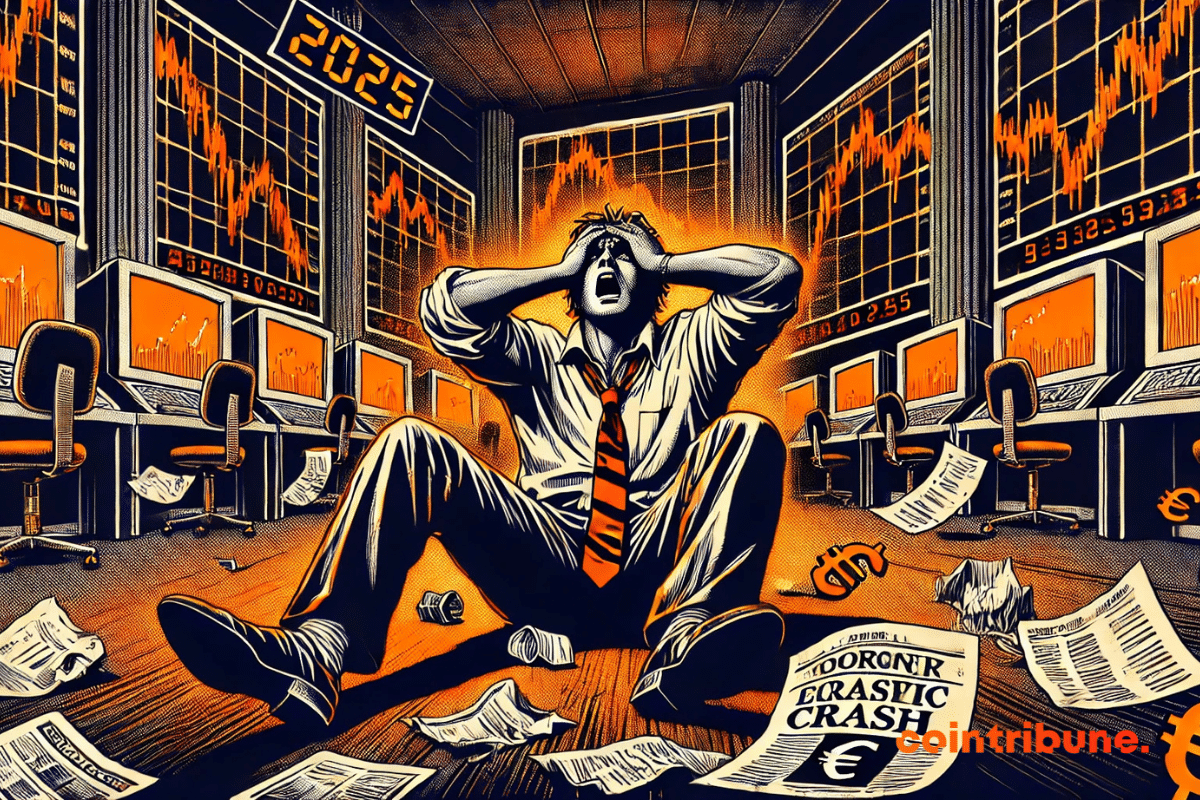
In April 2025, the International Monetary Fund (IMF) darkened the economic prospects of the United States with a brutal revision: growth projected at 1.8 %, against 2.7 % initially planned. This reversal, the most marked since the 2008 crisis, is not a simple technical adjustment. It reflects a conjunction of risks – commercial wars, tenacious inflation, dropping out of consumption – which threatens to redraw global economic balance. Behind these figures, an implacable observation: recent political decisions have precipitated a shock wave whose aftershocks could last.
In short
- In April 2025, the IMF strongly revised American growth downwards: 1.8 % against 2.7 % initially, an unprecedented fall since 2008.
- The trade war revived by Washington triggers a global domino effect.
- The spectrum of a recession is becoming clearer in the United States, with a probability of 40 % according to the IMF.
Customs war: the domino effect that shakes forecasts
On April 2, 2025, the announcement of reciprocal customs duties by the Trump administration acted as a detonator. In less than ten days, the IMF had to rewrite its projections – a process usually spread over two months.
“A major negative shock”according to The words of Pierre-Olivier Gourchaschief economist of the institution. The markets immediately reacted: the S&P 500 dived by 9 %, while the trade partners of the United States, from Europe to Asia, retaliated by symmetrical measures.
This protectionist escalation creates a vicious circle. Customs prices weigh down import costs, penalize companies dependent on globalized supply chains and slow the investment.
The IMF highlights a paradox: these measures, supposed to protect the national industry, could ultimately reduce the productivity of the American manufacturing sector. “A real depreciation of the dollar is not excluded”warns Gourinchas, evoking a structural weakening.
However, the impact is not limited to the United States. Global growth undergoes a downward revision, reaching 2.8 % (-0.5 point), revealing a worrying contagion.
The emerging countries, already weakened by a historically strong dollar, undergo a double pressure: slowdown in American demand and increases in currency loans. The alert IMF: this “improvised” trade war is likely to crystallize a new low growth diet.
Inflation: the thorny equation of central banks
In this volatile context, inflation becomes a headache. The IMF finds its forecasts for advanced economies at 2.5 % in 2025 (+0.4 point), with a 3 % peak in the United States. In question: the vigor of the prices of the services, the rise in basic goods and the direct effect of customs tariffs. “Tensions on logistical costs and raw materials are underestimated,” notes the April report.
Central banks find themselves trapped. If the prices are perceived as temporary, a drop in rates remains possible. But in the event of sustainability, the fight against inflation will require a monetary tightening, aggravating the slowdown. The IMF now estimates the risk of recession in the United States at 40 %-compared to 25 % six months earlier. A nightmarish scenario where stagflation and unemployment would progress together.
Ironically, the dollar-traditional haven of peace during periods of turbulence-has started an unprecedented depreciation since March 2025. A counter -intive dynamic, linked to doubts about the future competitiveness of the American economy. “” Exchange rates react less to commercial shocks than growth expectations ”Gourinchas analysis. For households, this drop in purchasing power is coupled with a crumbling of confidence. Indeed, the consumption index, pillar of the economy since 2020, shows signs of breathlessness.
The revision of the IMF is not limited to a statistical adjustment. It acts a change of era, where unilateral political choices can shake fragile economic balances. Between commercial wars, recalcitrant inflation and monetary uncertainties, the room for maneuver are reduced.
Will the coming months be decisive: will the United States manage to influence the curve without causing a brutal landing? The IMF, in any case, relies on caution – and recalls, in filigree, that today's decisions sculpt the crises of tomorrow.
Maximize your Cointribne experience with our 'Read to Earn' program! For each article you read, earn points and access exclusive rewards. Sign up now and start accumulating advantages.