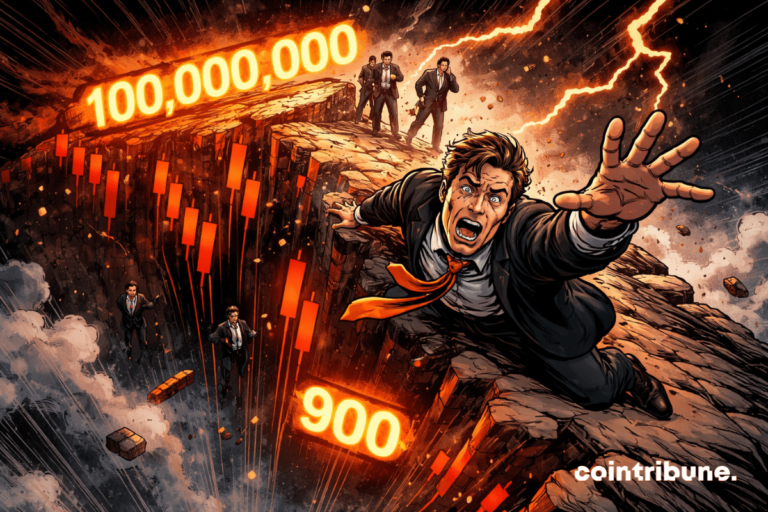
The recent taxation of massive customs duties by Donald Trump, followed by an unexpected break on certain Chinese products, plunged the financial markets into turmoil. What should be expected in the coming days?
In short
- On April 11, 2025, Donald Trump imposed customs duties of 145 % on Chinese products, causing a brutal fall in the markets.
- The Nasdaq lost 26 %, Tesla 56 % and Apple 35 %; American interest rates have climbed sharply.
- Faced with panic, Trump has suspended certain customs duties, especially on Chinese technological products.
- Some see it as an organized geopolitical strategy, others a retreat in the face of market pressure and the force of China.
- This sequence illustrates a switch to a multipolar world, where the United States could lose its economic hegemony.
Trump triggered the trade war
On April 11, 2025, Donald Trump sparked a shock wave by imposing customs duties from 145 % on Chinese products. This “Liberation Day”, as the Trump administration baptized it, officially aimed to rebalance trade and protect the American industry.
The reaction of the markets was immediate and brutal. The Nasdaq has dropped by 26 % from its highest, with particularly affected technological values: Tesla lost 56 % and Apple 35 %. At the same time, American interest rates have skyrocketed, going from 3.90 % to more than 4.60 % in a few weeks.
Faced with what some analysts already called “financial cataclys”, Trump announced a 90 -day break on customs duties for most countries that have initiated negotiations, with the notable exception of China. Then, in an unexpected reversal, He finally exempted smartphones, computers, electronic components and other Chinese technological products from new customs duties.
Has Trump 10 strokes ahead?
For some, these apparent reversals mask a shock strategy Perfectly controlled. The model would recall that of Colbert under Louis XIV, With the prices of 1664 and 1667, aimed at reorganizing the French commercial space then specifically targeting the rivals of the kingdom.
Trump would seek to set up a Reorganization of the World Economic Area Around the United States, with concentric circles: Conditional free trade with close allies, progressive customs duties for others, and quasi-Embargo for China. This structuring would prepare the ground for a confrontation.
The major innovation of this strategy would be the creation of a “External Revenue Service”, permanent tax system on a global scale. Trump himself would have mentioned that these countries should pay very significant sums annually. His advisor Stephen Miran also suggested that the allies could simply “Make checks” in the United States in exchange for privileged access to the American market.
This approach would reproduce Reagan's strategy against the USSR in the 1980s, with the Plaza (1985) and Louvre (1987) agreements, when the Allies had accepted economic sacrifices to contain the Soviet threat. The Trump method would therefore be that of maximum pressure, followed by negotiations, then new pressures if necessary.
The thesis of forced retreat
An alternative reading of events suggests that Trump simply capitulated in the face of the financial market pressure and in the position of force of China. The collapse of the dollar and the vertiginous increase in interest rates threatened directly to the capacity of the United States to refinance its colossal debt by $ 35,000 billion.
China, holding more than $ 1250 billion in American bonds, has a formidable debt weapon. Without even needing to use it, this threat would have been enough to bend the Trump administration, aware thatA massive sale of American treasury bills by Beijing could have rushed a global systemic crisis.
Several signals would have convinced Trump to retreat: the refusal of the American federal reserve to lower interest rates Due to inflationary risks, the warnings of Jamie Dimon (CEO of JP Morgan) on Risks of recessionand the Leak of foreign capital outside the United States.
For the first time in modern history, global investors demonstrated a distrust of American obligations and the dollar.
This situation recalls the case of Liz truss in the United Kingdom, whose economic policies deemed unrealistic by the markets had caused a Fall of the Sterling book, leading to its rapid resignation.
A reversal of power relations
Beyond these interpretations, a substantive trend is emerging: the inversion of power relationships on a global scale. PWC projections for 2050 place China as the world's leading power (20 %of world GDP), followed by India (15 %), then the United States (12 %).
This reconfiguration is accompanied by a collapse of soft power American declining. Historically, the United States has attracted the best brains on the planet (45 % of American doctorates are obtained by international students, especially in strategic fields such as IT). This capacity for attraction, based on an attractive model of society and economic opportunities, could erode with isolationist policies.
Faced with these changes, Europe is found in the center of the game. China reaches out to him, Xi Jinping explicitly inviting Europeans to “Join China in the fight against tyranny”. Some European elites seem to be seduced by this rapprochement, sharing with China a technocratic vision of the government and a regulatory approach to the economy.
However, this Chinese opening masks a risk: if Europe does not switch to the Chinese camp, Beijing could ally with Russia To destabilize the continent, seeking to “tear” it or neutralize it to deprive the United States of strategic allies.
Trump accelerates the end of a world
The Trump customs duties sequence, whether it is a deliberate strategy or a constrained retreat, illustrates the Tilting the World Economic Center to Asia. This movement does not mean the immediate end of American power, but announces An era of multipolarity and new rivalries.
The American economy retains undeniable assets: robustness of economic indicators, capacity for innovation, attractiveness of its universities. But record public debt, the vulnerability of the dollar and the growing dependence on external funding constitute structural weaknesses.
In this global reconfiguration, other powers seek to do well. India, in particular, aspires to become “the new workshop of the world” Instead of China, which naturally inclines it to the American alliance. This dynamic could rekindle Sino-Indian tensions on the border.
This transition promises to be a long -term process, of which Customs duties are only the first visible phase. The outcome of this confrontation, by deliberate strategy or forced adjustments, will determine the balance of powers for the decades to come.
In the immediate future, Trump may have saved the financial markets from a collapse, but the question remains: until when will this precarious stability stand in the face of the forces that redesign the world spectrum? As Ray Dalio points out, we live live “A relay passage” Historical between dominant powers, a cyclical phenomenon that marked the history of humanity.
Maximize your Cointribne experience with our 'Read to Earn' program! For each article you read, earn points and access exclusive rewards. Sign up now and start accumulating advantages.