
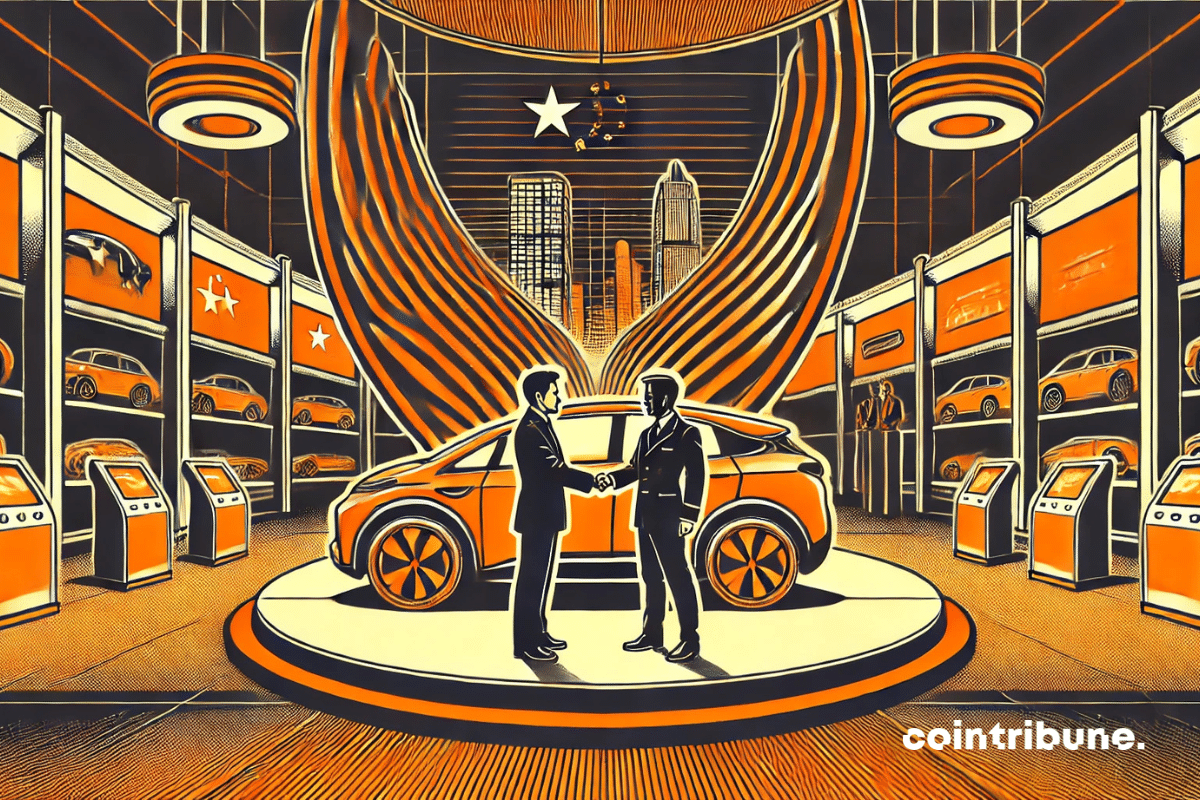
In the midst of a commercial battle, the European Union agrees to negotiate the abolition of customs tariffs on Chinese electric vehicles. Carried by massive subsidies, these low -cost models shake up the balance of the European market. This reversal marks a turning point, because Europe, torn between industrial protectionism and ecological transition, opens up to a risky compromise. In a key sector, this rapprochement could rebatter the cards between two rival powers, linked by competition as much as by interdependence.
The start of an unexpected trade dialogue
Beijing and Brussels seem to want to start a concrete dialogue on a subject hitherto marked by the confrontation. For several months, the European Commission accused China of subsidizing its automotive industry massively, which thus failed competition to the detriment of European actors.
These discussions, which are only in their infancy, take place in a climate of increasing diplomatic tension. The investigation launched by the EU last October on the commercial practices of Chinese manufacturers like Byd or Nio had suggested a tariff escalation.
Beijing had denounced a discriminatory initiative. Yet, The opening of negotiations seems to indicate a shared desire to avoid a trade war with potentially heavy repercussions for both economies. Among the key elements to remember at this stage:
- The European Commission is investigating subsidies deemed unfairly granted to the Chinese electric vehicle industry;
- The targeted manufacturers include several giants such as Byd, Nio or SAIC;
- Beijing strongly opposed these accusations, and denounced an attack on the principle of free trade;
- The dialogue initiative aims to defuse a confrontation likely to destabilize European markets.
A step towards a new economic balance
The framework of these discussions is still vague, but their scope is already carefully scrutinized by industrialists. The two economic powers have not yet detailed calendar or the precise methods of future negotiations.
However, the signal sent is strong. The simple fact of considering a pricing softening suggests that the European Union could reassess its approach to Chinese imports, in a sector as strategic as that of electric mobility.
This change of posture could reflect an awareness of the current balance of power. Chinese manufacturers have consolidated their technological advance in batteries and large -scale production.
By maintaining customs barriers, the EU may deprive itself of a competitive offer, at the very moment when its climatic objectives require accelerated electrification of the car fleet. Conversely, a precipitous withdrawal of protectionist measures could weaken European industrialists, still far from an economic balance in the face of their Asian competitors.
In the longer term, this opening could rebatch cards on the European market. If the negotiations between the EU and China succeed, the massive arrival of low -cost Chinese models could force historic players to deeply review their production and marketing models. This could also redefine industrial alliances strategies, with potential rapprochement between European and Asian firms. Whatever the outlets, future negotiations promise to be structuring for the future of the automotive sector in Europe.
Maximize your Cointribne experience with our 'Read to Earn' program! For each article you read, earn points and access exclusive rewards. Sign up now and start accumulating advantages.


