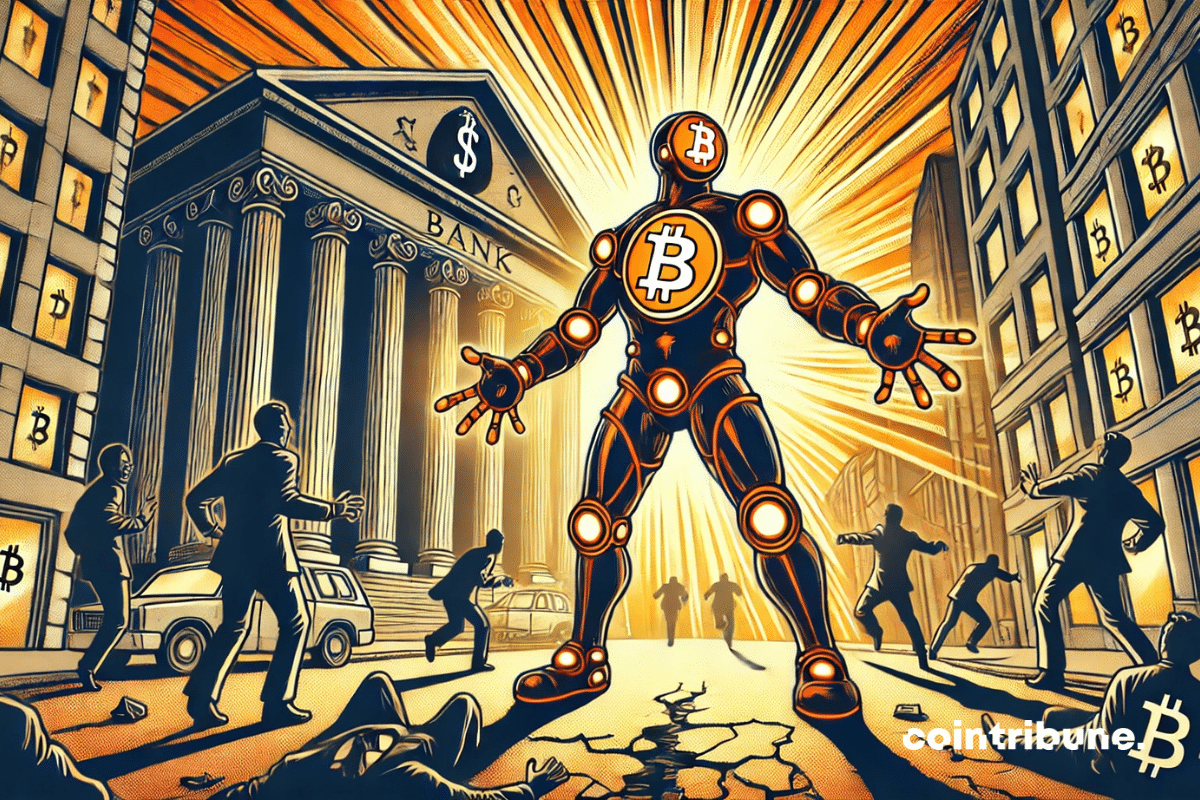
Finance crosses a silent, but brutal metamorphosis. Bitcoin, born in the shadow of the 2008 crisis, today embodies a revolution that shakes the foundations of the banks. Between promises of emancipation and technical challenges, his ascent questions: can he really dethrone the giants of traditional finance? Far from the clichés, plunge into an uncompromising analysis.
Bitcoin vs banks: an architectural war
Bitcoin is based on a Peer-to-Peer network, without conductor. Banks, on the contrary, work like centralized cathedrals, where each stone depends on higher authority.
This structural divergence explains why Bitcoin seduces: it replaces confidence in institutions with irrefutable mathematics.
In 2021, Salvador adopted Bitcoin as a legal currency, despite criticism. Result ? An economy less dependent on the dollar, but exposed to volatility.
Meanwhile, traditional banks, protected by state safety nets, resist storms. Bitcoin offers risky freedom; Banks, corseted stability.
Bitcoin treats 7 transactions per second, against thousands for visa. Solutions like the Lightning Network are trying to fill this ditch, but the path remains long.
Banks, despite their heaviness, master the art of massive flows. An advantage that could erode if blockchain technology matures.
Bitcoin promises a bank account on a smartphone. However, 3 billion people still do not have the internet. In Sub -Saharan Africaonly 48 % of adults have a mobile phone. Without digital infrastructure, the dream of inclusion remains a mirage.
Transfers cross -border via Bitcoin cost a few cents, compared to 6 % on average via traditional banks. But this economy masks a problem: the volatility of the BTC can cancel the gains in a few hours. The stablecoins are trying to respond, but their anchoring to traditional currencies perpetuates dependence on the current system.
Security: Blockchain against human psychology
The Bitcoin blockchain has never been hacked. But digital wallets are vulnerable. In the first quarter of 2025, losses linked to the hacking of cryptocurrency platforms reached $ 1.63 billion.
Banks spend billions in cybersecurity, but undergo regular data leaks. In 2022, 74 % of financial institutions reported an increase in attacks. Bitcoin eliminates intermediaries, but not human errors.
20 % of bitcoins are blocked in inaccessible wallets. A simple lost USB key, and fortunes evaporate. Banks, with their recovery procedures, offer psychological security that Bitcoin cannot match.
Economic stability: the deflationary trap
Bitcoin is limited to 21 million units. A rarity that attracts investors, but poses a problem: how to manage an economy without monetary adjustment? Central banks use inflation as a tool; Bitcoin requires rigor incompatible with crises.
In 2024, 60 % of BTC holders considered it “digital gold”. Few use it to buy coffee.
As long as there is an asset of speculation, its role of daily money will remain marginal. Banks, despite their faults, keep the monopoly on current exchanges.
Blackrock and JPMorgan integrate Bitcoin into their wallets, but as an investment product, not as a currency. A hybrid adoption which strengthens the current system more than it destroys it.
The EU adopted Mica in 2023 to supervise the cryptos. The United States oscillates between repression and innovation.
Without a clear framework, Bitcoin can never supplant the banks. But excessive regulation would risk compromising its decentralized essence. Bitcoin will not kill banks. He forces them to evolve. Meanwhile, the tax framework is evolving. Here are the essential dates to remember with regard to crypto and taxes in 2025.
Maximize your Cointribne experience with our 'Read to Earn' program! For each article you read, earn points and access exclusive rewards. Sign up now and start accumulating advantages.