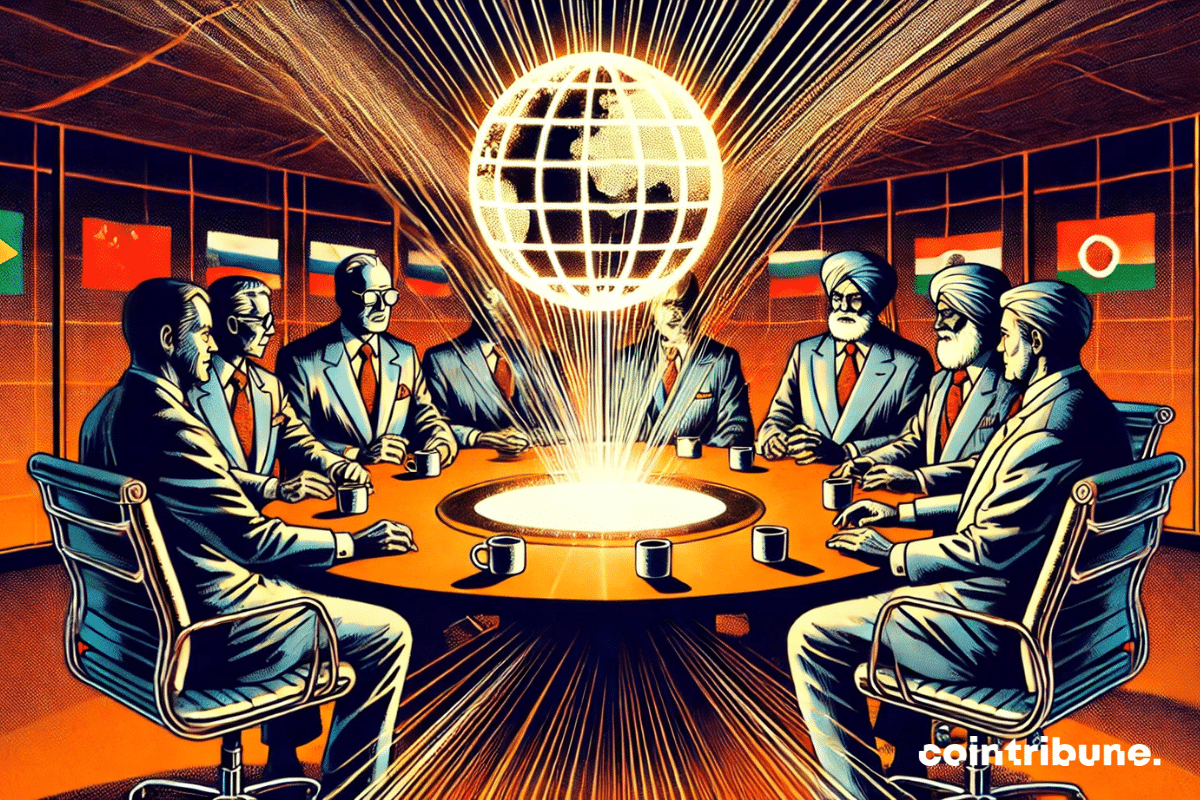
The BRICS project to create a common currency is causing growing interest among economists and analysts, as it could redefine global financial balances. For decades, the U.S. dollar has dominated as the primary reserve currency, providing the United States with considerable economic and geopolitical power. At their 2024 summit in Kazan, Russia, BRICS leaders intensified discussions on establishing an alternative called “Unit”, designed to facilitate trade within the bloc. This project is part of a broader strategy which aims to reduce their dependence on the dollar, in a context of growing geopolitical tensions and economic sanctions. At a time when many countries are seeking to diversify their reserves and circumvent the constraints imposed by the current monetary system, can this initiative truly shake the supremacy of the dollar?
A strategic response to the hegemony of the dollar
The US dollar remains the cornerstone of the global financial system. Currently, it accounts for about 59% of global foreign exchange reserves and is involved in almost 88% of transactions in foreign exchange markets, according to the Atlantic Council. This dominant position gives the United States a considerable strategic advantage, allowing it to finance its public debt at reduced costs and exert economic pressure through international sanctions.
Faced with this supremacy, the BRICS aspire to reduce their dependence on this currency. At the Kazan summit in October 2024, the idea of a common currency took center stage in the discussions. According to the bloc's leaders, this currency, potentially backed by a basket of local currencies and gold, could serve as a lever to circumvent the domination of the dollar, often perceived as a tool of economic and political coercion by the United States. Vladimir Putin, Russian President, has also declared : “we are not fighting the dollar, but we must find alternatives when we are prevented from working with it”.
This initiative comes against a backdrop of growing geopolitical tensions, exacerbated by the trade war between the United States and China as well as repeated economic sanctions targeting members of the BRICS. The stated objective is to strengthen the economic autonomy of the bloc and consolidate their influence on international markets.
On the ground, efforts to reduce dependence on the dollar are already resulting in notable developments. In 2023, around 20% of global oil trade will be conducted outside the dollar, a figure up significantly compared to previous years. This trend reflects a gradual transition, encouraged by BRICS initiatives to diversify their trade.
However, despite these advances, many challenges remain. Establishing a common currency involves overcoming major economic differences between the bloc's members. According to Anil Sooklal, South Africa's ambassador to BRICS, “the creation of a common currency is a long-term goal” because it requires consensus on complex aspects such as governance and allocation of reserves. These obstacles underline the extent of the work still necessary before this ambition becomes a reality.
A real or symbolic threat to the dollar?
Despite the ambitions displayed by the BRICS, a common currency does not seem capable of supplanting the dollar in the short term. The power of a currency on its commercial use, but also on the confidence it inspires in economic actors. However, the dollar remains, to this day, the main safe haven in times of uncertainty, which reinforces its dominant role in the global financial system.
However, the introduction of a BRICS currency could accelerate an already noticeable trend: the diversification of foreign exchange reserves. For several years, countries like China and Russia have favored bilateral trade in local currencies, and India has signed agreements to reduce its use of the dollar in its international transactions. This dynamic, described as “dedollarization”, reflects a growing desire of certain states to free themselves from American domination. Although this trend is progressing, a total challenge to the hegemony of the dollar remains unlikely in the near future, as its role in world reserves and trade remains unavoidable.
The BRICS project is also hampered by significant economic and political differences between its members. Although China and India are economic powerhouses of the bloc, their monetary visions differ. In October 2023, for example, Russia proposed that India pay for its oil imports in yuan, a suggestion firmly rejected by New Delhi, which prefers to use the dollar or rupee. The episode illustrates underlying tensions within the bloc, where the yuan's growing dominance could trigger reluctance among other members.
BRICS leaders themselves admit that creating a common currency is a daunting challenge. Thus, Leslie Maasdorp, president of the New Development Bank, recently declared that this project required a “medium to long term” horizon. The obstacles are numerous, particularly with regard to governance, currency stabilization and the establishment of sufficient international confidence. These structural challenges reinforce the idea that, despite its promises, a BRICS currency cannot currently claim to replace the dollar, but could, in the long term, gradually reshape global monetary balances.
Although the new BRICS currency does not represent an immediate threat to the dominance of the dollar, it embodies a shift towards a more multipolar global economy. Emerging economies seek to assert themselves in international financial decisions, through the development of alternatives capable of reducing dependence on the monetary system dominated by the United States.
For the BRICS, this initiative goes beyond the economic framework and is part of a political strategy aimed at rebalancing the global balance of power. The creation of a common currency could give them increased influence on the international scene and strengthen their weight in global economic negotiations. However, the success of such a project relies on strict conditions, including the establishment of reliable mechanisms to guarantee the stability of the currency and establish the confidence of economic actors.
In short, the idea that the dollar could lose its supremacy remains, for the moment, hypothetical. However, the emergence of a common BRICS currency could mark the start of a profound reconfiguration of the global monetary system. This project embodies a growing desire to diversify centers of economic power and create viable alternatives to American hegemony. Faced with these ambitions, the United States will have to rethink its strategy to preserve its position in a rapidly changing financial order, where new dynamics are beginning to reshape global balances.
Maximize your Tremplin.io experience with our 'Read to Earn' program! For every article you read, earn points and access exclusive rewards. Sign up now and start earning benefits.