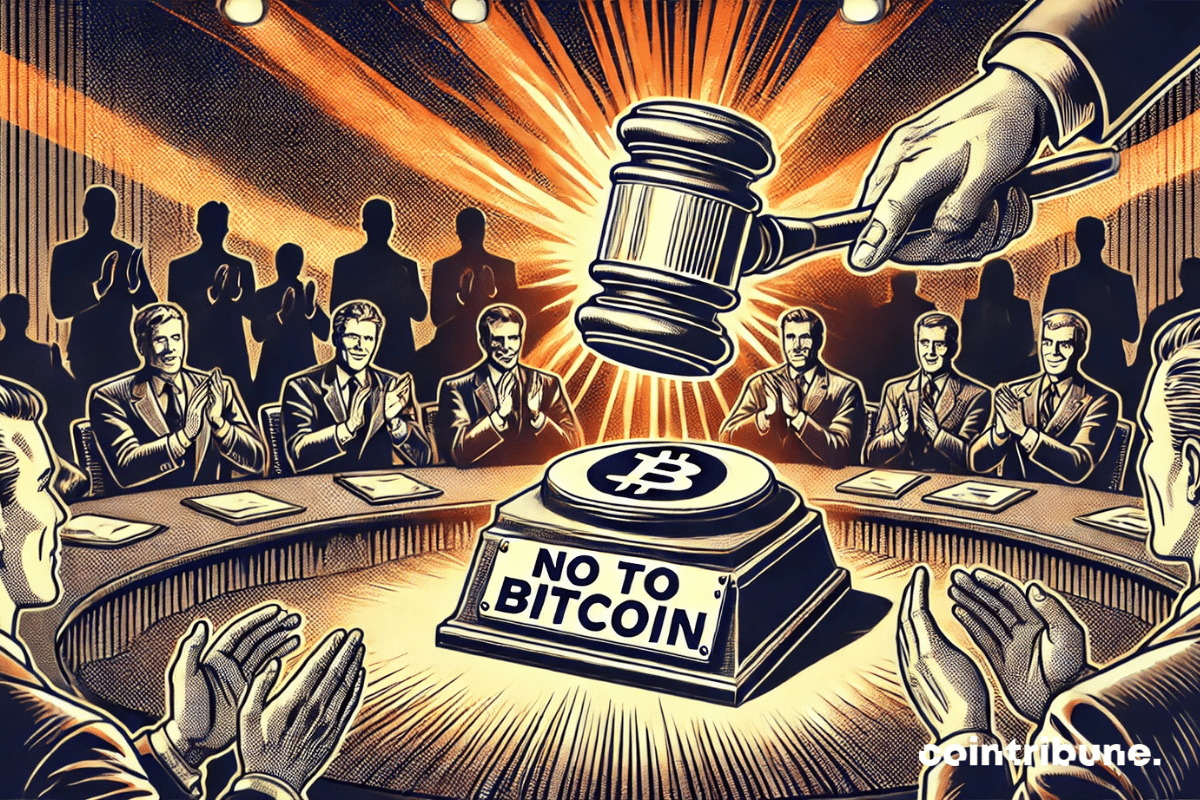
For years, bitcoin has established itself as a central subject in economic and financial debates, which deeply divides opinions. For its supporters, it represents a monetary revolution capable of redefining the rules of the global financial system. Conversely, its detractors denounce its volatility and the risks it generates, and consider it incompatible with prudent investment strategies. Indeed, Microsoft has added a new episode to this controversy. At its annual meeting, the company's shareholders rejected an ambitious proposal that aims to include bitcoin in the tech giant's cash reserves. This decision, taken in a context of particularly unstable financial markets, calls into question the place of cryptos in the asset management strategies of large companies. Between the opportunity for diversification and caution in the face of uncertainty, the debate is intensifying and reflects much broader issues for the future of cryptos in the global economy.
A reasoned rejection: Microsoft shareholders say “no”
On December 10, at its annual meeting, Microsoft considered a bold proposal submitted by the National Center for Public Policy Research (NCPPR), a Washington-based think tank. This resolution suggested investing between 1% and 5% of the company's profits in bitcoin. The stated objective was clear: to diversify Microsoft's assets and offer shareholders an opportunity for appreciation, and to prepare the company to embrace what crypto supporters call the “next technological wave”.
To support this initiative, the NCPPR prepared a video broadcast during the meeting. It opened with an important statement: “Microsoft cannot afford to miss the next wave of technology, and bitcoin is that wave.” Using charts and projections, the think tank claimed that this strategy could generate trillions of dollars of value for the company, and would reduce the risks associated with inflation and the devaluation of traditional assets. Despite these arguments, Microsoft's board of directors strongly opposed the proposal. It highlights the limits and dangers associated with such an investment.
In a document submitted to the SEC (Securities and Exchange Commission), the board justified its rejection by citing the extreme volatility of cryptos. “Crypto investments require stability and predictability that our corporate treasury cannot guarantee,” he said. specified. He insisted on the importance of preserving liquidity adapted to operational needs. Following this recommendation, the majority of shareholders ultimately rejected the proposal, which thus consolidates Microsoft's cautious stance towards the adoption of cryptos.
Divergent perspectives for business and bitcoin
Microsoft's rejection of this proposal goes beyond a simple isolated decision. It reflects a deeper debate that runs through the business world. Some companies, like MicroStrategy, have chosen a radically different path by massively integrating bitcoin into their financial balance sheets. Michael Saylor, CEO of MicroStrategy and ardent crypto advocate, tried to convince the Microsoft board. He claimed such a strategy could “add nearly $5 trillion to the market capitalization” of the company. However, despite his arguments for the unique opportunity that mass adoption would represent, this bold vision failed to resonate.
Such a conservative choice by Microsoft is part of a trend shared by other large companies. Amazon, for example, received a similar proposal from the NCPPR. Although the resolution was not rejected immediately, the e-commerce giant postponed its decision until April 2025, indicating a cautious attitude towards cryptos. This restraint reflects widespread concerns related to the volatility of these assets, as well as the desire of companies to maintain the stability of their liquidity in an economic context marked by uncertainty and fluctuations in global markets.
Microsoft's decision to reject the integration of bitcoin into its reserves illustrates a strategic choice that could influence other large companies. This refusal sheds light on a growing divide between daring players, ready to bet on crypto innovation, and those who favor stability in the face of economic uncertainties. The question remains: will bitcoin become a pillar of investment strategies or will it remain an opportunity reserved for a few pioneers? In a world where technological innovation and financial risks are intertwined, this debate is far from over. Bitcoin, meanwhile, continues to defy expectations and seeks to establish its legitimacy in the global economy.
Maximize your Tremplin.io experience with our 'Read to Earn' program! For every article you read, earn points and access exclusive rewards. Sign up now and start earning benefits.