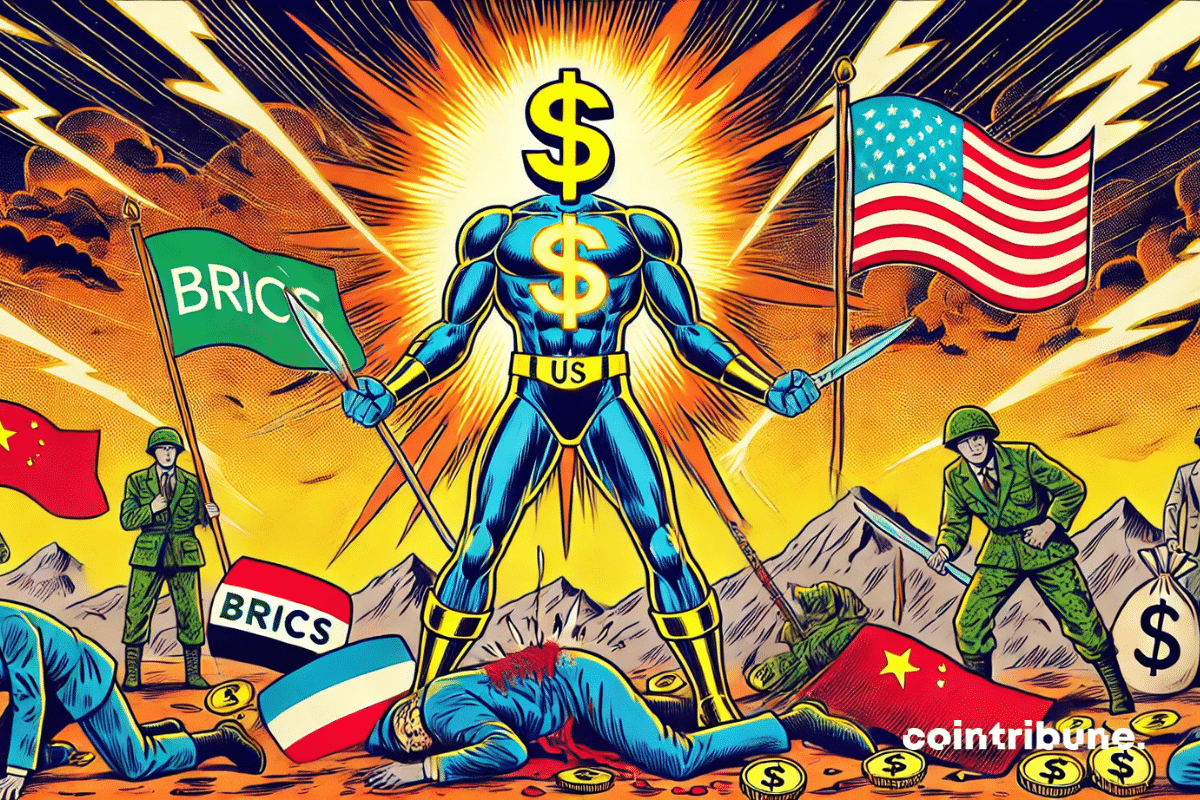
As the world closely watches BRICS efforts to reshape the global economic order, a new trend appears to undermine their ambitions. Foreign banks, far from aligning with the alliance's de-dollarization agenda, are on the contrary strengthening their US dollar reserves. This development, in a context where the local currencies of the BRICS are collapsing, calls further into question the future of economic multipolarity and the resilience of the global financial system.
The American dollar: an essential refuge in the economic storm
Faced with increasing volatility in global financial markets, the US dollar is consolidating its role as a safe haven. According to a report from The Economic Timesthe DXY index, which measures the strength of the dollar against a basket of global currencies, currently reached an all-time high of 107.06 before settling at 106.55. This rise in power comes even as the BRICS continue their dedollarization policy, which aims to reduce their dependence on the American currency.
The situation is aggravated by the depreciation of the local currencies of BRICS members. Thus, India, for example, saw its rupee reach its historic low of 84.47 INR/USD this week, despite interventions by the Reserve Bank of India. Likewise, the Chinese yuan fell to a seven-month low against the dollar. These Monetary weaknesses push foreign banks to accumulate more dollars to secure their reserves, attracted by the higher returns offered by the American currency.
BRICS strategy under pressure: between ambitions and economic realities
In this context, the BRICS objectives of creating a new international financial order seem to be receding. While the alliance's leaders tout the merits of stronger collaboration, the inability to stabilize their respective currencies weakens their credibility. Experts observe that this instability is fueling increased reliance on the dollar, even among financial institutions seeking to diversify their holdings.
Furthermore, the specter of new protectionist policies in the United States further complicates the ambitions of the BRICS. Analyst Boris Mezhuyev, a political scientist at the Institute of Scientific Information for Social Sciences of the Russian Academy of Sciences, said that “Donald Trump may seek to fracture the BRICS alliance and dash their dream of -dollarization upon taking office.” This scenario, where trade and political pressures would reinforce the dominance of the dollar, highlights the geopolitical challenges facing the BRICS.
In perspective, this dynamic could have profound implications for the global economy. If the BRICS fail to stabilize their currencies and offer a credible alternative to the dollar, their influence on the economic scene could decline. However, this situation could also stimulate closer internal cooperation or an acceleration of innovative initiatives to circumvent the mechanisms that dominate the current financial system. The future remains uncertain, but the stakes continue to grow.
Maximize your Tremplin.io experience with our 'Read to Earn' program! For every article you read, earn points and access exclusive rewards. Sign up now and start earning benefits.