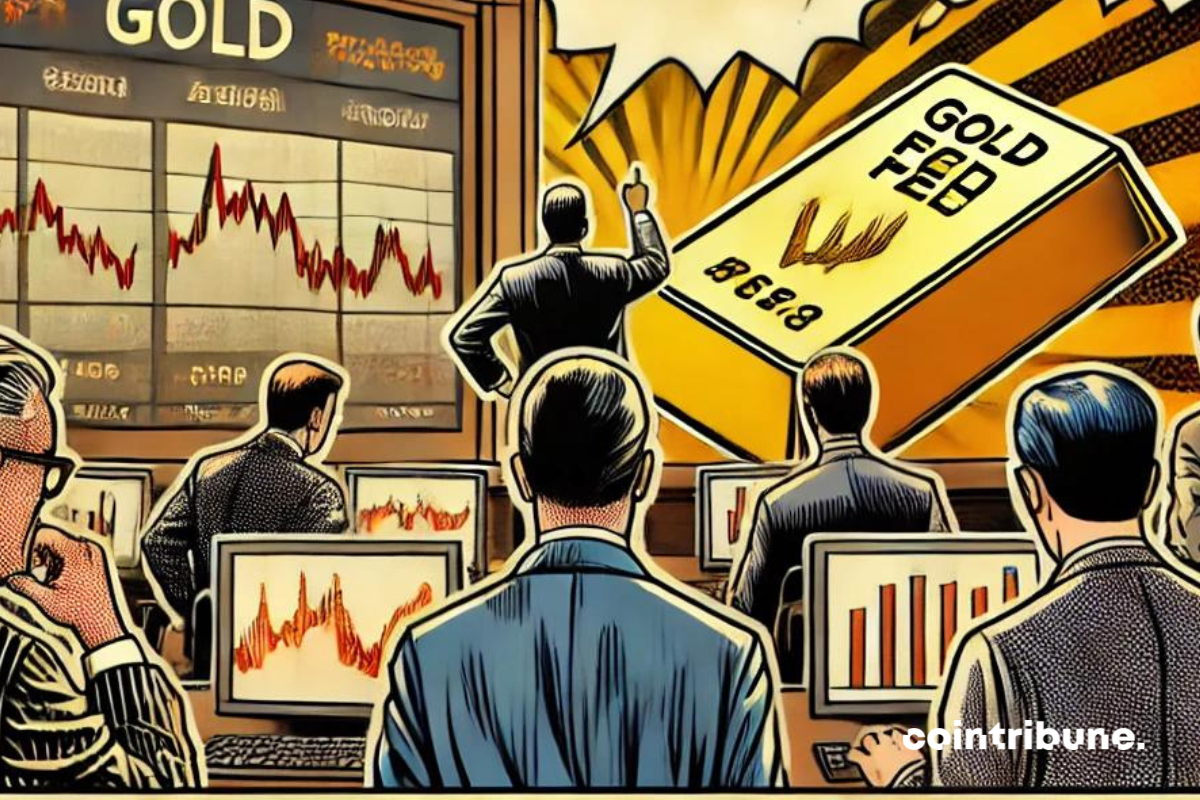
The gold market, often seen as a safe haven, is going through a period of cautious calm. Investors and traders seem frozen, their eyes fixed on imminent announcements from the US Federal Reserve and on inflation figures. At this critical moment, gold, despite its usual brilliance in times of economic uncertainty, remains stable.
Gold in the face of an economy suspended on interest rates
Gold is on pause. Spot gold prices, currently around $2,497.25 per ounce, reflect this investor indecision.
They are eagerly awaiting two key events this week: the Consumer Price Index (CPI) and Producer Price Index (PPI) figures. These data will provide a better understanding of the direction the Fed's monetary policy is taking.
Why the wait? The market is wondering about the size of the next interest rate cut by the US Federal Reserve.
Indeed, a low interest rate environment tends to strengthen the appeal of gold, a non-yielding but perceived as stable asset. If the Fed decides to adopt a more accommodative policy, by cutting rates by 25 to 50 basis points, this could propel gold to new highs.
US inflation, the trigger factor
Inflation is one of the main elements monitored by financial markets today. The August CPI figures, due on Wednesday, and the PPI figures, due on Thursday, will provide crucial clues for stock market traders.
If inflation is lower than expected, it would increase speculation that the Fed will cut interest rates. Such a move would help gold, which could then emerge from its current stagnation.
Market analyst Tim Waterer explains this situation in a few words: “Gold is holding just below the $2,500 level as the market awaits the CPI numbers. If these disappoint, we could see a surge in gold prices.”
However, a moderate rate cut will not necessarily lead to an immediate rebound in gold prices. The support levels between $2,470 and $2,480 are attracting particular attention. A fall in gold below these levels risks triggering massive selling.
The Fed: The Market Maker for Gold
Expectations for the Federal Reserve are largely influencing movements in the gold market. Currently, markets are pricing in a 69% probability of a 25 basis point cut at the Fed’s September 17-18 meeting. Some are even speculating on a larger 50 basis point cut, although this option is valued at only 31% according to the CME FedWatch tool.
What’s at stake for gold is the magnitude of the rate cut. A significant monetary policy brake could make safe assets like gold more attractive, especially as bond and other investment yields fall.
Conversely, a moderate reduction could keep gold in its current consolidation zone.
However, it’s not all about the Fed. Macroeconomic factors, such as U.S. employment data, also come into play. August figures showed a lower-than-expected increase in employment, but a decline in the unemployment rate to 4.2% indicates that the labor market remains robust.
This could limit the extent of an interest rate cut by the Fed, thereby dampening enthusiasm for gold.
Global demand for gold under pressure
On the global stage, gold demand is also experiencing mixed developments. In China, the world's second-largest gold consumer, the central bank has suspended its gold purchases for a fourth consecutive month. This has contributed to slowing the price dynamics of the precious metal on global markets.
On the other hand, inflationary pressures in China, where consumer prices accelerated in August, could revive demand for gold in the coming months.
Beijing is seeking to boost domestic demand to counter the effects of producer price deflation, and a boost to consumption could come from increased gold purchases.
Interestingly, China is also a strategic player in the silver, platinum and palladium markets, which are also up. Silver gained 0.3% to $27.99 per ounce, while platinum and palladium also saw moderate gains. This shows that while gold remains stable, other precious metals are attracting investor attention.
The gold situation remains complex. On the one hand, traders are cautious, waiting for clear signs of the Fed before taking a position. On the other hand, the global pressures on commodity prices and monetary policies of major economies add to the uncertainty.
In the long term, gold could benefit from the accommodative monetary policy that seems to be emerging in the United States with this index which encourages the Fed to reduce rates.
Maximize your Tremplin.io experience with our 'Read to Earn' program! For every article you read, earn points and access exclusive rewards. Sign up now and start earning benefits.