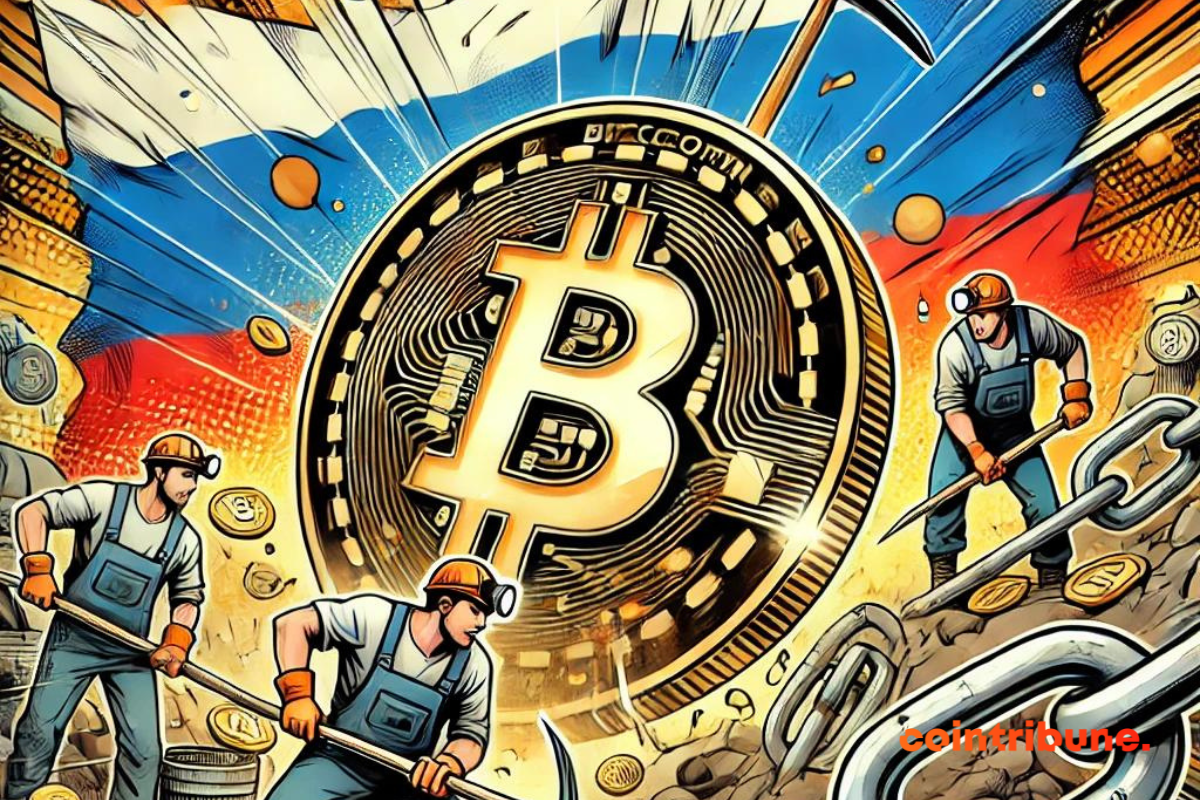
Bitcoin has taken on a new strategic dimension for Russia. Faced with economic sanctions imposed by the West, the country has found in cryptocurrency mining an unexpected lever to keep its economy afloat. With more than $3 billion mined in Bitcoin last year, Russia seems to have found a way to circumvent the restrictions while increasing its tax revenues.
Bitcoin Legalization: An Economic Masterstroke
Last July, the Russian State Duma took a decisive step by legalizing Bitcoin mining. This decision, much more than a simple legislative gesture, reflects a thoughtful economic strategy in the context of increasing international pressure.
By legitimizing this activity, the Russian government allows companies to register as legal entities and benefit from a favorable regulatory framework. This move thus paves the way for massive investments in mining infrastructure and stimulates the interest of local and foreign investors.
From a fiscal point of view, this initiative has already borne fruit. Indeed, according to estimates, mining activities have generated about 50 billion rubles (about $556 million) in taxes for the Russian state.
This figure, impressive for a first year, could increase further with the influx of new investors attracted by regulatory stability and potential returns.
The legalization of Bitcoin is part of a series of measures aimed at strengthening the use of cryptocurrencies in international trade.
Faced with restrictions imposed by the West, Russia appears to be finding in digital currencies a way to circumvent economic sanctions while boosting its internal economy.
Sanctions Evasion: A Well-Oiled Tactic
Russia's use of Bitcoin and cryptocurrencies is not just a domestic economic strategy. It is also part of a tactic to avoid international sanctions.
Economic sanctions imposed by the United States and the European Union have cut Russia off from many traditional financial markets, but cryptocurrencies offer an escape route.
The blockchain analytics company Chainalysis expressed concerns about the use of Russian crypto platforms to circumvent sanctions.
Among these platforms, Garantex, a sanctioned cryptocurrency exchange, has processed nearly $100 billion in transactions since 2018. Although the platform is under the supervision of the Office of Foreign Assets Control (OFAC) in the United States and the Office of Financial Sanctions Implementation (OFSI) in the United Kingdom, it remains a central player in the Russian crypto market.
Observers note that platforms like Garantex and Exved play a crucial role in facilitating cross-border trade, allowing Russia to maintain a certain level of economic exchange despite sanctions.
Exved, meanwhile, has ties to InDeFi Bank and was reportedly co-founded by Sergey Mendeleev, also head of Garantex, and Alexander Lebedev, a former KGB officer. This complex network of platforms and individuals illustrates Russian ingenuity in using cryptocurrencies to circumvent financial restrictions.
Towards a parallel economy?
Russia's strategy to mass adopt Bitcoin and other cryptocurrencies raises broader questions about the future of global economic exchanges.
By allowing Russia to continue trading with the rest of the world, cryptocurrencies create a parallel economy, sheltered from traditional financial institutions and international sanctions.
This reality could change the dynamics of global economic power, as other countries under sanctions could follow suit and turn to digital currencies to support their own economies.
Moreover, the legalization of Bitcoin and the growing adoption of cryptocurrencies in Russia could have repercussions on the entire digital asset ecosystem. By playing a more active role in this area, Russia could influence global regulations around Bitcoin and cryptocurrencies, turning them into geopolitical tools.
Maximize your Tremplin.io experience with our 'Read to Earn' program! For every article you read, earn points and access exclusive rewards. Sign up now and start earning benefits.