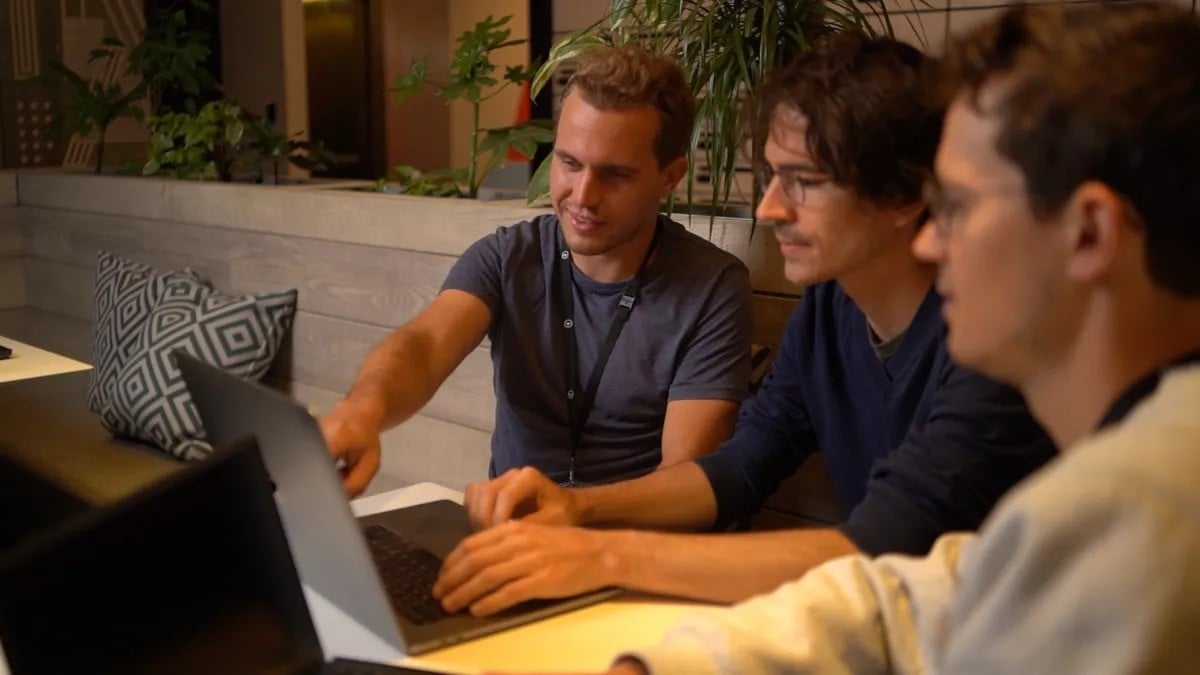
Today, we have the chance to interview Sébastien, one of the founding members of Massa Labs, who will take us behind the scenes of this innovative company that is pushing the boundaries of blockchain technology. With a clear vision and avant-garde technological developments, Massa positions itself not only as an alternative to existing blockchains, but also as a precursor in the future of the decentralized web. Join us to discover the inspiring origins of this project, its disruptive innovations such as autonomous smart contracts, and the exciting prospects that await Massa in the near future.
Could you describe the origins of the “Massa” project to us? How did three young scientists collaborate to envision the future of blockchain?
My fascination with blockchain technology began in 2017, captivated by its promises of decentralization. Since the advent of Bitcoin, it has become possible to create peer-to-peer currency, and much more, thanks to rules codified directly in the source code.
As I explored this technology, I identified a major technical challenge: achieving rapid consensus on data without a central authority. This decentralization, although beneficial, tends to reduce network performance and increase transaction costs. However, far from being discouraged, this observation rather motivated me to improve existing technology.
The first steps towards this improvement were outlined in the form of sketches, quickly followed by a functional prototype. I then shared this draft with Damir, a friend I met during my preparatory class in Marseille. Together we refined the idea, enriching the initial concept. Shortly after, Adrien, a friend from the INRIA laboratory where I was writing my thesis and he was doing his post-doctoral work, joined us. His input helped push the idea even further, refining the technology until it was ready for commercial launch.
In 2020, building on these years of development and enriching collaborations, we founded Massa Labs. Our objective was clear: to revolutionize the field of blockchain by optimizing performance while maintaining the principles of decentralization. This is how, from simple curiosity and numerous collaborative efforts, the Massa project came to be.
Massa, a new Layer 1 blockchain, another fallen hope like Ethereum and its exorbitant fees or Solana and its repeated bugs, or a real technological advance for users?
Massa clearly distinguishes itself from other first-layer blockchains with its innovative and efficient approach. Unlike platforms such as Ethereum, with its sometimes prohibitive transaction fees, or Solana, which has encountered stability issues, Massa offers a tangible technological advancement for users.
Our unique architecture is based on parallel block technology, which allows us to achieve an unrivaled level of transactions per second in a fully decentralized network. To date, several thousand nodes actively participate in consensus and ensure high capacity and strong security without compromising decentralization.
This configuration contrasts sharply with other blockchains where either performance is limited, generating high fees as in the case of Bitcoin and Ethereum, or a limited number of nodes participate in the creation of blocks, as for Binance Smart Chain (BSC) , Polkadot or Hedera, thus limiting their decentralization.
Since the launch of our mainnet in January 2024, between 1500 and 2000 nodes create blocks every day, making Massa the most decentralized launch blockchain to date. In addition, we have introduced innovations such as “autonomous smart contracts” and “on-chain decentralized web”. These developments directly target current industry challenges and offer robust solutions to users, making them not only efficient, but also more autonomous and integrated within the blockchain.
Massa's mission: A decentralized web, but what does that mean?
Massa's mission is to redefine the approach to the decentralized web, but what does the term actually mean? Currently, many decentralized applications (dapps) on the blockchain claim to be decentralized because they operate using smart contracts for their back-end logic. Take the example of Uniswap, a cryptocurrency exchange that operates via smart contracts on Ethereum, as opposed to Binance, a centralized exchange using traditional servers. However, these platforms, although they use smart contracts, have centralized user interfaces (frontends), such as app.uniswap.org for Uniswap and binance.com for Binance.
Recently, we have observed several hacking incidents on the sites of these dapps, for example Curve Finance, Balancer, and the case of BadgerDAO where around $120 million was stolen. In these situations, users were directed to a compromised website that siphoned funds from wallets instead of transmitting transactions to smart contracts. There have also been incidents of censorship, such as with NFTs on OpenSea. Thus, users of these websites do not fully benefit from the advantages of blockchain, namely enhanced security against attacks and censorship, guaranteed by verifiable and immutable source code.
To fill this gap, Massa is developing a decentralized DNS that will allow developers to choose a domain name directly on the blockchain, with the “.massa” extension, and directly associate the source code of their website with it, such as JavaScript, also hosted on the blockchain. Thus, users will be able to access dapp websites directly from the Massa blockchain, without ever going through a web 2.0 intermediary. This system substantially improves application security by ensuring that frontends cannot be modified or censored without users being informed. This innovation marks a significant step towards a truly decentralized web, where security and transparency are at the heart of the user experience.
The innovation of “autonomous smart contracts”? What exactly does it consist of?
Massa’s “autonomous smart contracts” represent a significant advancement in blockchain. As with Ethereum, smart contracts require external interaction to be activated, that is, they cannot execute code autonomously without being prompted by external action. This dependency limits their effectiveness, as contracts often need to be triggered manually by users or automated by scripts on external servers, introducing potential points of vulnerability subject to errors or attacks.
Massa transforms this model by introducing smart contracts that can be programmed to activate under certain predefined conditions, without external intervention. For example, a standalone smart contract on Massa can be configured to automatically perform a specific function at regular intervals, like a computer performing scheduled tasks. This autonomy provides a more intuitive and secure way to develop decentralized applications, reducing dependence on external servers and eliminating associated risks.
In summary, if Bitcoin can be considered as a decentralized storage server and Ethereum as a platform allowing calculations in response to external interactions, Massa represents the evolution towards a true web 3.0 server. It combines the functionality of traditional web servers with autonomous calculations and a fully decentralized and secure infrastructure, setting a new standard for decentralized applications and services.
What are the recent developments and future initiatives planned for the Massa project? How will these advancements impact the ecosystem and opportunities for participants and developers?
After a successful debut with listing on Bitget and Mexc on April 15, Massa established a bridge with Ethereum, thus facilitating the transfer of tokens between the two blockchains. This development was followed by the listing of several tokens on Dusa, Massa's first DEX (Decentralized Exchange). These initiatives show that the Massa ecosystem is rapidly expanding.
Currently, there are attractive incentives for those interested in staking on Massa Layer 1, as well as those interested in providing liquidity on Dusa, with annual yield rates (APR) exceeding 100%. These opportunities are a boon for investors and ecosystem participants.
The Massa Foundation grant program attracts a wide range of projects, from DeFi to NFTs, games, tools and monitoring. The foundation also encourages the community to submit their own projects and regularly offers new awards to stimulate innovation.
In the more distant future, Massa plans to integrate other exchange platforms and deploy its decentralized web concept. Improvements are also planned for standalone smart contracts. In addition, project governance will be gradually decentralized to involve the community more.
A notable partnership with Starknet is underway, underscoring Massa's commitment to collaborating with other technology leaders to strengthen its infrastructure and expand its influence.
With the introduction of revolutionary concepts such as autonomous smart contracts and the decentralized web, Massa is tackling head-on the security and decentralization issues that often hamper traditional blockchain technologies. Their vision for an ecosystem where operations are both transparent and secure could well set new standards in the field.
Maximize your Tremplin.io experience with our 'Read to Earn' program! For every article you read, earn points and access exclusive rewards. Sign up now and start earning benefits.
Click here to join 'Read to Earn' and turn your passion for crypto into rewards!