

Since 2022, the American central bank has been waging a fight to combat inflation. Two years have passed and we still find ourselves with inflation above 2%. Will the FED be able to achieve the objective of its mandate? Should we abandon the 2% objective? This is where we will look together at the factors that could make the task more difficult.
The FED’s 2% standard
The US central bank has two mandates, one is to control inflation and the other is to ensure full employment. This first mandate is legislated by Congress and also by the President to maintain a stable price level. And it turns out that the level of stability is around 2%. It is an international standard established since 1990. According to Mr. Bullard (a FED official), abandoning this standard would be a disaster. In this vein, other central banks around the world should do the same.
Risk of inflation rebound?
Inflation in the USA has stabilized for several months at between 3 and 3.5%. Obviously, in the fight against inflation, the fall in prices of raw materials has made a strong contribution. There is a strong correlation between the two variables as can be seen in the graph below:
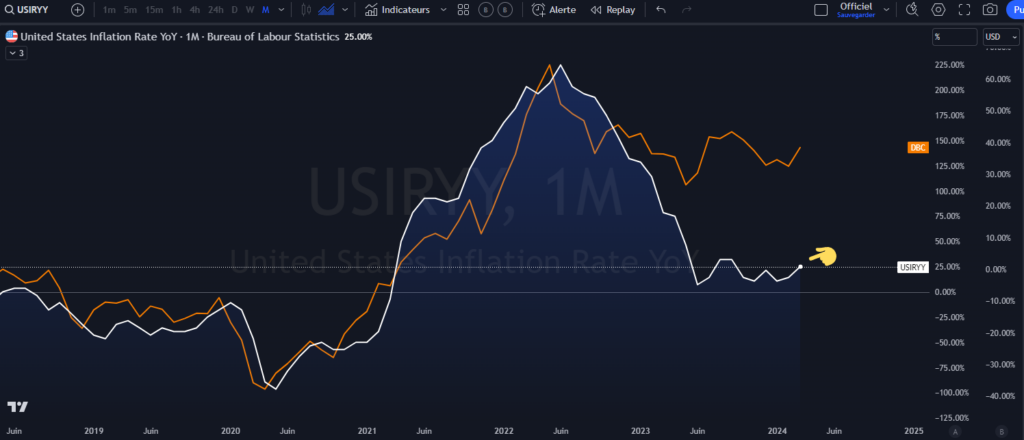
Bringing inflation back toward the 2% target rate would likely require a sustained decline in commodity prices. We could add to this a more pronounced economic slowdown. The 3% inflation level also technically corresponds to commodity support as can be seen in the chart below. Without another major catalyst like rising unemployment for example, it would likely require a price decline below the commodity sideways zone.
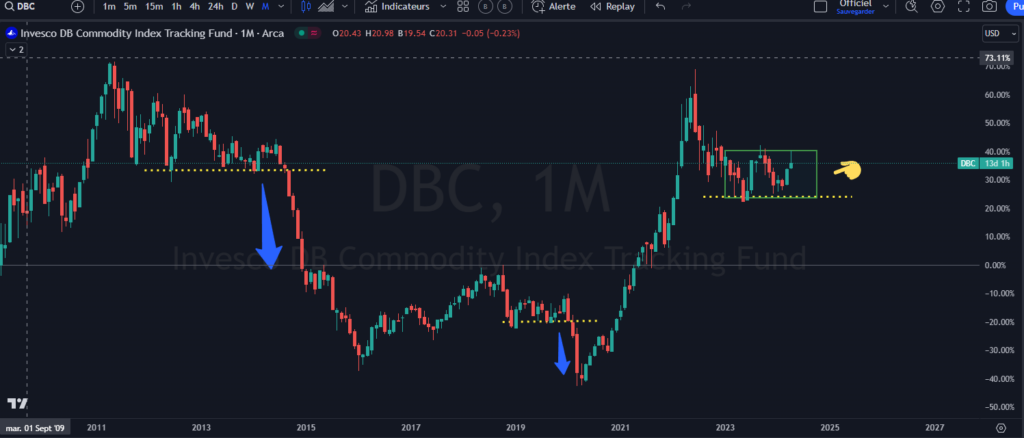
However, with geopolitical tensions still present, commodities still remain a risk. For example, if we have an escalation between Israel, Iran and Palestine, this could lead to an increase in the price of oil. On the other hand, commodities are still undervalued compared to stocks, which can also attract investors.
The limited effects of restrictive monetary policy on inflation
Despite all the efforts of the FED over the last two years, there are probably limited effects of restrictive monetary policy. For example, when we look at how the different debts are distributed in the US, we can see that a large part (the majority) has fixed rates:
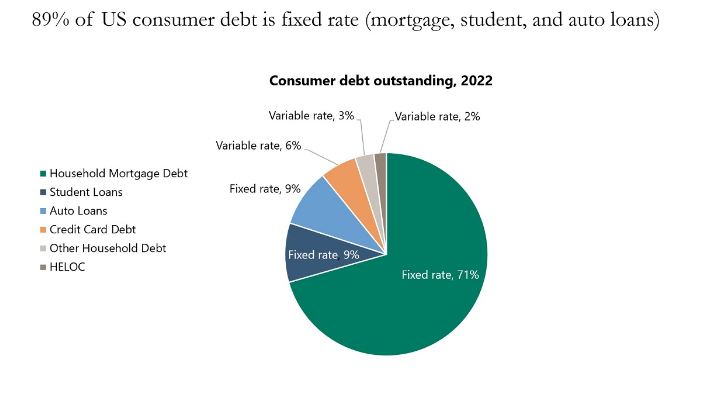
Consequently, as the variable part is lower, the effects remain limited. But restrictive monetary policy has made it possible to limit loan requests since we can see a very low level of mortgage subscription.
The other element to take into account is also to see that companies have not really suffered from the rise in rates because they took advantage of covid to contract debt at low rates. Companies even benefit from this since they can use this money to invest in the money market without risk with higher rates.
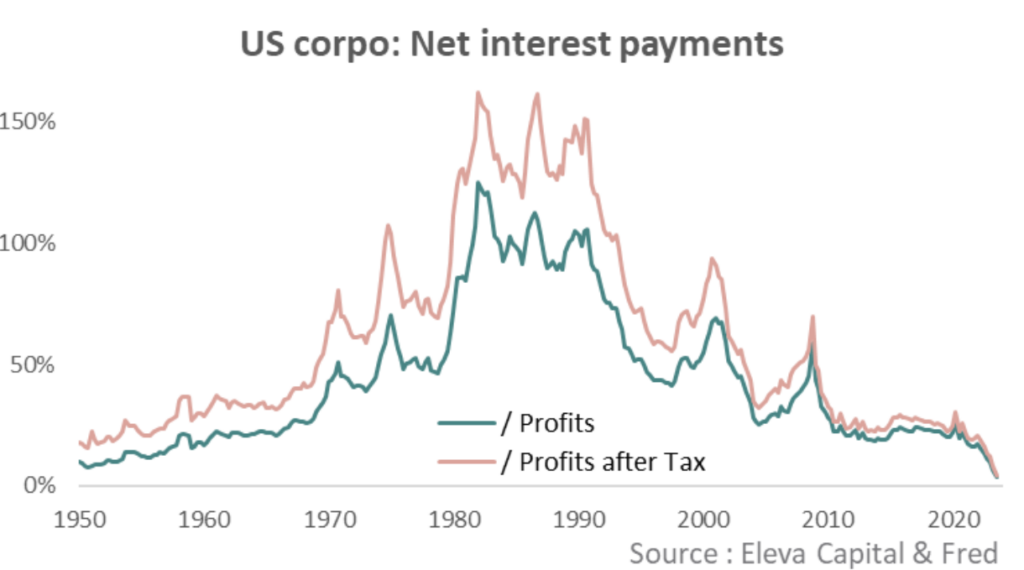
On the other hand, companies were able to issue long-term corporate bonds at low rates. Therefore, they can also benefit from revenues from today's higher interest rates.
Fiscal dominance, another challenge for inflation?
The other thing that we don't hear much about but which puts pressure on the FED is fiscal dominance. To put it simply, fiscal dominance is a context where monetary policy is dependent on fiscal policy. That is, the context of high rates in a high debt environment becomes problematic because the cost of servicing the debt increases. Therefore, it is necessary to issue even more US bonds and bonds to at least pay the interest on the debt. We can see in the graph below that the level is similar to that of 2020 even though we are not in recession.
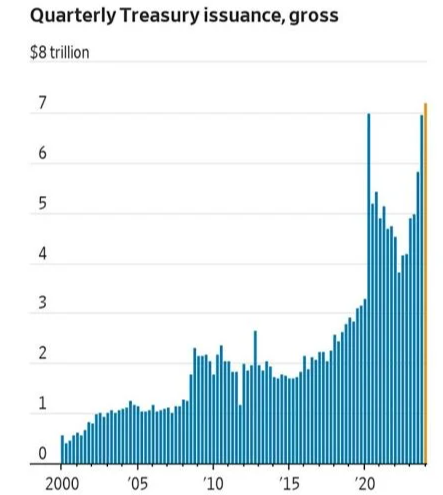
This expresses that we have changed regime (fiscal dominance) and that the central bank is caught in a certain vicious circle. The harmful effect of the growing fiscal deficit is that it remains inflationary. As debt increases, so does the risk of default. Therefore, investors demand a higher return to compensate for the risk, which keeps rates high. When rates remain high, the cost of a mortgage loan is higher, which is why the fiscal deficit is said to be inflationary.
Some countries abandon bonds for gold
Over the past year, we have seen that certain countries such as China are gradually abandoning their positions on US bonds. All with the aim of buying gold in return. Beyond fiscal dominance, a lack of interest from foreign investors in US bonds could also keep rates high. The value of the bond varies opposite to the rates. Therefore, if we face bond sales, the rate is likely to rise or remain high. On the other hand, since the FED is not buying back maturing bonds currently, this does not help alleviate the pressure.
Abandoning the 2% target level?
There are too many issues going on in an election year. It would be surprising to make a change at this level. Moreover, we could hear the intervention of President Biden specifying that the FED will make a reduction this year. However, the decisions of the FED are supposed to be independent of those of the President. There is a strong likelihood that the 3% floor level will persist in the presence of fiscal dominance and political tensions. A major catalyst such as an increase in unemployment would be necessary to suppose a return to 2%. The FED is preparing to lower its rates when it is sure that we are facing a lasting decline in inflation.
Several names like Paul Krugman (2008 Nobel Prize winner) support the fact that the inflation target should be increased to 3%. I also quote his words: “The changes brought about by the pandemic in the way we work and our purchasing choices have shown that the adjustment problems are even greater than we thought, and they might be easier to solve if we accepted a inflation at 3%, or even 4%.” We can also add to this the changes at the demographic level (aging population), better wage growth, the energy transition, etc.
CONCLUSION
The future will tell us, but it will be quite difficult to bring inflation down from 3.5% to 2% without a more significant economic slowdown. Especially when we take into account the other persistent factors stated above. Could the FED lose credibility by going from 2 to 3%? We have to see things differently, it is better to maintain a stable economy with an inflation level of 3% than to force an economic slowdown which can cause more damage.
Maximize your Tremplin.io experience with our 'Read to Earn' program! For every article you read, earn points and access exclusive rewards. Sign up now and start earning benefits.


