The famous bitcoiner and entrepreneur Balaji Srinivasan has just published a diatribe against the United States. According to him, the federal state is on the verge of bankruptcy and being swallowed up by trillions of dollars in debt. Faced with such a crisis, the Fed would activate the largest printing policy in American history to divert taxpayers' money.
Towards an imminent debt crisis?
It's weird. Look at this chart recently published by the Wall Street Journal:
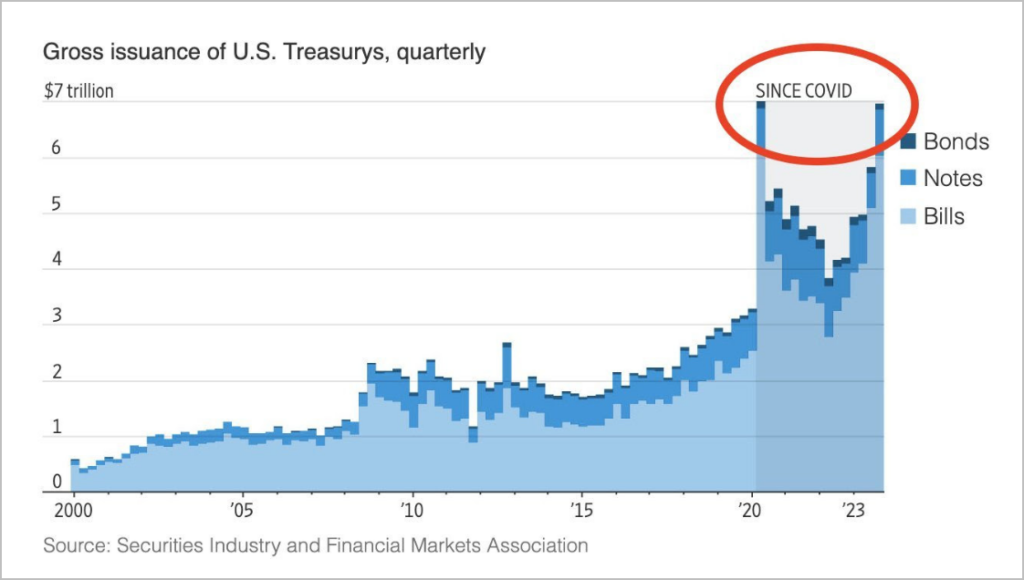
Why is the US government issuing emergency Treasury bonds when the official narrative is that everything is fine? And why is the Wall Street Journal acknowledging that something extremely strange is going on…and that it could end badly?
“The rapid growth of markets, from tech stocks to mortgage bonds, has ended badly in the past. Many people consider Treasury bills as the safest securities and the easiest to trade on Wall Street, and they fear that any instability spreads quickly.
They underestimate the situation. When they talk about a “bad ending,” they’re talking about a crisis.
- 2000 is the crash of the internet bubble
- 2008, the financial crisis
- 202X is the sovereign debt crisis
Additionally, the WSJ also recognizes that (a) there is risk in the supposed “risk-free asset”, that (b) instability in the Treasury market is not only possible, but could spread , and that (c) “many” are worried about this.
This has all been evident for some time. But now that the WSJ (and BlackRock!) is starting to admit that debt is out of control and that the “safest asset in the world” could actually become the riskiest asset in the world.
September 11, 2008 crisis, covid
The thing is, I'm hesitant to accept some of these parallels. What is a good precedent for what is coming? We can use the progression of the financial crisis of 2000, 2008 and 202X, as the WSJ implicitly did. But we can also place the events of 2001, 2008 and 2020 in a different crisis progression, as the economist Summers did:
“The COVID-19 crisis is the third major shock to the global system in the 21st century, after the terrorist attacks of 2001 and the financial crisis of 2008.”
Civilizational crisis
Let us first note that the years 2001, 2008 and 2020 have all were preceded by a warning event.
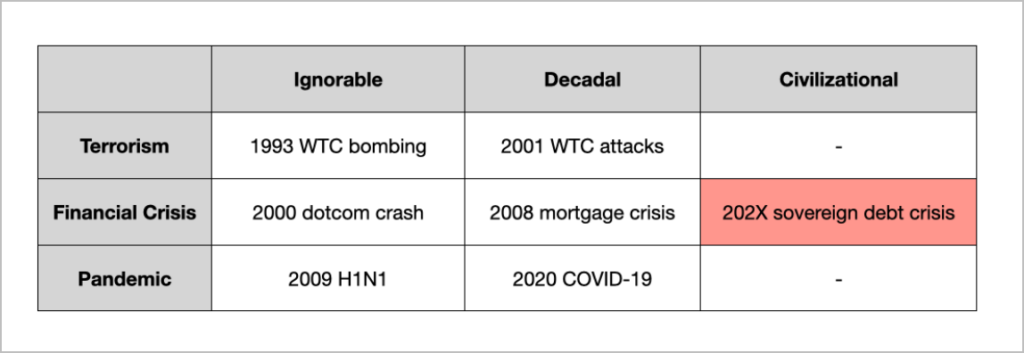
The 1993 bombings preceded 9/11, the 2000 dot-com crash preceded 2008, and the 2009 H1N1 influenza pandemic preceded COVID-19.
In all cases these were points that could be linked retrospectively, glimpses of the future for those who knew how to extrapolate. But the scale of these changes was radically different.
The world was transformed by 2001, 2008 and 2020 in ways that had not been the case for each of the preceding events. (We could quantify this phenomenon based on media coverage).
Then note that as you move forward in time, things become more serious. I used the terms “ignorable,” “decadal,” and “civilizational.” An ignorable event is a news item that even someone who experienced the event at the time might not have remembered. A ten-year event is an event that marked the decade. And a civilizational event? It's been a long time since we had one.
The most important crisis of the century?
What concerns me is going from an ignorable event to a decadal event to a civilizational event.
I don't know if we will see a nuclear 9/11 or a pandemic far worse than COVID-19. But I think, like Ray DalioStanley Druckenmiller and Larry Fink, that we are heading towards a sovereign debt crisis.
This is why comparing 2008 to what lies ahead can give a false sense of security. What if the coming sovereign debt crisis was to the mortgage crisis what COVID-19 was to H1N1? What if it was so much bigger that it would be like comparing a small war to a world war?
Because this is Dalio's thesis. That a sovereign debt crisis will lead to a change in the world order.
Alright Alright. Let's not move too quickly. If I represent the “it's happening” faction, it's always helpful to hear the rebuttal from the “nothing ever happens” faction.
Here I say that the economy is not real, that it is backed by record debt and will fake it until they break it. It would indeed be a historic event.
Those who think the crisis will not happen
We regularly hear that the State has more than $177 trillion in assets.
But the figure of 177 trillion dollars does not really concern state assets. This is everything owned by American households (and nonprofits, hedge funds, private equity funds, and personal trusts). And now we get to the heart of the matter.
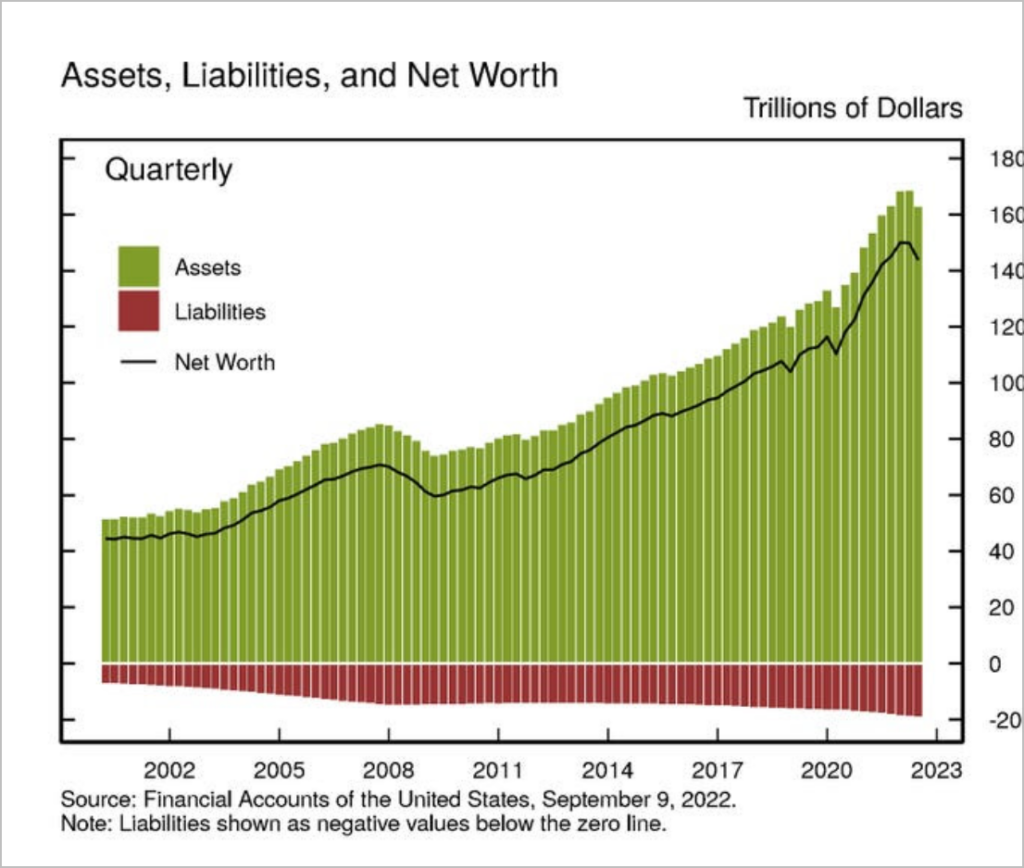
Keynesianism resembles communism in that it sees no real difference between household and state assets. They do not recognize no moral limit to what they can take from the population through inflation and seizure, but only practical limits.
If you doubt this, ask a Keynesian whether they would accept a hard limit on the money supply or an upper limit on the tax rate. They won't. And that's the reason why they print trillions while continuing to propose “wealth taxes.”
The implication is that every dollar can be diluted and every possession can be confiscated, if only the state can find a legal basis to do so. Ideally, it would be a 1,000-page bill, passed in the early hours despite protests.
Your money will pay what the state owes
The idea is this: Your household assets will be seized to pay what this bankrupt state owes.
And how much does he owe? To find out, we can refer to a recent analysis of the United States government's February 2024 financial report.
Here is the table in which the American government itself admits that even the $37 billion is an underestimate of the debt.
If we include Social Security and Medicare “social insurance”, this is an additional item of $78.4 billion. But wait, that's not all!
Later in the document, the Treasury itself admits that this is a gross underestimate of what the United States owes in terms of Social Security and Medicare, because it does not take into account future payments several decades from now.
Once this is the case, how high are the numbers? Here is the direct quote from the study: “The total…is $175.3 trillion in today’s value.” This need can only be met by increased borrowing, higher taxes, reduced program spending, or a combination of both. »
When everything is taken into account, Druckenmiller used the figure of approximately $200 trillion total US government liabilities. And of course, at this point we find ourselves in monopoly currency territory:
- The federal government collected only $1.86 billion last year
- Deficit spending inflates this figure
- The dollar has fallen ~25% in real terms since 2020
- And the “177T” in asset value collapses if they are liquidated
- …or in the event of a financial crisis, or both.
Promises that the State will not keep
So no, the US government doesn't have nearly enough money to pay what it owes. He's made promises to everyone, from allies to retirees, that he simply can't keep.
Clinging to power amidst this web of unfulfilled obligations will require a viciousness that most people can't really understand.
I do like that we're starting to see the endgame, though. When a failed state collapses, it is like a black hole. It sucks everything it can into its gaping maw. The State will grab whatever he can grab. It will print whatever it can print.
All your possessions become his property. All it takes…is all you have.
Balaji Srinivasan's alarmist remarks about an imminent bankruptcy of the American federal state raise legitimate concerns about the colossal public debt of the United States. Official Treasury figures, largely underestimated, reveal total liabilities approaching $200,000 billion according to some analysts. Faced with these disproportionate commitments, the specter of a sovereign debt crisis looms large, with the risk of a collapse of the dollar and a massive confiscation of household assets. If such a catastrophe were to occur, it would undoubtedly cause an economic and social earthquake unprecedented in the recent history of the United States.
Maximize your Tremplin.io experience with our 'Read to Earn' program! For every article you read, earn points and access exclusive rewards. Sign up now and start earning benefits.