
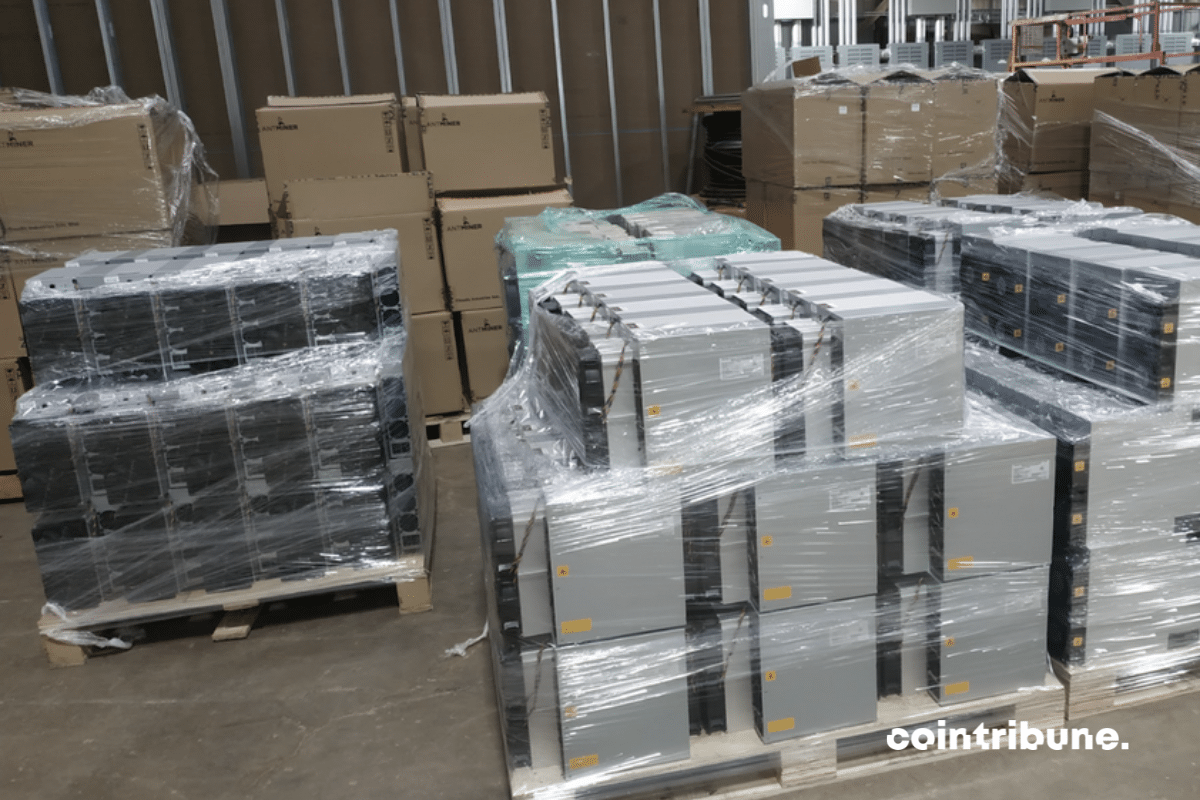
A killer bill for the American bitcoin industry has made its way to the US Congress. Are we at the dawn of a new exodus?
Remake of the Chinese “Ban”?
There was a time when China provided more than 60% of the Bitcoin network’s energy. This domination has declined significantly following the “ban” of the Chinese government. It was a little less than three years ago.
At the time, energy consumption dropped by 65% within two months. It took almost a year for the hashrate to return to its highest level.
Today, the largest pool in the world (Foundry) is based in the United States and more than ten North American miners are listed on the stock exchange. Notably Cleanspark, Riot, or even BitFarms. Several pools are still based in China (f2pool, Antpool, Binance), but they no longer aggregate a dominant share of the hashrate.
This exodus was a blessing in disguise in two respects. This was good news for the decentralization of Bitcoin. It is important that all minors are not grouped together in the same country.
The climate was also grateful. Foundry says its customers consume 71% green electricity, or ESG-friendly (via the recovery of methane that would otherwise be flared).
What remains of China’s Sichuan province’s surplus hydroelectric power (built in an era of overinvestment in ghost towns) will ultimately fuel the AI craze.
Despite the heavy hand of the Chinese government, the Middle Kingdom is still home to around 20% of the hashrate. The latter has since increased from 200 EH/s to nearly 600 EH/s. As a result, Bitcoin has partly gotten rid of its geographical concentration problem.
The murderous regulations regarding American miners could change the situation by causing a new exodus.
Biden threatens miners
As Brian Morgenstern (Riot) says: “Bitcoin brings freedom to the entire world, just as the United States has fostered for generations. So it makes sense that the bitcoin industry would thrive here.”
Problem is, the bitcoin industry is refocusing in North America. Perhaps not for long given that the Biden administration aims to impose a 30% tax on electricity on miners.
This tax will apply even to minors who are not directly connected to the national network. That is to say those who are installed near wind turbines where the majority of the current is produced when it is not needed.
“A tax on the use of electricity by miners could reduce their activity and the resulting environmental impacts”can we read in the law Project.
If adopted, this tax would come into effect next year. It will be 10% in the first year, 20% in the second year and 30% from 2027.
This would certainly be bad news for the Riot miner who planned to multiply its hashrate by ten and reach 100 EH/s. That said, the balance of power in the US Congress suggests that this law will not pass.
However, this would be very good news for the decentralization of Bitcoin. Texan miners already represent more than 10% of the global hashrate. We are even at more than 40% for all of North America.
The migration of miners to surplus energy and hydro sources in South America would be welcome. The miner BitFarm, for example, recently set up in Paraguay to benefit from surplus electricity from the Itaipu dam.
Many miners are also eyeing Argentina which also has electricity to spare and, above all, a shortage of foreign currency which is weighing down the peso exchange rate.
An exodus would be good news
All countries with chronic trade deficits would do well to roll out the red carpet for bitcoin miners. Not having minors means exposing yourself to a vicious circle.
Trade deficit => Falling exchange rate => Inflation => Growing popularity of Bitcoin
However, a country that does not have its own miners is forced to import its bitcoins from abroad, which in turn aggravates the problem of the trade deficit and everything that results from it.
This is why many countries like Lebanon, Nigeria and Ethiopia block bitcoin purchasing platforms. What is currently happening in Nigeria with Binance is a textbook case.
In 2022, Ethiopia imported $23 billion worth of products and services, compared to just $11 billion in exports. That is to say a trade deficit of 12 billion dollars which weighs down the local currency.
Hence the country’s recent decision to mine bitcoins using excess electricity from its gigantic Renaissance Dam. Most Chinese bitcoin miners have already reached agreements with the Ethiopian power company.
Instead of waiting for demand to be there, Ethiopia is using bitcoin as a catalyst to accelerate its economic growth and narrow its trade deficit.
Many running chronic trade deficits would do well to emulate Ethiopia. Because sooner or later, their citizens will turn to bitcoin to protect themselves from inflation.
Capital controls and limitations on currency purchases always result in the emergence of a parallel exchange rate leading straight to hyperinflation.
Nations with the highest inflation rates should be given priority in welcoming bitcoin miners.
Maximize your Tremplin.io experience with our ‘Read to Earn’ program! For every article you read, earn points and access exclusive rewards. Sign up now and start earning benefits.


