While there will never be more than 21 million bitcoins, Ethereum’s money supply is theoretically infinite…
Bitcoin (21M) vs Ethereum (∞)
For Bitcoin, the maximum supply is 21 million BTC. Bitcoin issuance automatically halves every 210,000 blocks. That is to say approximately every four years. This is the famous “halving”.
Truth be told, we will never reach 21 million BTC. A non-zero but insignificant amount of BTC will continue to be mined after the year 2140.
The number of bitcoins in circulation is already close to 19.5 million units, or 93% of the maximum supply. For Ethereum, we are at 120 million units.
Before talking about the mechanism for issuing ethereums, let us remember that they were 70% “pre-mined”… Which Satoshi Nakamoto did not do. It is the miners who create bitcoins by providing energy (“Proof of Work”).
Ethereum was also originally launched with a PoW system. But the first ETH was not created in the Ethereum genesis block. Far from there. Vitalik Buterin and his friends created gigantic quantities of them, ex nihilo, to finance the Ethereum Foundation.
These pre-mined ETH were sold for between $0.29 and $0.40 apiece. That is to say between 2000 and 1337 ETH for one BTC at the time of this ICO organized a year before the launch of Ethereum, on July 30, 2015.
A total of 60 million ETH was sold to insiders. Another twelve million were distributed free of charge to founders Vitalik Buterin, Amir Chetrit, Mihai Alisie, Anthony Di Iorio, Charles Hoskinson, Joseph Lubin, Gavin Wood and Jeffrey Wilcke.
ETH “Burn”
The trajectory of ethereum’s money supply has changed several times. The first turning point was the London hard fork, known as the London Upgrade, in August 2021. It was decided to introduce a “burn” mechanism aimed at destroying the ETH corresponding to the transaction fees.
The second major alteration was the transition from Proof of Work to Proof of Stake. This update known as “The Merge” took place in September 2022.
Today, Ethereum’s money supply depends on two parameters. The first is the creation mechanism via rewards for “validators”. The more there are of these, the more the creation of ETH accelerates. You must provide 32 ETH as collateral to become a validator. This system is called “staking”.
This monetary creation is compensated by the “burn” mechanism. The increase in the number of transactions causes an exponential increase in transaction fees and therefore the number of ETH destroyed.
When the number of ETH destroyed is greater than those paid to validators, the total money supply contracts. And vice versa.
This results in a changing monetary policy which you can observe in this graph from the paper Understanding Bitcoin and Ethereum Supply from Fidelity:
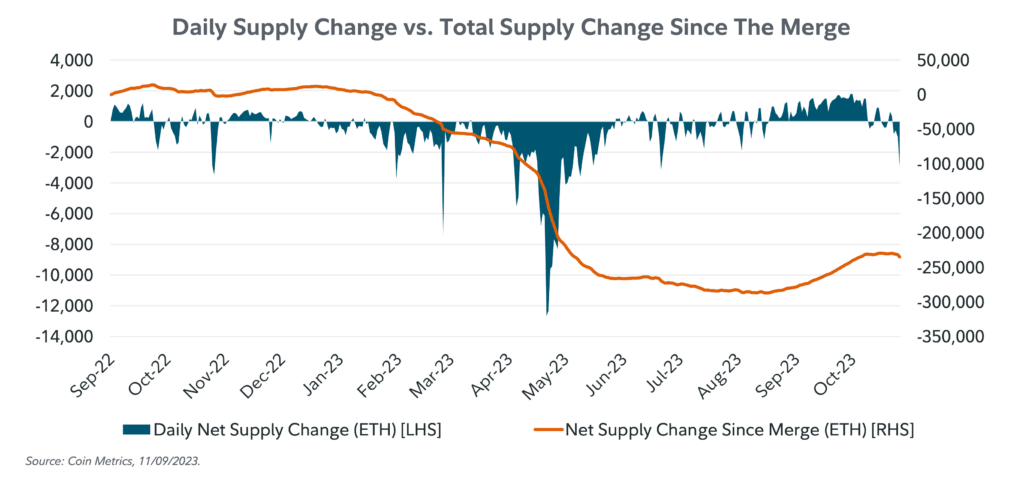
Blue curve: Daily variation of the money supply (left abscissa)
Source : Fidelitydigitalasset.com
Even though Ethereum’s money supply is theoretically infinite, it is currently in decline. However, it has been rising since August 2023.
The Ethereum Foundation has already changed its monetary policy several times and plans to do so again. On the other hand, the bitcoin code continues to ossify. Its decentralization means that no one can modify its money supply.
Maximize your Tremplin.io experience with our ‘Read to Earn’ program! For every article you read, earn points and access exclusive rewards. Sign up now and start earning benefits.