Ordinals and other inscriptions in bitcoin transactions raise questions. Summary of the debate that has been raging for several days.
Some numbers
Ordinals are a type of NFT. They are housed inside bitcoin transactions via “registrations”. Here are two articles for more information on how these jpegs are entered into the blockchain:
–Bitcoin and the drama of ordinals
–Ordinals, attack or improvement?
To summarize, we are dealing with scam professionals promoting what they claim to be digital art. As always, it’s about selling your junk to yourself very dearly while waiting for naive people to give in to FOMO and take the bait.
Alongside the ordinals, we also have “rare sats” or the “brc-20” shitcoins. The latter represent the majority of registrations:
The brc-20s replaced the ordinals which are much more demanding in block space. It is more profitable to create brc-20s given the prevailing market capitalizations. More than $160 million has already been spent on BRC-20 registrations which are now backed by a $3.5 billion bubble.
Hence the recent increase in bitcoin transaction fees. It cost $20 to insert a transaction into the next block at the time of this writing.
$23.6 million in charges in one day. »
The bellows of the ordinals collections is not left out. It now weighs four times more than the next two NFT markets combined (Solana and Ethereum).
Many turn a blind eye for the moment, but the majority still recognize that these inscriptions are a nuisance.
How did we get here ?
Inscriptions, an ancient practice
It has always been possible to insert a bit of arbitrary data into the blockchain.
Satoshi Nakamoto, for example, wrote the famous newspaper headline “Chancellor on brink of second bailout for banks” in the coinbase of the genesis block.
In 2013, the entire white paper was included in the utxo set. The same year, the lyrics of the song “Never gonna give you up” are inserted via the Op_Return script.
By the way, the Op_Return outputs are a good place to insert data since it can be pruned by the nodes. However, the available space is extremely limited.
All of these registration types predate the Segwit (2017) and Taproot (2021) soft forks. But they were light. From SegWit it is possible to insert much more data. Taproot makes things even worse, but more marginally.
SegWit is a major update inherited from the “Blocksize war”. In particular, it greatly facilitated the emergence of the Lightning Network. More interestingly for our purposes, it separates the transactions into two distinct sections.
SegWit (Segregated Witness) transactions store signature data separately, in the witness section, which can accommodate up to 3 MB of data.
The aim of the maneuver was to increase the number of transactions that could be inserted into the second 1 MB section. Before SegWit, a block could contain up to 1650 transactions, compared to 2700 transactions today.
All this to say that the witness allows you to enter ordinals for cheap. A SegWit transaction can be up to 0.4 MB. Above that, transactions are filtered by the Bitcoin core mempool.
Only a pool can insert a larger transaction, of up to 4 MB. Moreover, certain pools do not hesitate to sell this service in complete opacity, depriving their clients (the miners) of transaction fees.
Where is the problem ?
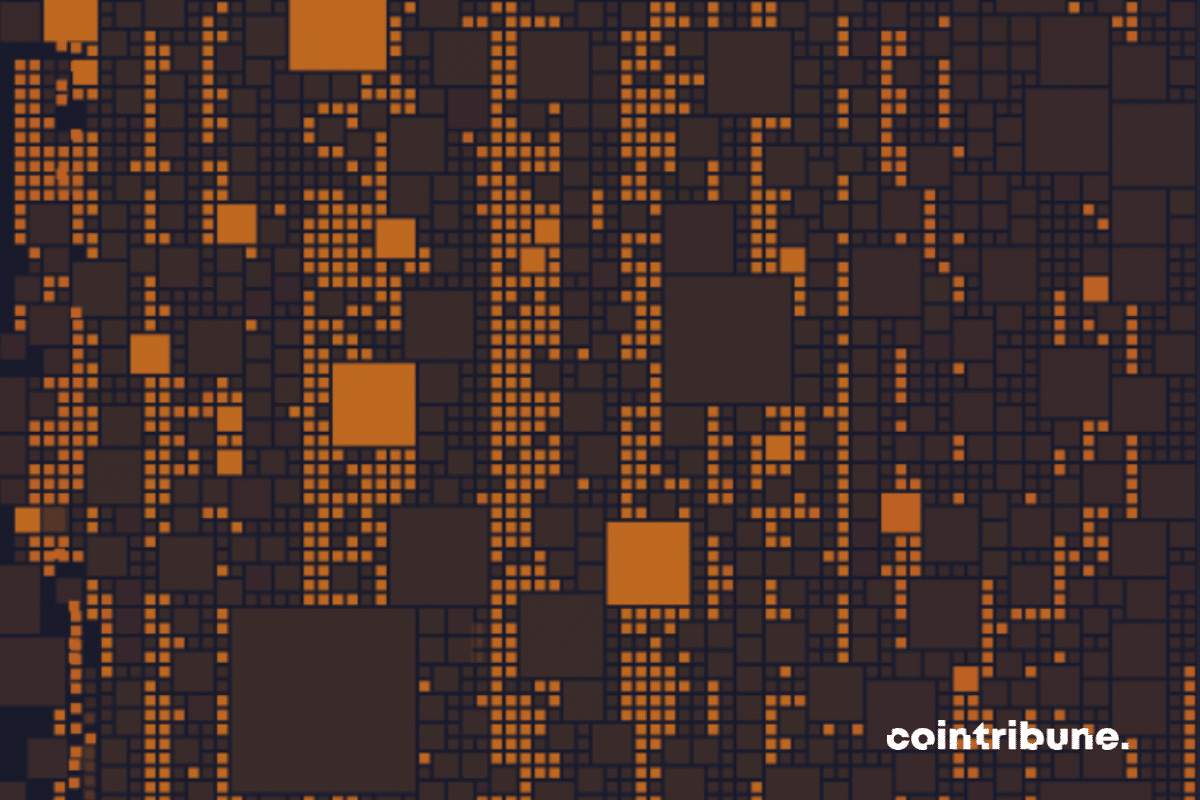
Since the beginning of February, around 20% of the 80 GB of block space has been taken up by registrations. We have even hovered around 50% since their recent resurgence:
The problem is that it takes up space for nothing. The blockchain is growing faster than normal. The blockchain currently weighs 535 GB. However, the more expensive a node is in memory, the more the decentralization of bitcoin decreases.
That said, only full nodes are affected. Others can prune the data contained in the witness. Which makes some people say that it is better for these torrents of shitcoins to flow there rather than into the utxo set.
This is precisely what the STAMPS protocol allows you to do. The problem is then twofold.
Not only can this data not be pruned. But they also increase the requirements for random access memory (RAM). The nodes keep all the utxos there to quickly verify transactions.
The operating principle of the Stamps protocol is to encode the jpegs in a Base 64 string. The latter is placed after the “stamp” suffix inside the transaction, posing as “bare multisig” keys.
This stamp can be decoded into an image and uploaded to stampchain.io for users to view.
We recently passed the 150,000 stamp mark, half of which were registered in the last few weeks.
While waiting for the debate to be fruitful as to what should be done, the Ocean pool is offering miners the opportunity to filter all of this.
Ocean gives power back to the miners
The debate over registrations gained momentum when the Samourai wallet team realized that the pool ocean was filtering its coinjoin transactions. Much ado about little, because that really wasn’t Luke Dash Jr.’s intention.
Ocean simply uses the Knots client rather than Bitcoin Core. With Knot, the Op-Return free space is lower, which poses a problem for Samourai who strangely uses this space for his coinjoin transactions.
Here is a balanced explanation for Anglophiles:
One thing led to another and the debate refocused on the registrations. Some believe that moving shitcoin on-chain is a DoS attack. The unfortunate consequence being that transaction fees could remain high until the bull run ends.
An attack which is moreover free since financed by the hundreds of thousands of naive people manipulated via the same social engineering techniques used to sell NFTs and shitcoins.
A solution came from Pool Ocean, which proposed filtering registrations, which sparked accusations of censorship.
The pools can be accused of censorship since the hashrate does not belong to them. But can a minor really be accused of censorship? “Proof-of-work is essentially one-CPU-one-vote,” says the white paper…
By adopting Stratum V2, pool ocean offers miners the ability to choose transactions themselves, whether they include registrations or not. Each minor will be free to filter registrations, or not.
Finally, note that the Ocean pool has the good taste of being No KYC and of remitting transaction fees directly via coinbase.
We can bet that the Ocean pool will become more successful when OFAC comes knocking on the doors of its competitors. This would be real censorship, not sincere efforts to contain yet another unforeseen vulnerability.
Maximize your Tremplin.io experience with our ‘Read to Earn’ program! For every article you read, earn points and access exclusive rewards. Sign up now and start earning benefits.