It looks like everything is coming together for bitcoin to have an explosive year in 2024. This week has been more important than most when it comes to the state of the markets. Two major events happened at the same time with the release of the latest inflation data and the December meeting of the Federal Reserve which announced plans for a rate cut.
Inflation falls
Inflation fell by 3.2% in October at 3.1% in November. However, the basic price index (excluding food and energy) remained unchanged from last month, at 4.0%.
A closer look at the CPI data reveals that the “housing” component continues to keep the overall figure highwhile energy continues to see a significant decline.
Barely a month ago, the chairman of the Fed, Jerome Powelldeclared from the podium: “The fact is that the committee is not thinking about rate cuts at all at the moment. We are not talking about rate cuts. »
Rates will fall
It’s amazing what can happen in a month. During the last press conference, Jerome Powell apparently did a 180-degree turn by declaring that the timing of upcoming rate cuts “is clearly a topic of discussion around the world and un topic of discussion for us at our meeting today.”

Fed officials now expect that at least two rate cuts of 0.25% take place next year.
Jerome Powell’s message at the press conference can only be described as incredibly dovish. He indicated that the Fed is “probably at or near the maximum rate for this cycle.”
The market is now pricing in even bigger rate cuts than those announced by Fed officials. Futures contracts now involve rate cuts of around 1.4% by the end of 2024.
Markets are starting to rise again
The market reaction to Powell’s speech was perceptible across all assets. The animal spirits of investors have returned in force. The stock market rallied, bond yields fell dramatically, and gold and bitcoin soared.
With markets in danger of soaring and causing further inflationary pressures, New York Federal Reserve Chairman John Williams reversed course the next day, declaring: “We’re not really talking about rate cuts right now.”
But the damage is probably already done. Markets generally view Powell’s comments as the “Fed pivot” they have been waiting for for a long time.
Why now ?
The question is: why now? While inflation remains above Fed targetthat the unemployment rate is still at its lowest for several decades, that the GDP is still high and stocks are near their all-time highswhy does the Fed choose to send a message of softening its policy today?
A possible explanation is that its monetary policy decisions are increasingly influenced by fiscal policy. This trend is observed on a global scale.
As central banks have started to ease policy around the world, budget deficits as a percentage of GDP remain high.
An unsustainable budgetary situation
For Treasury officials, higher rates represent a challenge to finance their massive budget deficits.
31% of outstanding US public debt will expire within the next year. This debt will need to be refinanced and, with current rates, this will be a very expensive undertaking.
Already, interest charges on outstanding US public debt have exploded as interest rates have soared.
In other words, the Treasury needs rates to fall, and so he probably applauded Powell’s dovish speech in seeing the 10-year yield fall below 4%its lowest level since August.
Treasury urges Fed to lower interest rates
We can only speculate, but it is hard to believe that these fiscal dynamics are not on the minds of Fed officials when considering interest rate policy for the future.
Longer term, the budgetary situation seems unsustainable, especially in a higher interest rate environment.
That’s probably why we heard from Treasury Secretary Janet Yellen about her thoughts on inflation.
In a recent interview, she said she believed inflation was falling “significantly” and that it would not be difficult for the Fed to complete the “last mile” to bring inflation back toward its target of 2%.
Is the worst yet to come?
The other possible explanation for this turnaround is that the Fed is worried about the delay effects of its rate increases.
So far, we have not seen the impact of rising interest rates on the economy in general, but that may change if rates stay high longer and more and more businesses and households are having to refinance their debts.
In 2024, approximately 4% of S&P 500 debt will mature. In 2030, approximately 38% of total S&P 500 debt will have matured.
Small and medium-sized businesses have less room for maneuver than large companies. By 2030, approximately 52% of their debt will have matured.
A debt that will have to be refinanced rates much higher than those observed over the last decade.
This is a point to watch out for, especially if we start to observe an increase in bankruptcies of small and medium-sized businesses.
Overall, however, it seems that companies have a lot of room to maneuver when it comes to their debt.
It’s the same for American households regarding their mortgage loans.
Households and businesses therefore took advantage of low interest rates to refinance their debt, which gave them room to survive a higher interest rate environment.
These data lead us to believe that it is probably the dynamics of public debt which encourages the Fed to ease updespite the rise in asset prices and the dynamism of the economy.
In fact, the Fed is not independent
If this thesis is correct, then the Fed is not as independent as it likes to believeand if the Fed is not independent in its policies, then that means that a third unspoken mandate for the Fed going forward is to maintain the government’s ability to continue to run large fiscal deficits.
Should you buy bitcoin, gold and stocks?
In a future where budget deficits are in the thousands of dollars, real assets such as bitcoin and gold will likely perform better.
The unsustainable long-term budgetary situation makes holding assets operating outside the traditional financial system an attractive proposition for investors.
Additionally, bitcoin has other endogenous factors that could act as a catalyst for its price and help push its adoption to new heights in the years to come.
One of these factors is acceptance of new FASB accounting rules, which will make it easier for companies to hold bitcoin on their balance sheets.
So far, companies were facing difficulties when trying to put bitcoin on their balance sheet, due to the way bitcoin was treated on balance sheets.
Towards a revolution around bitcoin accounting?
Companies must classify bitcoin as an intangible asset, which means that itIf the price of bitcoin falls, they must write down the value on their balance sheet, and if the price rises, they cannot record the gain unless they sell the bitcoin.
In the event of a drop in the price of bitcoin, these companies are therefore faced with a considerable loss of value in their balance sheet. This results in a situation where a company potentially has to list bitcoin on its balance sheet at a value lower than the current market price, when all it does is hold it.
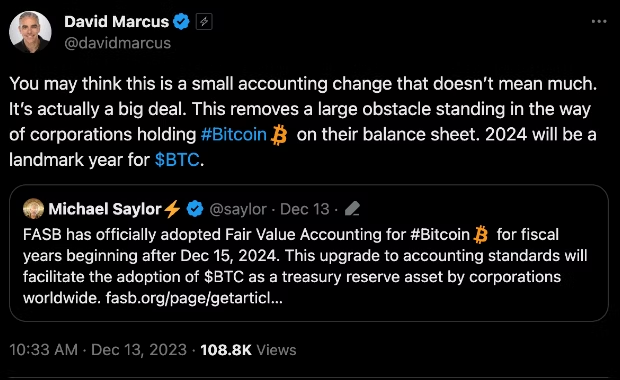
This accounting update will facilitate the adoption of bitcoin as a cash reserve asset at the enterprise level.
Industry leaders, such as David Marcus, former president of PayPal and CEO of Lightsparkspoke on to underline the importance of this change of rules.
This change in accounting rules comes at a time when the recent rise in bitcoin seems to be in the crosshairs of companies.
In November, SEC filings have mentioned bitcoin more than 1,000 timesmarking an increase of more than 30% compared to the same month last year.
Businesses are ready to buy bitcoin
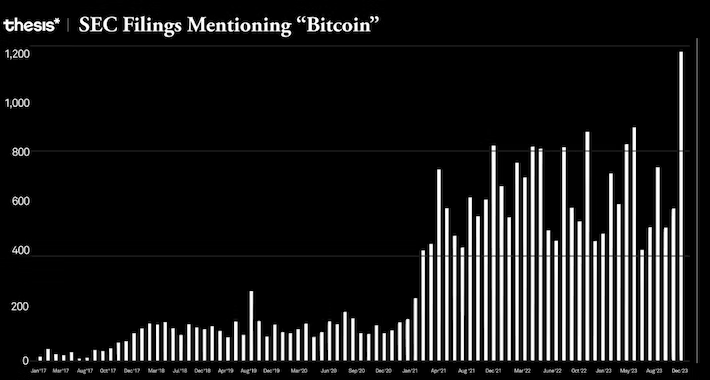
Companies are paying attention. It’s about to get a lot easier for them to put bitcoin on their balance sheets.
Google trends indicate imminent bitcoin bull run
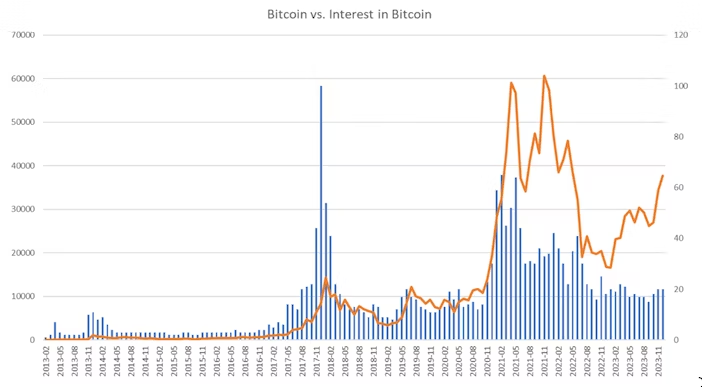
Despite this positive development, interest in bitcoin, as measured by Google trendsremains at levels last observed before the last bull run, in 2019.
The general public still seems to be unaware that bitcoin is up more than 140% from its lowest level last year.
This lack of public interest, despite bitcoin’s impressive performance this year, indicates that we are at the very beginning of this bullish cycle.
It looks like all the conditions are in place for bitcoin to have an explosive year in 2024. We have increased institutional adoption, potential ETF approval, the halving, more favorable FASB accounting rules, and the government will likely continue to run massive budget deficits. It’s only a matter of time before bitcoin starts to gain mainstream attention, and when that happens, the bull market will really start to gain momentum.
Maximize your Tremplin.io experience with our ‘Read to Earn’ program! For every article you read, earn points and access exclusive rewards. Sign up now and start earning benefits.