Geopolitical tensions will end with the emergence of a new international monetary system. With bitcoin at its center.
The dollar is still king, but for how much longer?
The greenback has been the world’s primary reserve currency since World War II.
It represents 58% of the currency reserves held by all central banks. The euro, the second most used currency, represents 21%.
But the lines are shifting, particularly since Russia’s invasion of Ukraine. Apparently, many countries are taking advantage of this change to turn away from the dollar.
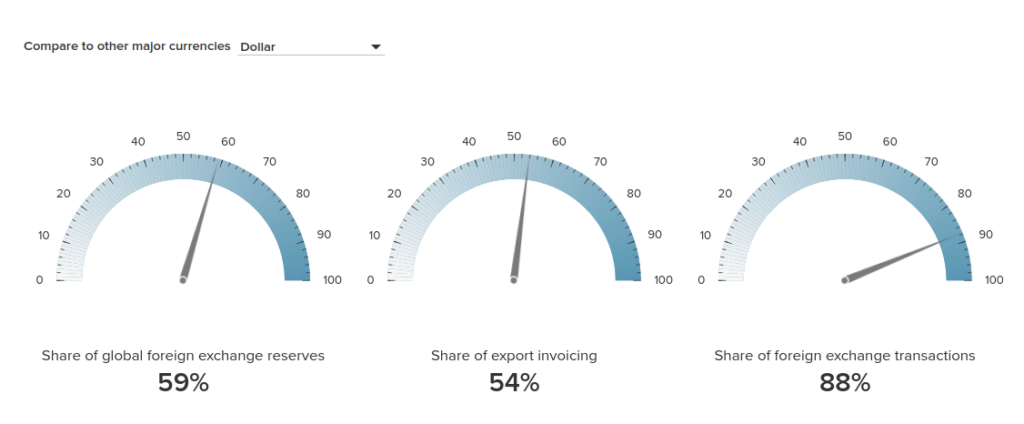
Now, BRICS (Brazil, Russia, India, China and South Africa) actively encourage the use of their national currencies. Since Rome was not built in a day, the dollar still dominates foreign exchange reserves, commercial invoicing and international transactions:
Dedollarization will take the time it takes, as will the emergence of a new international reserve currency. Gold? The yuan? A CBDC? Bitcoin?
In the meantime, the evolution of the BRICS share in world GDP is clear. The hegemony of the dollar will decline frankly, sooner or later.
We must realize that the Chinese economy already exceeds that of the United States at purchasing power parity. Another unmistakable sign is that Chinese industry represents approximately 29% of total world industrial production. That’s almost as much as the United States, Japan and Germany combined.
In total, the BRICS represent 31.5% of global GDP, compared to 30.7% for the G7. And this gap will widen a little more with the arrival of Ethiopia, Egypt, Iran, Saudi Arabia and the United Arab Emirates.
The deployment of Chinese financial plumbing is another leading indicator of the imminent abandonment of the dollar by the great emerging powers. China’s international payments system CIPS (a yuan settlement mechanism) now includes 119 direct participants and 1,304 indirect participants worldwide.
Certainly, the dollar represents 46% of SWIFT payments, compared to 23% for the euro and 3.7% for the yuan, but these figures do not tell the whole story. THE CIPS (China International Payments System) processed a transaction volume of 100,000 billion yuan (~$14,000 billion) in 2022, compared to 150,000 billion dollars for SWIFT. What will the figures be for 2023?…
The extreme scenario of complete dedollarization of international trade would be very painful for the United States. It would no longer be possible for them to post an abysmal trade deficit without the dollar collapsing.
Getting into debt will also become more difficult. US Federal Government Debt:
-2008: 10,000 billion dollars
-2023: $34 trillion
That’s $70,000 in additional debt (per American) in just 15 years. The American public debt, which today represents 1/3 of the world public debt, will have to increase more slowly if no one wants it anymore.
This will be the consequence of dedollarization. Here are some examples of BRICS efforts in this direction.
Brazil
The Brazilian president is a fervent supporter of dedollarization, even if things are moving slowly in practice.
“Every evening, I wonder why all trade must be done in dollars”he declared in April at the headquarters of the Shanghai New Development Bank, also called the “BRICS Bank”.
“ Who decided that the dollar would be the international currency after the demise of the gold standard? Why can’t we trade based on our own currencies? »he added, eliciting thunderous applause.
Since then, the Brazilian Central Bank has established a swap line with the People’s Bank of China (PBOC). Both nations can now trade in their currencies. Knowing that China is its largest export market
If the dollar remains largely dominant in Brazil’s foreign exchange reserves, the tendency has clearly been declining since 2018
Brazil’s efforts to increase its exposure to the yuan are important. Non-dollar-denominated transactions will increase and its dependence on the dollar is expected to significantly erode in the medium term.
Russia
The Russian president recently gave figures on Sino-Russian trade:
“As of September this year, the situation is as follows: the ruble is at 40%, the yuan is at 33%, and the combined use of the dollar and the euro is at 24%. Before it was 87%, now it’s 24%. »
The yuan has supplanted the dollar as the most traded currency in Russia in 2023. The red note and gold have become the main reserve assets of the Russian central bank which no longer invests a kopeck in American debt.
Russia has pursued anti-dollar policies since 2014 to mitigate the impact of financial sanctions. These include freezing 300 billions of dollars/euros of foreign exchange reserves.
This complete dismantling of the world’s leading nuclear power has far from gone unnoticed by the rest of the world. Many nations now realize that it is very risky to keep too many dollar reserves.
The Russian president said this week that Russia is keenly interested in blockchain and central bank digital currencies:
“When it comes to international transactions, we are increasingly converting to advanced solutions, including those involving blockchain and CBDCs. »
And since CBDCs don’t use blockchain, perhaps this was a nod to bitcoin? The latest news is that Vladimir Putin has never uttered the word Bitcoin. Even more suspicious, a “retail” CBDC is being tested. Mistrust.
Concerning this “wholesale” CBDC, it is a project led by the Bank for International Settlements (BIS):
India
India avoids any initiative likely to support the yuan. A certain rivalry remains between the two Asian giants. Indians are focusing on expanding bilateral monetary agreements that facilitate rupee trade. Particularly with the United Arab Emirates which supplies a good part of their oil imports.
Faced with the Western embargo on Russian oil, India jumped at the opportunity to buy naphtha at a low price. With all the more enthusiasm since Moscow made the effort to accept the rupee as payment.
Unfortunately, the Indian subcontinent doesn’t produce much that interests Russia. So the Russian central bank does not want to accumulate too many rupees. India now pays Russia in UAE dirhams.
In short, India is leading its boat, not refusing any bargain such as Russian naphtha at a discount, even if it could damage its relations with the West a little.
For example, India uses the Russian financial messaging system SFPS. This decision dating from April allows the acceptance of Indian Ru-Pay cards in Russia and Russian MIR cards in India. Other countries like Turkey eventually backed down under Western pressure.
China
China has established bilateral swap lines with all founding members of BRICS except India and with more than forty central banks around the world.
China’s parallel financial plumbing is another leading indicator of the upcoming abandonment of the dollar by the great emerging powers. China’s international payments system CIPS (a yuan settlement mechanism) now includes 119 direct participants and 1,304 indirect participants worldwide.
In 2023, the yuan will overtake the dollar as the most used cross-border currency in China. In addition, if its reserves in the form of US Treasury bonds have fallen by 40% in a decade. However, they remain above 800 billion dollars.
The decision to lift capital controls, or not, will be a key factor in allowing the yuan to become an international reserve currency. But this does not seem to be Beijing’s objective.
On the other hand, gold purchases are breaking historic records by central banks. China has been buying them liberally since the Fed began printing money (QE).
What about Bitcoin?
It is hard to imagine how the CBDC project could reconcile the United States and Russia… Who will have the last word in this system (mBridge) headed by the BIS? How can we be sure that no country is ever disconnected as is the case with the SWIFT network?
If the goal is to create an uncensorable payment network, bitcoin is the place to turn. No country can prevent a transaction made via stateless bitcoin. In any case, as long as bitcoin miners are scattered all over the world.
Bitcoin also has the advantage of being a payment system as well as a currency. Two in one. As such, it replaces gold, which is much inferior to bitcoin as a store of value and payment network.
Bitcoin is digital gold traveling almost free at the speed of light to the four corners of the world. Nations that have accumulated large quantities of gold are in denial, but we will have to face the facts one day.
Bitcoin is the replacement solution for the SWIFT network as well as the dollar. If bitcoin were to replace foreign exchange reserves (~$12 trillion) and gold (~$14 trillion), then a single bitcoin would be worth $1.3 million. To the wise.
Maximize your Tremplin.io experience with our ‘Read to Earn’ program! For every article you read, earn points and access exclusive rewards. Sign up now and start earning benefits.