
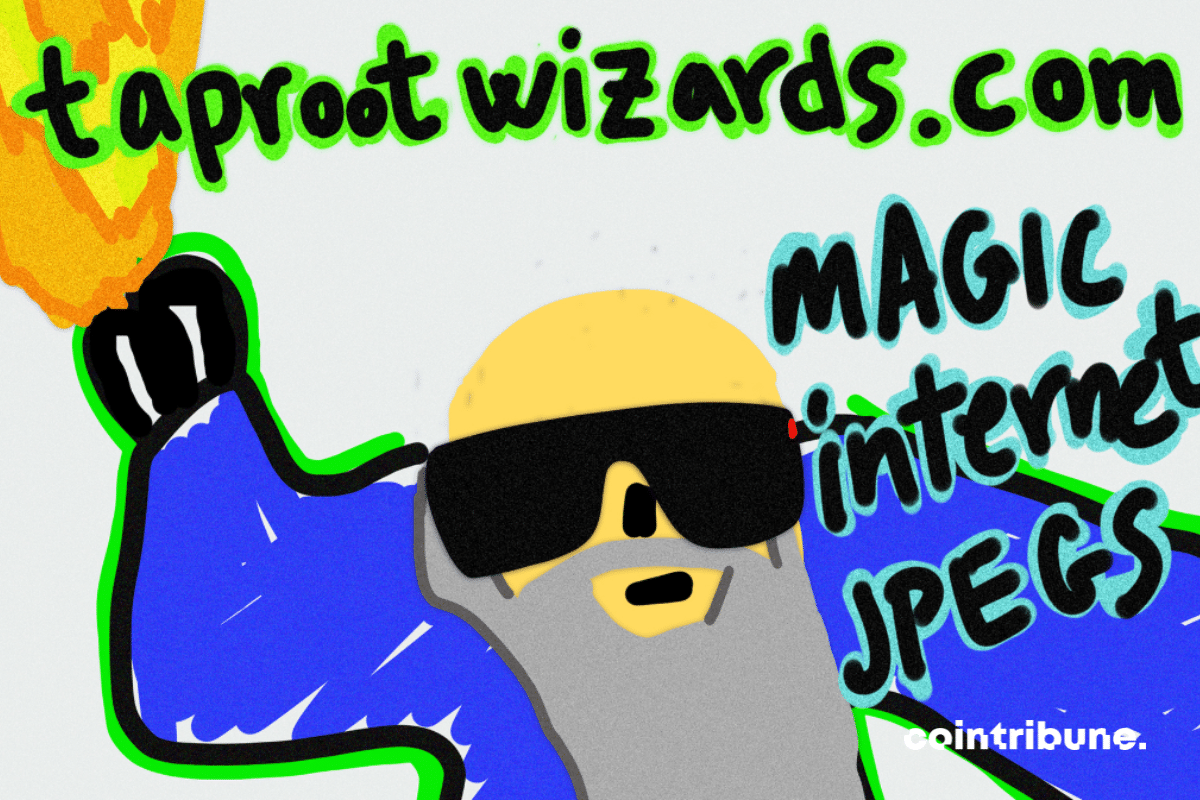
Ordinals have been sowing discord since the OCEAN pool launched by Luke Dashjr and Jack Dorsey began filtering them.
What is an Ordinal?
This is a new word popularized to describe jpegs supposedly linked to satoshis via “inscriptions”. A type of NFT immanent in Bitcoin created less than a year ago by developer Casey Rodarmor.
This sleight of hand is done by numbering each satoshi (ordinal theory). According to the ordinals convention, the five billion satoshis of the genesis block mined by Satoshi Nakamoto are numbered 0, 1, 2, 3… up to 4,999,999,999. And so on for all the following blocks.
The inscriptions are arbitrary data linked by convention to satoshis. That is to say generally jpegs presented as “digital artifacts” which come to squat forever in the blockchain.
Satoshis are realigned virtually after each transaction by the explorer ordiscan which conceptually maps the satoshis one by one. The explorer already lists more than 47 million registrations weighing a total of almost 14 GB.
It has always been possible to insert a bit of arbitrary data into the blockchain. The famous title “The Times 03/Jan/2009 Chancellor on brink of second bailout for banks”, For example. But these are a few bytes. A jpeg is thousands of times heavier than that.
This abuse of space was made possible by the Taproot and SegWit soft forks which allow up to 0.4 MB per transaction. That’s 10% of the space of a single block for a single transaction…
SegWit
This soft fork is a legacy of the “Blocksize war”. A war won by the obvious: a blockchain that is too large would signify the end of decentralization. Segwit was a compromise.
Segregated Witness (SegWit) refers to a change in the format of transactions. The signature and scripts are now segregated into a section called “witness” where the rule is that a byte weighs only 0.25 vbyte (virtual byte).
This segregation makes it possible to build blocks that can weigh up to 4 MB without violating the consensus of 1 MB maximum for a block.
Subsequently, the Taproot soft fork removed the limit on the quantity of data that can be inserted into scripts (“Opcodes”) which are essentially used to link a quantity of bitcoin to a public key.
The OP_RETURN Opcode was notably used by Satoshi Nakamoto to write the message “Chancellor on brink of second bailout for banks”.
Ordinal registrations use three Opcodes: OP_FALSE, OP_IF and OP_PUSH. The data contained in OP_IF is preserved, allowing ordinals to be inserted for posterity.
In short, since Taproot, scripts are no longer constrained by the 10,000 byte limit. However, the mempool (Bitcoin core) ignores transactions weighing more than 400,000 bytes.
However, a larger transaction can be directly inserted by a pool. In this case, the limit is 4MB:
Where is the problem ?
One of the criticisms made of ordinals is that they make the blockchain heavier. The 14 GB of registrations represent almost 20% of the 80 GB added to the blockchain since the start of hostilities. This buildup of gunk makes installing a node take longer and more expensive.
You have to realize that a knot today costs between $300 and $700! And that downloading 530 GB can take days in some areas.
There is no danger in the house, far from it. This is good publicity for the Lightning Network. But the fact remains that registrations are a nuisance.
No node expected to download and relay mountains of jpegs after Taproot. The anonymous account Volker had a nice picture about this:
“Registrations are like pumping electricity to a telephone company, or pressure to a water company. Using these networks in a manner inconsistent with their design is at best a scam, at worst an irresponsible attack on something essential. »
Bitcoin is a payment network, not a jpeg parking lot. A Peer-to-peer Electronic JPEG Cash System. Of course, block space naturally sells to the highest bidder, but let’s not bury our heads in the sand either.
Ordinals, BRC-20 and other rare sats exploit a vulnerability via social engineering capitalizing on FOMO and pump & dump. The registrations can be seen as a DoS attack financed by armies of newbies manipulated by professional scammers.
If ordinals are the new dogecoin, the permanent increase in transaction fees risks quickly annoying more than one person.
Fix the bug?
This unexpected bug should not be brushed aside as if nothing had happened. But what to do? After all, Taproot is important for coinjoins, anonymity, and multisig transactions.
For example, Schnorr signatures make it possible to aggregate multiple keys and signatures into one. This results in smaller (and therefore cheaper) and more discreet multisig transactions. They also make life easier for CoinJoins coordinators and offend channel openings on the Lightning Network.
Some therefore suggest that miners filter registrations from the mempool. This is what the OCEAN pool recently launched by Jack Dorsey and Luke Dashjr does. After all, the mempool already filters transactions exceeding 400,000 bytes.
Some are calling for censorship. Others appreciate this initiative against this interference which smells like a DoS attack. The others have their asses stuck between two chairs.
By the way, OCEAN also plans to implement the Stratum V2 protocol. The goal is to give miners the power to select transactions themselves.
It is very good news to remove this responsibility from pools which will sooner or later be forced to censor normal transactions. Perhaps this is the real risk of censorship…
Maximize your Tremplin.io experience with our ‘Read to Earn’ program! For every article you read, earn points and access exclusive rewards. Sign up now and start earning benefits.


