This is a delicate and unique question. However, many symbols cover the use of money today, whether traditional currencies or cryptocurrencies. The symbolism used in a domain informs us about the effective action of a principle on a community. In this respect, the study of the lack of symbolism in contemporary money nevertheless allows us to judge certain predispositions of money on the minds of the public. Similarly, the symbolism used in cryptocurrencies partly takes up the codes of traditional currencies.
What is symbolism?
Symbolism is an artistic, literary and philosophical approach that uses symbols to represent ideas, concepts or meanings deeper than what is literally visible. Symbols are visual, verbal or conceptual elements that have a broader and deeper meaning than their outward appearance. Symbolism is often used to convey complex, emotional or spiritual ideas in an evocative and suggestive way. Since modern times, symbolism has seen some decline, and an increasing number of people and scientists are unaware of the symbols around them.
The most famous symbols are obviously those of religions. For example, the Christian cross or the Islamic crescent, the Star of David, etc. Each of these symbols is not chosen at random and has an effective meaning. But symbolism goes far beyond religion, and modern society has also invented its “symbols” (like the heart for love, the bottle for the party, the shapes of the marks, the flags, etc…). The study of symbols gives above all an image of the society that produces them. But some symbols cross the ages, and their original meaning is known only to a small number of people.
Finally, symbolism arises from a paradox. Indeed, if the symbols belong to what is inexpressible, it is paradoxical to want to interpret them and put words to them. Therefore, symbolism is often, as a matter of principle, kept silent.
Gold and circularity: the symbol of bitcoin (BTC)
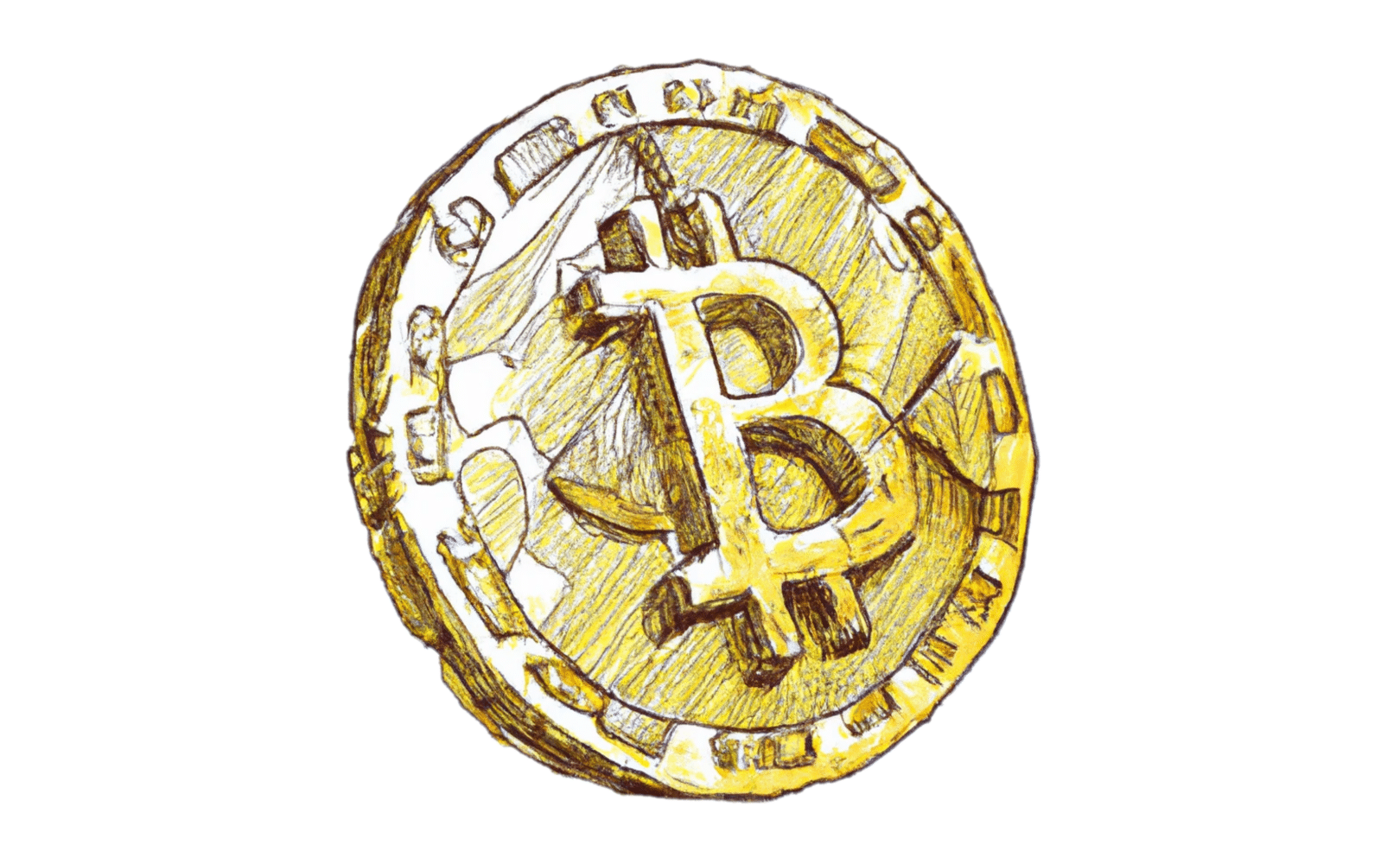
Bitcoin is a dematerialized network. However, in the mind of the public, the latter is often compared to a gold coin. There is a double symbolism in Bitcoin. Indeed, we first notice that the “₿” of bitcoin uses the codes of the dollar $, with the presence of two vertical bars. The vertical bar present on the dollar can be explained in several ways. On the other hand, the second symbolism relates to the Gold to which Bitcoin is generally attached, and to a lesser extent, to the circularity of its representation.
A reference to the dollar
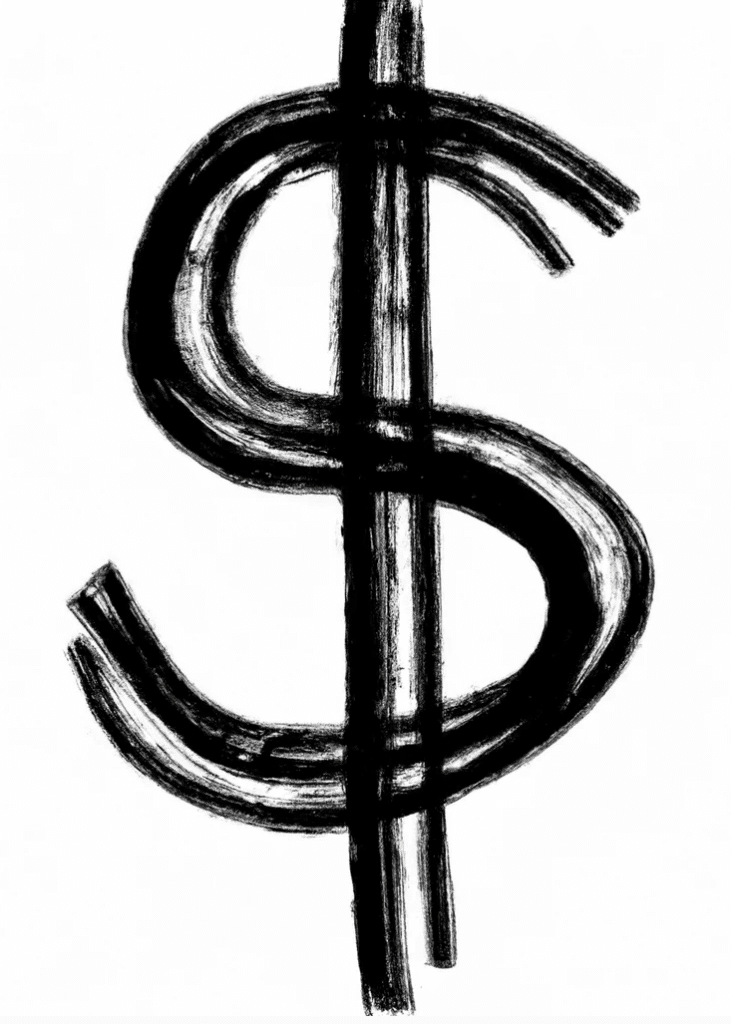
One of the most common theories is that the dollar sign ($) comes from the abbreviation “PS”. The P stands for “peso” in Spanish, used during colonial times in America. Thus, the letter “P” was often written above the letter “S”, creating a shape similar to the crossed out “S” of the dollar sign. But the vertical element in the symbol could be a stylization of the “S”, or it could represent a letter “U” superimposed on a letter “S”. Which therefore refers to “United States”.
For its part, the design of the symbol was created by a Belgian graphic designer, Alain Billiet. The euro symbol is inspired by the Greek letter epsilon (ε), which symbolizes the currency of ancient Greece, and it is also related to the letter “E” for “Europe”. Because of this, the two horizontal bars in the euro symbol often represent the stability and balance of the euro. Under another aspect, they can also symbolize the union and the economic convergence of the member countries of the euro zone.
In any case, this famous “₿” is clearly there to remind us of the competition it exercises against the dollar. Also, in ancient symbolism, vertical strokes often represent the Divine Spirit (“In God we trust”), linking what is high to what is here below. Money would then be, in this interpretation, an object that actually goes beyond the society that produces it. On the other hand, the horizontal lines often symbolize the earthly plane, the apparent stability, and sometimes, the equality between the members. The euro is of some relevance in this regard.
The symbolism of Gold
Gold is considered in ancient traditions as the noblest of metals. He is the incorruptible, the eternal. It is also the symbol of the Golden Age, like the lost paradise, in which external appearances did not count. In Hindu cosmogony or Roman mythology, this age is followed by a degeneration, where the silver, bronze and iron ages follow one another. In 1360, the French theologian Nicolas Oresme wrote, in his Traite Des Monnaies, a passage that deserves our attention.
“This is how we did it [l’alliance de métaux] formerly of bronze, as Ovid recounts in the first book of Fasti, saying: “Bronze were the denarii that were once given, but now gold is a better guarantor. And, defeated, the currency of the old times bowed to the new”. It is a similar change that the Lord promised through the voice of the prophet Isaiah, saying: “instead of bronze I will bring gold, and instead of iron I will bring silver.”
Nicolas Oresme, chapter II, of Coin Treaty (1355-1360)
Gold is therefore a guarantee of stability, constancy and elevation. Gold coins accompanied most of ancient history until the beginning of the 20th century. But today, Gold is only observable on old currencies, and it is less concrete and effective for many people.
Despite everything, symbolizing Bitcoin as a gold coin is still an implicit message. On the one hand, this can be interpreted in the idea that Bitcoin is as stable and eternal as Gold. On the other hand, it can also mean that Bitcoin has become the new Gold, and that it is competing with it. We therefore find here again the interpretation of the vertical lines. Concretely, the comparison between Gold and Bitcoin amounts to awakening a feeling of greatness and confidence for an innovation that is paradoxically dematerialized, and therefore, without representation. In addition, Gold and bitcoin are comparable in few aspects.
On the circularity of currencies
A final element is given to us by the circularity of coins. Of course, there is the practical reason that a coin is circular. But the symbolic reason is all the stronger as the ancient texts refer to it explicitly. The circle is one of the great pillars of symbolism, it is found almost everywhere and in all the greatest authors (from Aristotle via Marc Aurèle, René Descartes and many others…). So, “it represents the finite and infinite whole, the unity and the multiple, the full and the perfection as is the Creator of the Universe”. In many traditions, the circle embodies time and currency is thus inscribed in the temporal domain, under the authority of royal and/or spiritual power.
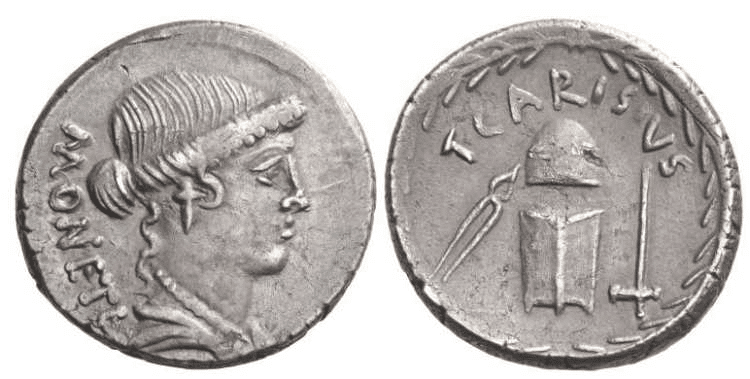
Nicolas Oresme wrote the following words in his treatise about money… “O inventions of wise men! O wise dispositions of the ancients! Exquisite system which, at the same time, classifies what is necessary for man and symbolically contains so many mysteries of nature.. In geometry, the circle is also the primordial element from which most geometric figures derive (square, triangle, etc.). Therefore, symbolizing the currency as a golden circle is the assurance of perfect harmony. The cryptocurrency ecosystem has relied, consciously or not, on these codes from another time.
At the origins of money
Contemporary vocabulary has inherited a certain symbolism on money. Indeed, money originally refers to the idea of making peace, of participating in a community, and in a set of social relations. Let us underline the etymology of the word to pay, which in Latin is written pacarewhich means ” make peace “. Likewise, the word ” interest “ decomposes as interestedthat’s to say “to be among”. Money is therefore one of the great pillars of human societies, one of those external forces of the economy, which transcends times and places.
“Money (from the Latin moneta), in the etymological sense of the term, originated from Juno Temple (goddess of Rome, wife of Jupiter) in Rome where coins were minted. The Latin term moneta is itself derived from the term monēre, which translates as warning, reminding something. The historical, functional, and etymological roots of money are also those of debt. »
Money and private currencies – Tremplin.io
Furthermore, we also find in the word ” obligation “, bond in English, the idea of the emotional bond, of the social bond. We therefore see that the symbolism of money extends beyond figures or matter. Money is a noble thing, which certain minds constantly strive, through innovations, to maintain in an eminently respectable old form.
Receive a summary of the news in the world of cryptocurrencies by subscribing to our new service daily and weekly so you don’t miss anything of the Tremplin.io essentials!