
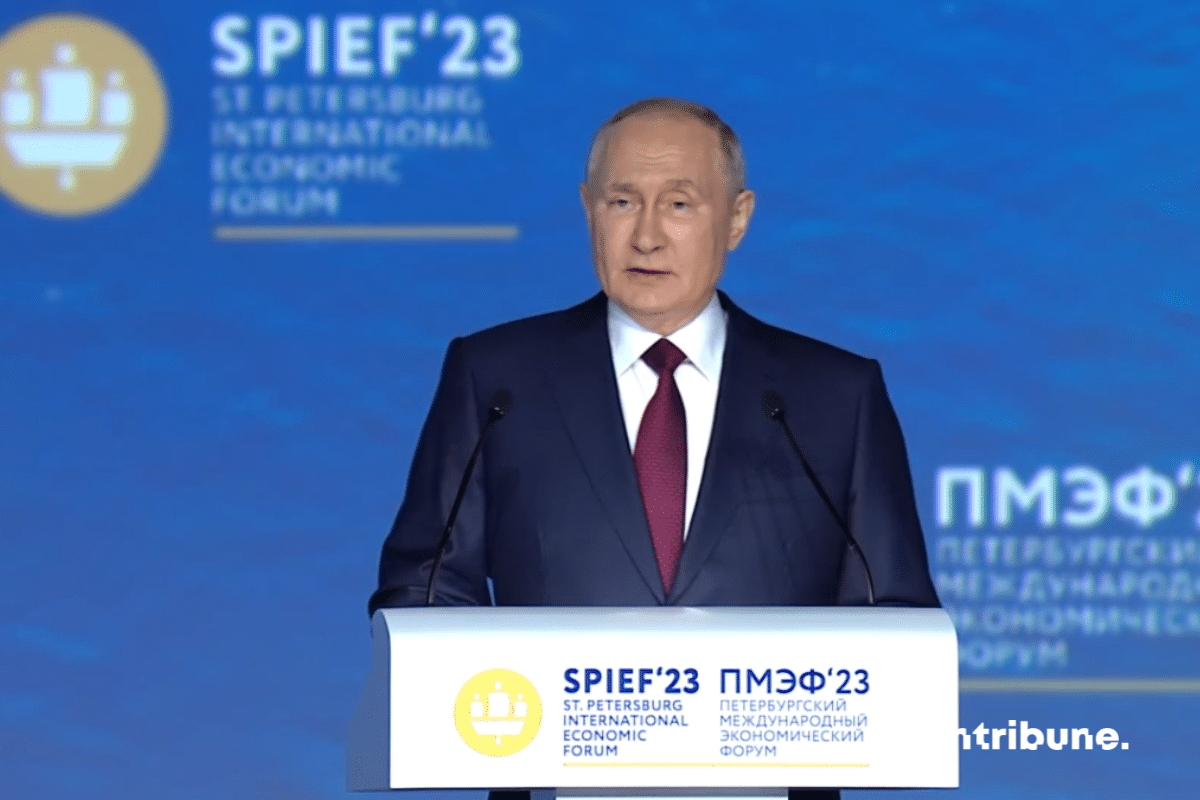
The main event this weekend was the St. Petersburg International Economic Forum. Sharing the stage with his Algerian counterpart, the Russian president predicted the end of the dollar there.
dollars? No.
For Vladimir Putin, the growing use of national currencies for cross-border trade signals the end of US dollar hegemony.
Russia is obviously setting an example by carrying out more than 80% of its trade with China via the ruble/yuan pair. The ruble is even involved in 90% of Russia’s trade with the countries of the Eurasian Economic Union.
V. Putin did not fail to point out that dollar reserves and trade settlements using US currency continue to decline:
“The share of settlements in dollars is decreasing. The share of settlements in yuan is increasing. […] Oil producers in major Arab countries now say they are ready to accept the yuan as payment for their oil. If this trend gains momentum, then it will be the beginning of the end for this currency [le dollar]. »
V. Putin also hailed Brazil’s and Argentina’s plans for a new reserve currency for all of South America. Asked about the question of a kind of common currency in the Arab world by his Russian counterpart, Algerian President Abdelmadjid Tebboune replied:
“I wish that were the case. Some currencies have been imposed on the whole world. Algeria would like to join the BRICS organization in the near future. We would like to join it so that we no longer suffer certain pressures on our economy. Several countries like Saudi Arabia and the United Arab Emirates have very strong currencies. Perhaps such a decision will be made. We will see what the future holds for us. »
The Boomerang Effect of Sanctions
The Russian president insisted that Russia never intended to de-dollarize either its national economy or the global economy.
It was the policy of American sanctions against Russia that forced Moscow to drop the greenback for other currencies in order to keep its economy afloat:
“By pursuing opportunistic short-term political goals, they [USA] undermine their power, including in global finance. By using the dollar as a weapon, the United States raises doubts about the reliability of its currency as an instrument of payment, but also as a reserve asset”.
And the fact is that many countries are inspired by the sling of Russia. This was again seen recently at the meeting of BRICS foreign ministers. The Washington Consensus is crumbling and the world is crying out for a multipolar world order.
“The old neo-colonial international system has ceased to exist while the new multipolar international order continues to grow stronger”launched V. Putin during his speech.
Russia’s and China’s alliances with other countries have created powerful groupings. And in particular the Shanghai Cooperation Organization which represents around 30% of the world’s GDP. But also and above all the BRICS which bring together 40% of the world’s population.
It’s a safe bet that regional reserve currencies will soon emerge under the BRICS umbrella. As well as new international institutions which will soon trump those of Bretton Woods (IMF and World Bank).
Our article: BRICS: A new Bretton Woods this summer?
New world order
IMF President Kristalina Georgieva recently admitted that the dollar’s share of international foreign exchange reserves is declining. But she does not expect a sudden decline:
“The share of the dollar in international foreign exchange reserves has fallen from 70% to less than 60%. But we do not expect a rapid change in the composition of foreign exchange reserves. For what ? Because it is the strength of the US economy and the depth of its capital markets that make the dollar a reserve currency. Wait a bit before burying it. »
Today it is, but slowly.
Then it does, but it doesn’t matter.
Finally, it is inevitable, and it is your fault if you did not cover yourself. »
Certainly, but everything is simpler when nations are forced to sell oil exclusively in dollars…
The nations are tired of this reverse aid for the benefit of Uncle Sam. Again this week, it is the Egyptian Minister Ali Moselhy who has snubbed the dollar in trade with the BRICS.
“Discussions are underway so that we can trade in the national currencies of countries such as India, Russia or China”said Mr. Moselhy.
Russian Ambassador to Egypt Georgy Borisenko told him that Cairo had officially applied to join the BRICS:
“Egypt applied to join the BRICS group because of one of our initiatives to diversify as much as possible the currencies used in trade, whether it is a national currency or the creation of a common currency. Egypt is very interested in this issue”.
Very good, but there remains the thorny issue of the reserve currency. National currencies, whatever they are, remain inflationary ponzis. Bitcoin and its 21 million units is chomping at the bit.
Receive a digest of news in the world of cryptocurrencies by subscribing to our new service of daily and weekly so you don’t miss any of the essential Tremplin.io!


