
We have several risk events that have accumulated recently. Risks that are often linked to lack of liquidity. We are now dealing with the consequences of the 2022 rate hikes. And as the risk of recession increases over time, it is important to see the different ways to protect against a recession. We are going to see 5 ways to protect yourself from a recession.
The definition of a recession
The theoretical definition of a recession is when the GDP has two consecutive quarters of negative growth. In practice, it happened a few times to have two consecutive quarters of negative growth without having a recession. To have a recession, there must also be an increase in the level of unemployment.
The NBER’s definition of recession specifies that it involves a significant drop in economic activity that spreads throughout the economy and lasts for several months. In determining a recession, they will take into account the following three criteria: depth, spread and duration. That’s why I prefer to look at the major factors of economic growth like:
- The production
- employment
- The consumption
- Revenues
In the current case, if we look at these 4 factors, we have growth that is around 1% in the United States. The average growth over 10 years is around 2%. Consequently, the current growth is below the average of the last 10 years.
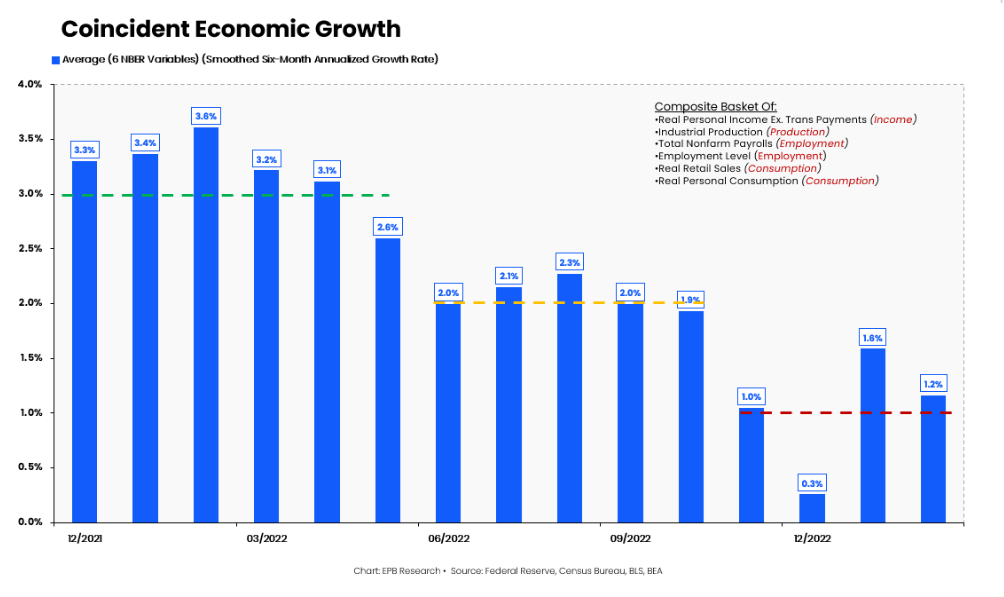
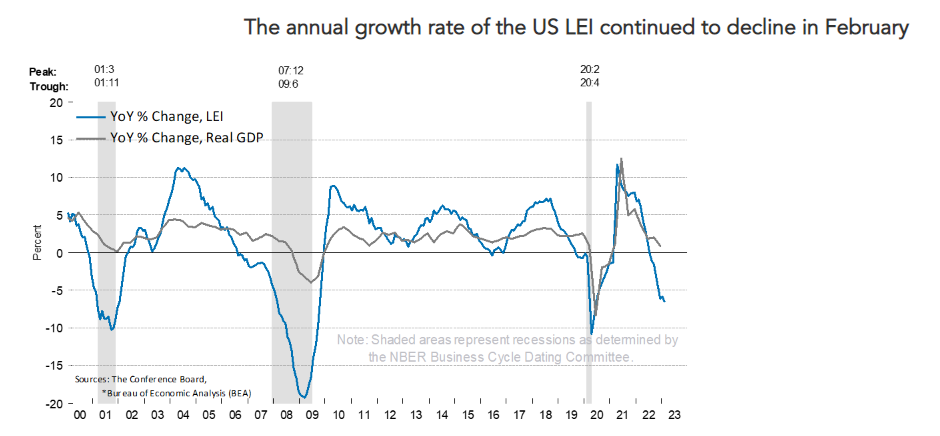
However, the coincident numbers do not give the direction but the current state. If we look at the Conference Board’s leading economic indicator, we can see that the growth of the indicator remains negative in expectations. Until then, it is rare that the indicator has not anticipated a recession with such a deeply negative level.
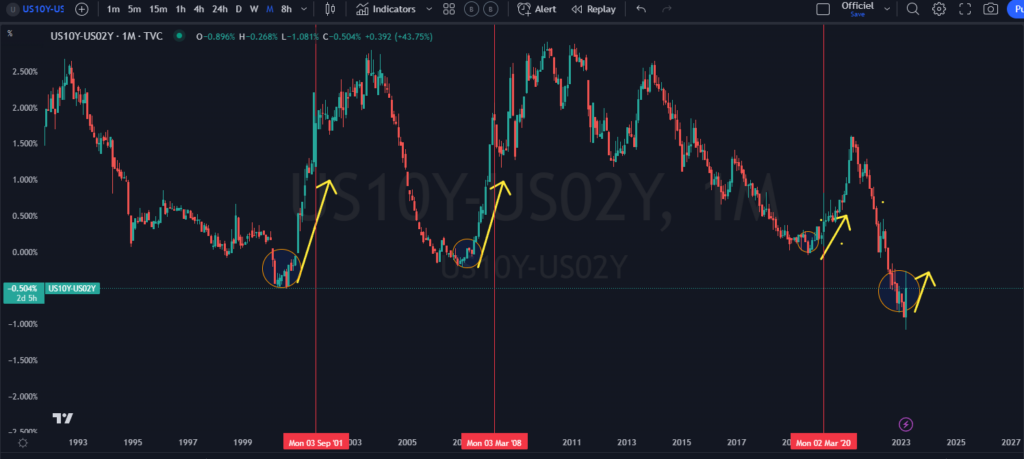
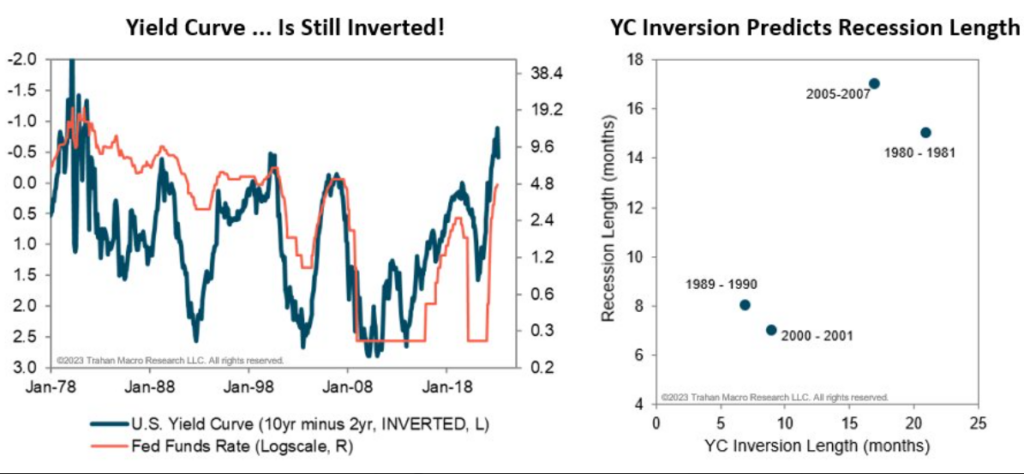
The other leading pre-recession indicator remains the inversion of the yield curve. We can see that the curve has been negative for several months. That said, it is often after the rebound in the curve that the recession begins in the coming months. We recently had a curve bounce.
The other important element remains the duration. The relationship between the duration of the curve and the duration of the recession are quite correlated. The more the curve remains inverted A LONG TIMEthe longer the recession can last.
5 ways to deal with a recession
As long as we have no elements for improvement, we will look together at 5 ways to protect yourself from both an economic slowdown and a recession. Of course, this is not advice but different ways to limit the damage before the recession officially begins. On the other hand, even without officially going through a recession, it is also a way of protecting against economic slowdowns.
1. CASH is not TRASH
We often hear the proverb that says CASH IS TRASH, which means that cash is trash. Certainly, it is true that in normal times, cash naturally loses value due to inflation. This is why it is frequently said that cash should be invested to make it work in order to fight inflation. If we go straight into a recession, a lot of assets will lose value. Therefore, investing no longer fulfills its role of protecting your cash against inflation since there is a loss in value. It is in this type of situation that CASH remains privileged.
We define cash in several ways, you have both monetary funds, but also treasury bills and any short-term interest investment.
The fact that the FED increased its key rate throughout 2022 nevertheless made it possible to have higher short-term rates. This is an advantage to remunerate short-term cash. In particular on treasury bonds or monetary funds. For example, we can see quite a shift from cash to monetary funds currently:
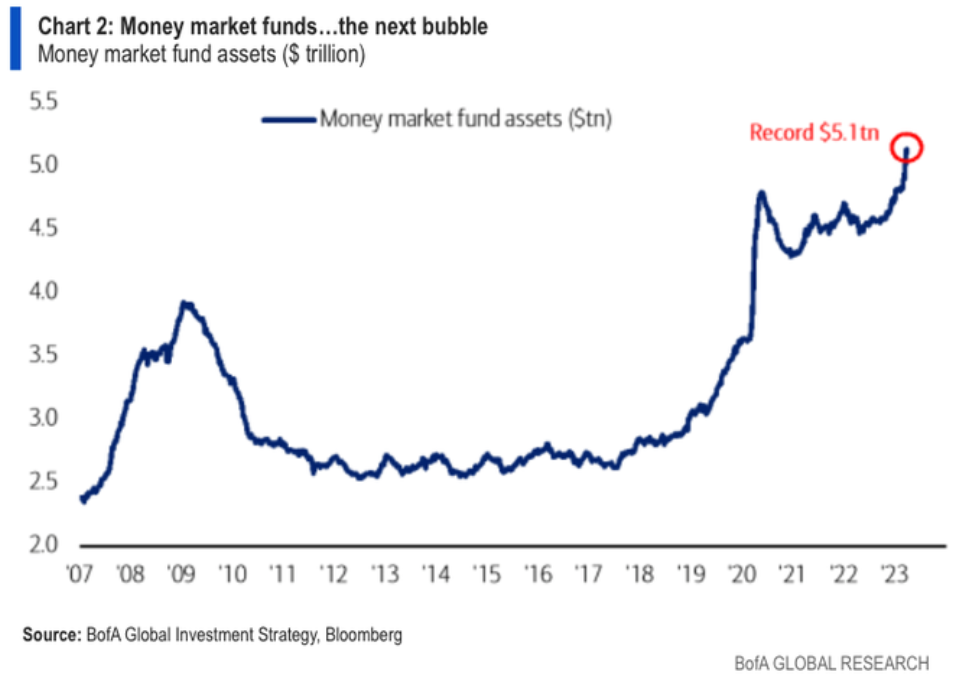
Even if high rates make it possible to have an interesting rate of return without risk, this is not always an advantage for the banks. This is currently the case because they do not offer to remunerate the cash as it should. Consequently, individuals will prefer to deposit their cash on the money market like treasury bonds. The fact that there is a deposit reduction increases the systemic risk related to liquidity since the banks use these deposits to make transactions.
2. Dividends
Dividends that relate to high quality companies. For example, companies with financial stability, stability in terms of revenue growth and profit growth. Collecting dividends during a recession allows you to diversify your income and obtain returns to compensate for market declines. On the other hand, if we choose high-quality companies with solid foundations, this also makes it possible to reduce the risk of individual default.
If you want to reduce individual risk through diversification, you can choose an exchange-traded fund (ETF) that brings together a set of high-dividend companies.
3. DCA
The DCA (Dollar-Cost Averaging) strategy is to smooth a price by gradually investing fixed amounts over a fixed period. This allows you to deal with more volatile periods which are often during economic downturns or recession. Investing small amounts lessens the stress of loss that may be incurred compared to a single fixed price investment. There have been studies that have been done to find out when DCA is most effective. Here is a graph that highlights this kind of study:
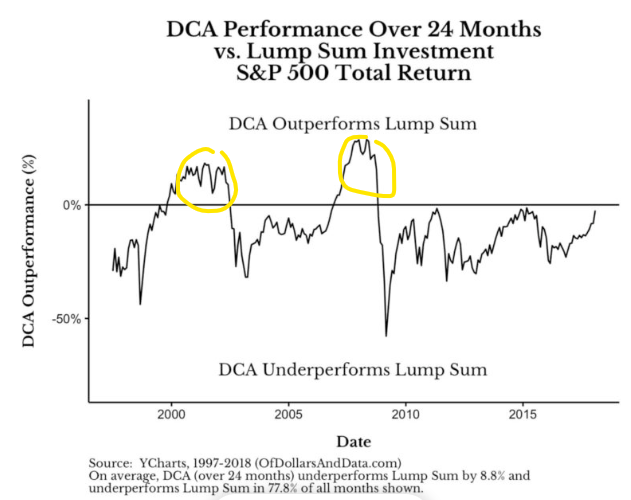
It can be seen that DCA is more specifically effective during recessions or downturns.
4. Asset performance during a recession
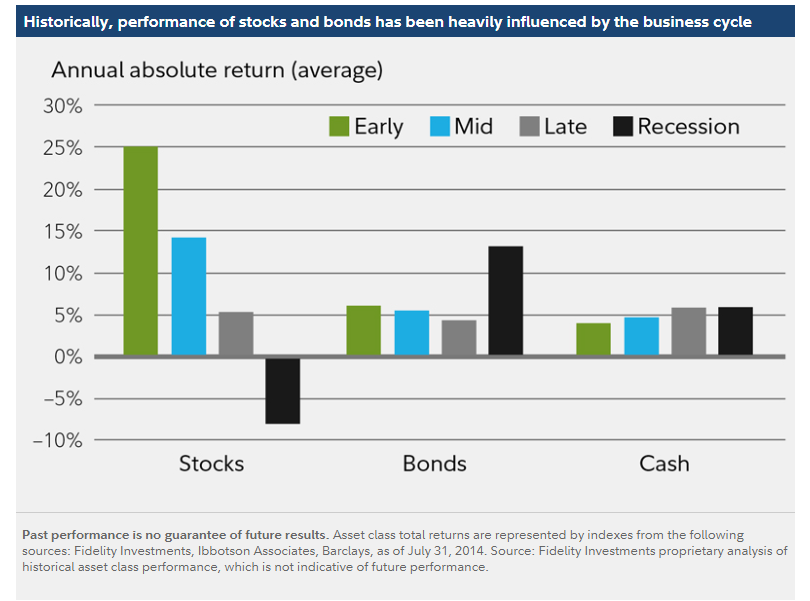
When we talk about major assets at the macroeconomic level, we are talking about equities, commodities (precious and industrial metals), bonds and currencies. Generally speaking, bonds are often the best performers during a recession. We are talking about bonds with a long maturity. Here is a table that highlights the different performances of the assets:
We can also talk about gold since it is considered a safe haven. Here is a chart that puts the performance of gold during different economic phases. You can see that gold reacts quite positively during economic downturns and recessions:
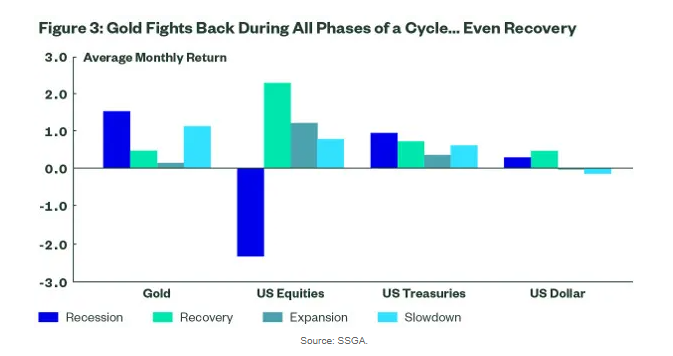
On the other hand, just like bitcoin, gold reacts very well to an increase in the Fed’s balance sheet. They are assets that are quite sensitive to this.
5. Know how to take a step back
During a recession, there are often panic movements, these are human behaviors that are repeated. However, recessions have always existed and are an integral part of cycles. Therefore, if you are not comfortable with a market decline, you need to review your profile. Investing is not just about making money but it involves risk. When you are not comfortable with the risk, you have to review and determine your tolerance level. Invest only what you are ready to lose or the other possibility remains to use less risky products, but which offer less performance.
CONCLUSION
We know that historical performance does not guarantee future performance. But statistically, there are assets that perform better during a recession. Therefore, one can find alternatives and implement different strategies according to one’s profile.
Receive a digest of news in the world of cryptocurrencies by subscribing to our new service of daily and weekly so you don’t miss any of the essential Tremplin.io!