
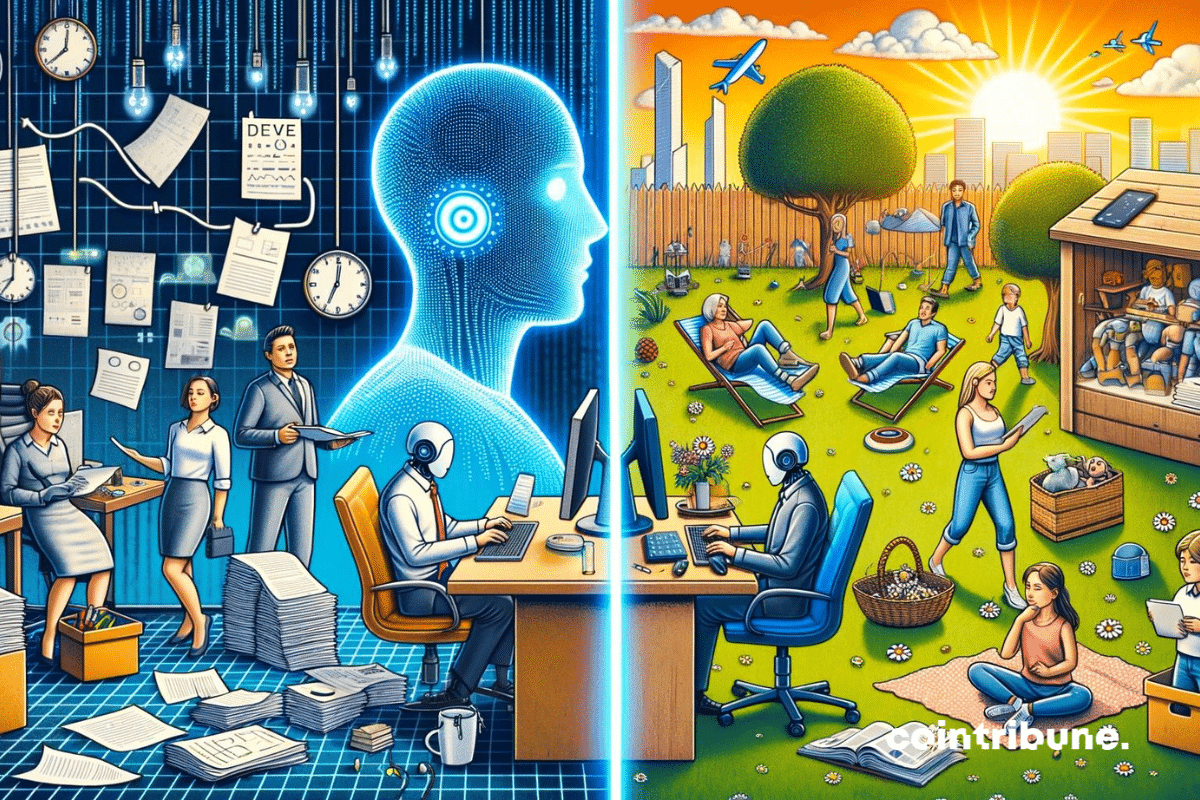
Artificial intelligence (AI) is revolutionizing the professional world, opening up new perspectives. Among these is the vision of a three-day work week. Recently, billionaire and Microsoft founder Bill Gates became the torchbearer for this vision of the world of work. An idea that finds support in the business community, notably with banker Jamie Dimon. The prospect of a working world operating for 3 working days may seem enticing at first glance. But it still raises debates relating to its possibility or not of materializing. In this article, we examine the sustainability of this perspective and its possible implications.
Is the idea of a 3-day work week thanks to AI possible?
There is no denying that artificial intelligence (AI) has benefits. Saving time being one of them. And it is precisely this time saving that suggests that AI could promote a change in the working week. Usually 5 days, the latter would increase to 3 days according to the suggestions of some. But fundamentally, is it actually possible to achieve such a transition using this technology?
It must be recognized from the outset that the idea of a 3-day work week thanks to AI has both multiple and impactful benefits. Firstly, this approach would promote an increase in productivity. The integration of artificial intelligence into work processes would enable the automation of repetitive tasks. This would free up time for employees to focus on higher value-added missions.
Additionally, a shorter work week would provide a better work-life balance. By having an extra day ” rest “, workers would be able to devote more time to their personal activities. This could contribute to their well-being, both physical and spiritual, in particular by reducing the stress and professional burnout associated with a hectic work pace.
Other benefits of this perspective: improved employee creativity and innovation. But also, protecting the environment by reducing the carbon footprint, with AI helping employees optimize their travel, thereby reducing the use of energy resources.
But these benefits are just the tip of the iceberg. An in-depth analysis quickly makes us realize that basically, the implementation of a 3-day week using AI is not easy. This option has a number of disadvantages that must be considered.
The 3-day week driven by AI envisaged: challenges to overcome?
The introduction of a three-day working week, thanks to the integration of artificial intelligence, is sparking a complex debate. It highlights significant concerns that deserve special attention. Indeed, although this proposal may seem attractive at first glance, it involves several challenges that require careful consideration.
The prospect of an AI-enabled three-day workweek faces one major requirement. That of maintaining employee income. Because, basically, the materialization of such a possibility could result in a significant drop in income for employees. Indeed, the reduction in working hours would inevitably lead to a drop in income for those who are paid by the hour or month.
Additionally, some sectors may have difficulty adapting to a shorter work week. This would, for example, be the case for customer services or activities involving continuous production. Therefore, such a scenario could compromise their operational efficiency and results.
Another crucial aspect must be taken into account. It is due to the increased risk of increasing inequalities. In other words, higher-skilled, better-paid workers might be more likely to benefit from a three-day work week. Less qualified and lower paid workers could be left behind. Enough to aggravate the already deep socio-economic disparities.
Furthermore, the implementation of such a measure might not suit businesses, especially since it could generate considerable costs for them. It should be noted that automating tasks and reorganizing work to adapt to a three-day week would require significant investments. Particularly in terms of time and financial resources. Not to mention that these changes could also involve difficult transition periods and disruptions in production and service delivery processes.
The idea of establishing a three-day work week through the integration of artificial intelligence seems attractive at first glance. In the end, it is much less so given the legitimate concerns it raises.
A tricky trade-off to find?
We will have understood it. The prospect of a three-day workweek sparks heated debate because of its implications for productivity, worker well-being and organizational effectiveness. But beyond these obstacles, it could be deployed in a relevant manner if certain conditions are respected.
Thus, the implementation of this possible work structure must be carefully planned and executed. Companies need to develop effective strategies to fairly distribute the workload across the three days involved. This would help avoid overload that could compromise the mental and physical health of employees.
It is therefore crucial to provide workers with access to training and resources to help them develop new skills. This reduced work time could then be used productively to allow employees to expand their knowledge and improve in their field. And precisely, the potential of AI can be exploited for this purpose.
Conclusion
In short, the vision of a three-day work week thanks to artificial intelligence offers attractive potential despite being surrounded by significant challenges. Certainly, it promises increased productivity, a better work-life balance, as well as environmental benefits. But it also raises concerns about financial stability of workers, the adaptability of certain sectors and a risk of widening inequalities. For this perspective to be successful, careful planning, equitable workload distribution and access to training are essential. Ultimately, a three-day work week with AI can be a viable reality if its implementation is effectively managed.
Maximize your Tremplin.io experience with our ‘Read to Earn’ program! For every article you read, earn points and access exclusive rewards. Sign up now and start earning benefits.


