

Growing interest in Ethereum's long-term prospects is leading to rising validator queues, both for entry and exit. Recent data indicates that around 1.5 million validators are waiting to join the staking system, while around 2.45 million ETH are waiting to be withdrawn. This situation illustrates an intense period for participants who favor native staking over liquid staking solutions.

In brief
- Entry and exit queues are growing, a sign of continued confidence in the security of the Ethereum network.
- Native staking appeals to those seeking direct control, despite reduced liquidity and stronger operational requirements.
- Institutions are increasing their presence, while stablecoin payments and DeFi activity are strengthening Ethereum's economic role.
- Controlled exit mechanisms ensure network stability and smooth withdrawal processing.
The growing accumulation of validators, a sign of lasting trust
Queues play a critical role in regulating validator throughput and network stability. Ethereum adds and removes new validators at regular intervals — an epoch occurring every 6.4 minutes. Too sudden variations would put the security model to the test: the protocol therefore manages inputs and outputs according to a strict order. Growing demand from both sides is now extending wait times to several days.
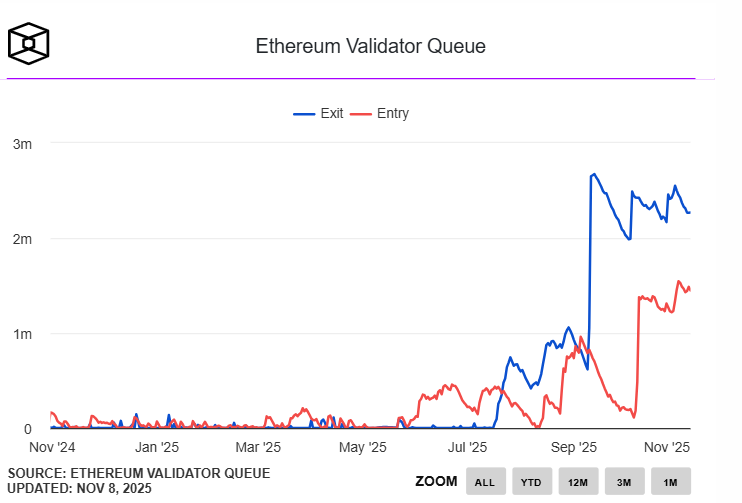
Native staking continues to appeal to users who want to maintain control of their assets. Liquid staking tokens like stETH or rETH offer more flexibility, but involve dependence on third-party smart contracts and operators. Many long-term investors prefer to hold their own keys and manage their infrastructure, despite the technical burden and lower liquidity.
The main compromises of native staking:
- Full control over validator hardware and operations;
- No exposure to external operators or third-party protocols;
- Less dependence on third-party smart contracts;
- Commitment of 32 ETH per validator;
- Acceptance of longer withdrawal times and the risk of slashing.
The interest of institutions adds new impetus. Stablecoin settlements, DeFi flows and on-chain activity place Ethereum at the heart of the crypto economy. Major protocols like Aave continue to process significant volumes on the mainnet, cementing Ethereum's role as the gold standard settlement layer.
Buterin defends the controlled exit model
The increase in entry queues reflects increased confidence in the sustainability of Ethereum. Many participants agree to lock up their capital for extended periods of time, in exchange for validator rewards and direct participation in network security.
As more entities adopt this approach, staking activity demonstrates enduring confidence in Ethereum's role as the leading smart contract platform, despite its liquidity and operational constraints.
Furthermore, Vitalik Buterin reminded that the ETH staked cannot be withdrawn instantly: this waiting period acts as a real protective measure. It helps avoid massive withdrawals that could weaken network security and guarantees the stability of the consensus. The exit queue processes withdrawals block by block, transforming what might seem like a “rush to the exit” into a controlled and predictable flow.
Maximize your Tremplin.io experience with our 'Read to Earn' program! For every article you read, earn points and access exclusive rewards. Sign up now and start earning benefits.


