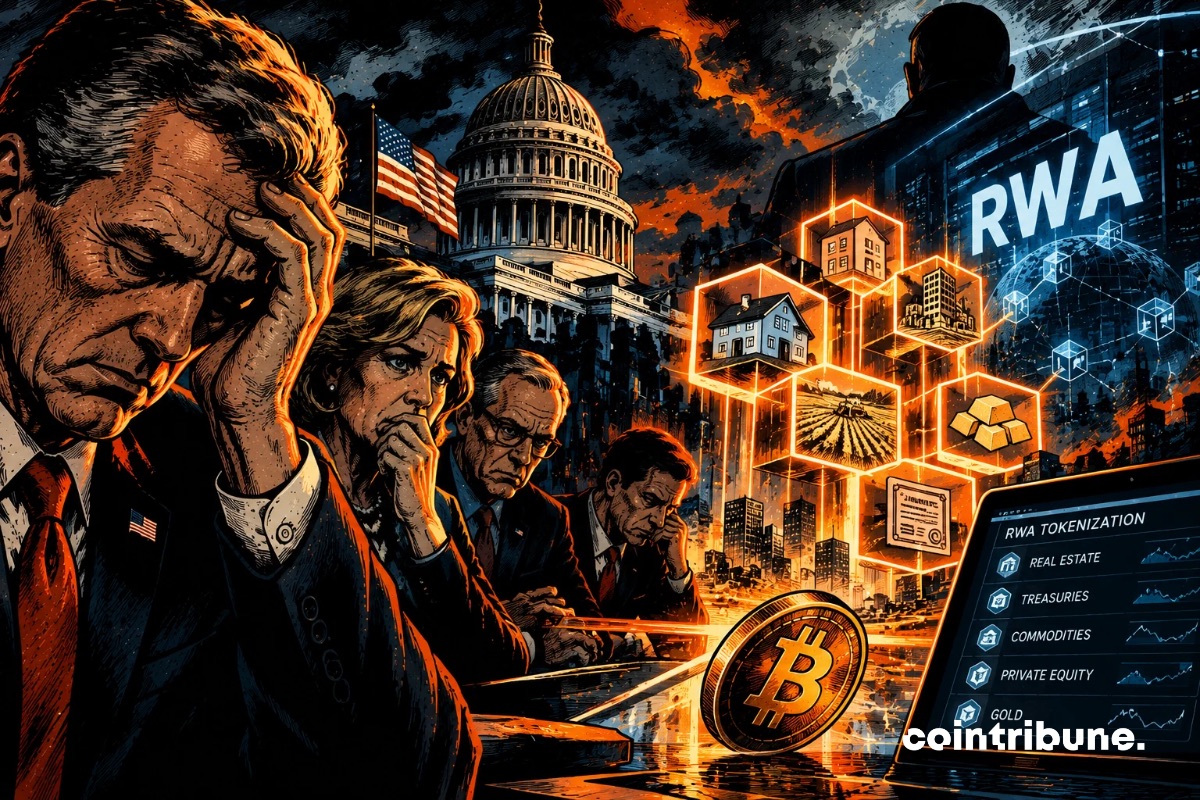
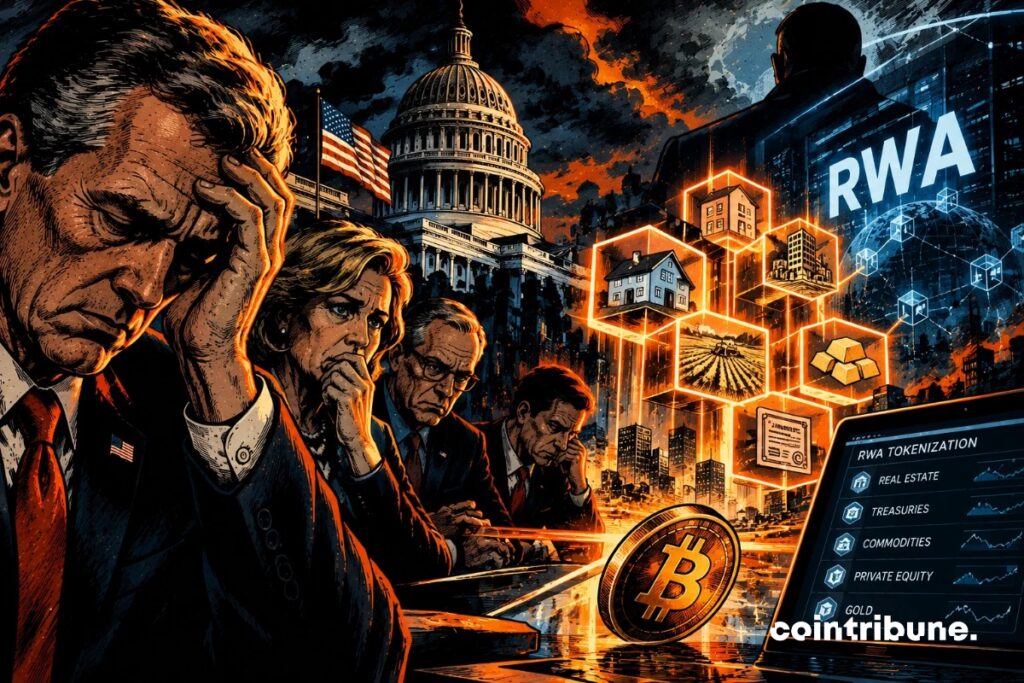
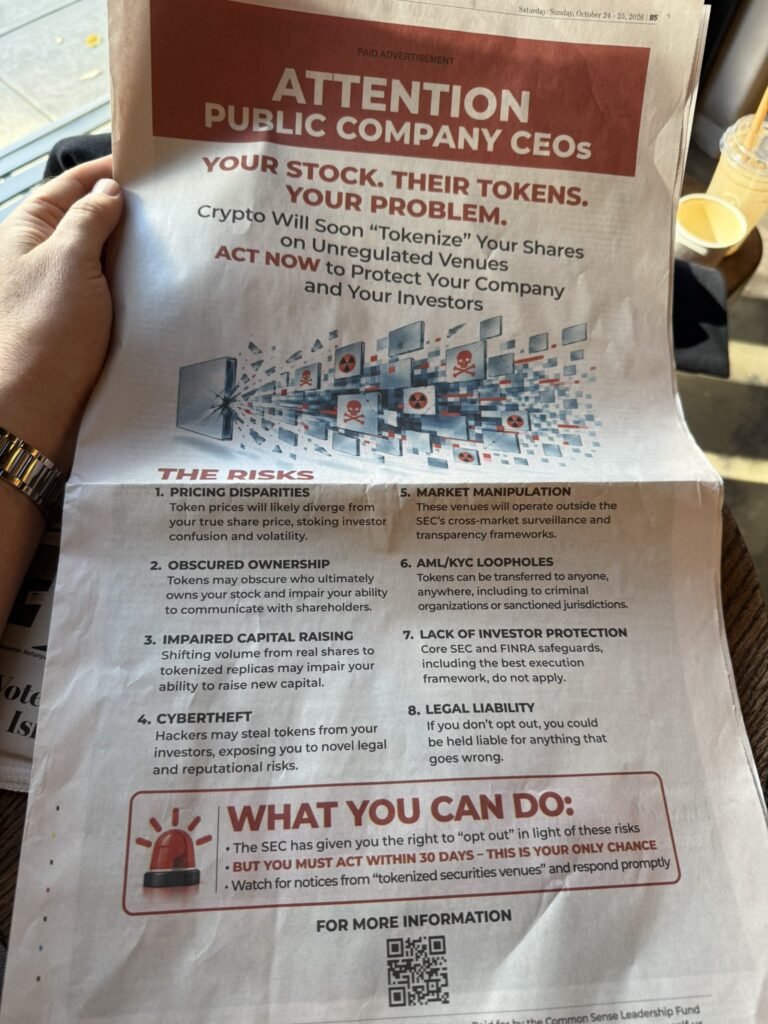
In the weekend edition of October 24 and 25, 2026 of Wall Street Journalbig American bosses discovered a full-page advertisement with a general warning tone. Its initiator, Common Sense Leadership Fundsummons the leaders of the S&P 500 to exercise a 30-day withdrawal right to oppose the replication of their shares in the form of crypto tokens on the blockchain (RWA tokenization).
In brief
- The Common Sense Leadership Fund published a full page in the Wall Street Journal against the tokenization of RWAs.
- The group denounces the conversion of traditional financial securities into real world assets (Real World Assets or RWA) tradable 24 hours a day.
- The lobby is urging CEOs to use the SEC’s 30-day opt-out mechanism to protect their companies.
Crypto: the cry of alarm from an American lobby against the tokenization of RWA
Published on page B5 of the Wall Street Journal business daily, the publication opens with a shocking formula: “Your actions. Their tokens. Your problem. » THE Common Sense Leadership Fund, details eight major risks that would result from the tokenization of RWAs without the explicit consent of issuers.
| Risks put forward by the conservative group | Alleged consequences |
| Price Spreads & Volatility | Risk of decorrelation between the price of the real action and its token. |
| Loss of traceability | Opacity on the true identity of the final shareholders. |
| Hacking & Cybertheft | Investor exposure to token theft through network breaches. |
| Circumvention of SEC/FINRA rules | Exchanges carried out outside federal supervisory frameworks. |
THE Common Sense Leadership Fund argues that the creation of tokens representing stock market shares on decentralized platforms escapes traditional governance mechanisms and poses a legal risk to listed companies.
Why RWAs are straining traditional finance
Real-world asset (RWA) tokenization allows digital representations of financial assets, such as government bonds or shares of large companies, to be issued directly on blockchain networks. For the crypto sector, this is a major step forward providing permanent liquidity, transparency and reduction of intermediation costs.
However, for conservative circles and certain traditional players, this model calls into question the central role of historic stock exchanges (NYSE, Nasdaq) and regulators. The lobby recalls in this respect that the SEC would grant a 30-day window to company managers to issue a formal objection (opt-out) against the tokenized replication of their titles.
Additional pressure after the crisis of physical crypto wallets
This political offensive comes in a climate already under tension for the Web3 ecosystem. As major crypto cold wallet brands experience a series of major security breaches, the question of custody and trust in custody infrastructure becomes central. For critics of RWA, these technical vulnerabilities constitute an additional argument to slow down the migration of traditional assets to decentralized networks.
If this campaign testifies to persistent political distrust, it also underlines the magnitude taken by crypto in the global macroeconomic landscape. The use of large-scale advertising campaigns in a media such as Wall Street Journal demonstrates that tokenization is no longer a simple technological experiment, but a strategic subject taken seriously by American power circles.
The initiative of Common Sense Leadership Fund illustrates the growing tension between decentralized finance and traditional regulatory frameworks. It remains to be seen whether American CEOs will respond to this call for a boycott or whether the adoption of RWAs will continue to expand in global markets. Why do you think the crypto ecosystem is so fought over?
Maximize your Tremplin.io experience with our ‘Read to Earn’ program! For every article you read, earn points and access exclusive rewards. Sign up now and start earning benefits.